
Bareskrim Reveals 'Helicopter' Modus Operandi in Subsidised Fuel Misuse Case
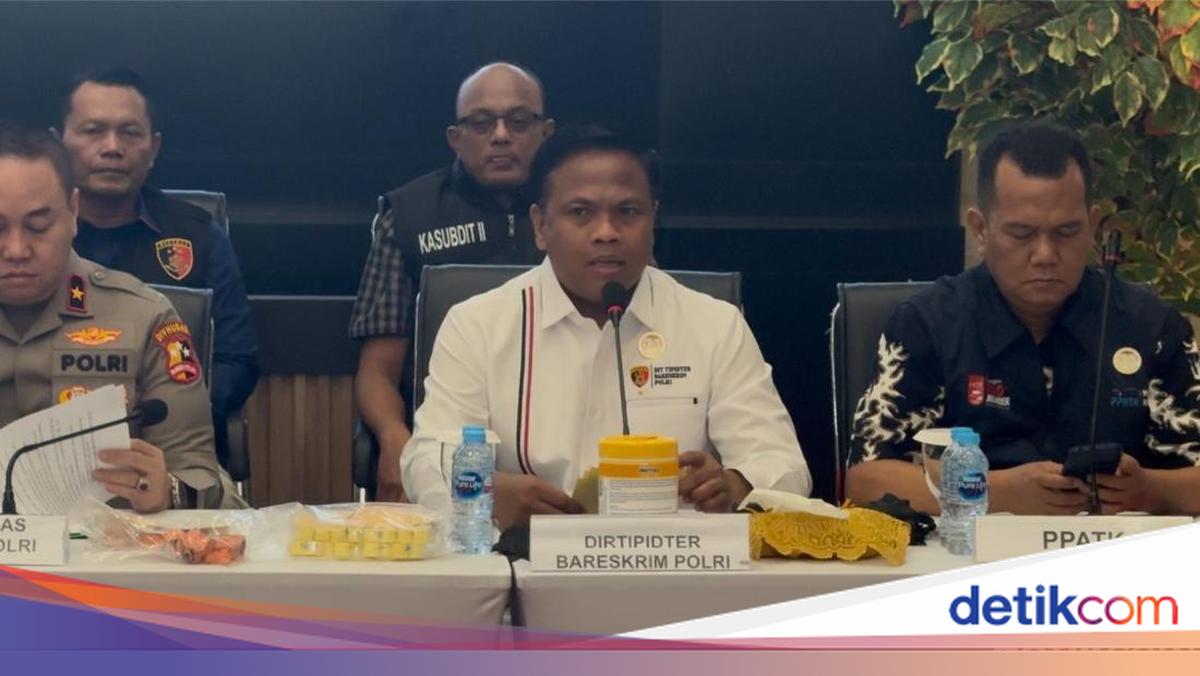
The Directorate of Specific Crimes (Dittpidter) at Bareskrim Polri has revealed various modus operandi employed by perpetrators misusing subsidised fuel and LPG. These include the ‘helicopter’ method, the use of fake licence plates to deceive the barcode system, and modified trucks with enlarged tanks.
Dirtipidter Bareskrim Polri Brigadier General Mohammad Irhamni initially explained that these illegal practices are triggered by the high price disparity between subsidised and non-subsidised fuel. Currently, non-subsidised fuel prices reach Rp31,000 per litre, while subsidised prices are only Rp6,800 per litre.
“This disparity is what spurs perpetrators to commit crimes with highly lucrative profits,” said Irhamni during a press conference at the Bareskrim Polri building in South Jakarta on Tuesday (21/4/2026).
Irhamni revealed that one of the most common modus operandi is the ‘helicopter’ method, or known as ‘ngoret’ in Sumatra. This involves repeatedly purchasing subsidised diesel at several petrol stations using the same vehicle.
“Purchasing subsidised diesel repeatedly at several petrol stations, then storing and hoarding it at bases, before distributing it to industries in the surrounding areas. In Jakarta, it’s called ‘helicopter’; in Sumatra or Bangka Belitung, it’s ‘ngoret’,” explained Irhamni.
Not only that, perpetrators also use fake licence plates to circumvent Pertamina’s barcode monitoring system. By changing licence plates and barcodes, a single vehicle can refuel multiple times beyond the set quota.
“Purchasing subsidised fuel using fake licence plates to avoid monitoring conducted by Pertamina. Thus, perpetrators can make multiple purchases by switching vehicles or barcodes,” he clarified.
There is also the modus operandi of using modified trucks with larger storage tanks to siphon large amounts of diesel in a single fill-up at petrol stations.
“The next modus operandi is collusion with petrol station officials to obtain a larger fuel quota,” he disclosed.
In addition to fuel, Bareskrim has highlighted the misuse of subsidised LPG. The method used is transferring gas from 3 kg subsidised cylinders to 12 kg and 50 kg non-subsidised cylinders.
Irhamni continued that this illegal practice is commonly found in areas surrounding the capital.
“This is very prevalent in the Jakarta buffer zones, making distribution easy to industrial areas or restaurants and hotels around Jakarta,” said Irhamni.
From this operation, police seized 403,000 litres of diesel, 58,000 litres of Pertalite, and more than 13,347 LPG cylinders of various sizes. Additionally, 161 trucks were secured.
On that occasion, Irhamni emphasised that they will not stop at field perpetrators. Bareskrim is collaborating with the Financial Transaction Reports and Analysis Centre (PPATK) to track the assets of energy mafias.
“Perpetrators are charged under the Oil and Gas Law, as well as the Money Laundering Crime Law. We are obtaining direct data to trace all the wealth of the perpetrators, and there is no place in our country for these perpetrators to enjoy wealth obtained from illegal practices,” he explained.
For information, over 13 days, from 7-21 April 2026, Polri has handled 223 police reports with 330 suspects. The total state loss in that short period reached Rp243 billion.
In this revelation, Central Java and East Java were identified as regions with the highest case detections, with 44 and 41 police reports respectively.
“It appears that in East Java and Central Java, it is still rampant. Coincidentally, in East Java, there are approximately 1,000 operating petrol stations,” said Irhamni.
“The hope is that misuse can be suppressed so that it can be enjoyed by the community that needs it,” he stated.