
Barantin: Non-Halal Products Allowed Entry with Clear Labelling
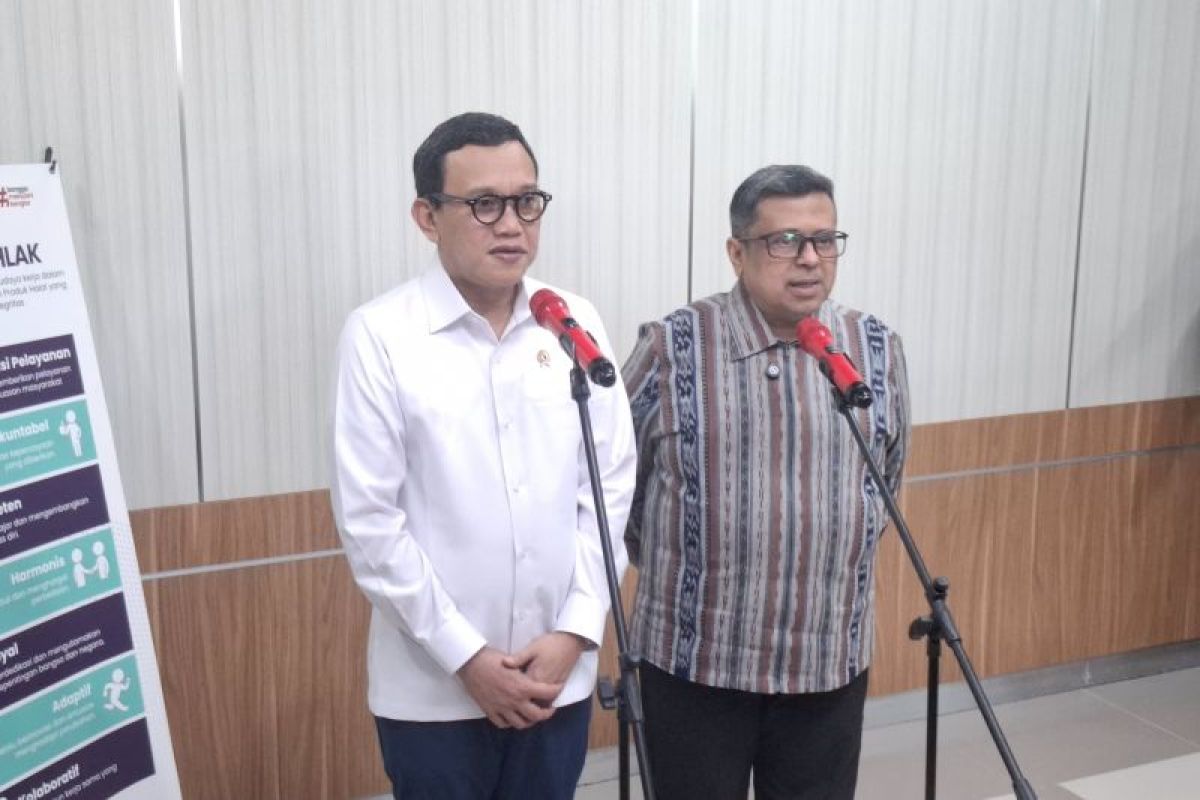
Jakarta (ANTARA) - Head of the Indonesian Quarantine Agency (Barantin) Abdul Kadir Karding has confirmed that non-halal products are still permitted to enter Indonesia as long as their non-halal content and status are correctly stated in documentation and labelling, thereby providing the public with certainty of information.
Karding said the supervision carried out by Barantin together with the Halal Product Assurance Agency (BPJPH) is not aimed at banning all non-halal products, but rather at ensuring the conformity between documents and the condition of the goods being traded.
“As long as the process is clear, it is not that we prohibit entry. For example, if something is clearly pork. Is it not allowed in? Not like that. It is allowed, but we require that it must be stated that this product contains pork,” Karding said after the signing of a Cooperation Agreement between Barantin and BPJPH in Jakarta on Thursday.
According to him, products that meet labelling requirements and statutory regulations are not a problem as long as information about their contents is conveyed correctly to the public.
“We ensure that halal products must have their halal certificate and halal logo listed, and non-halal products must also be listed. Why? Because we are protecting the entire nation and all the territory of Indonesia,” he said.
Karding said problems arise when there is a discrepancy between the documents and the actual condition of the goods.
Head of BPJPH Ahmad Haikal Hasan gave an example: if a product is declared not to contain pork in its documents, but the inspection results show otherwise, this situation could constitute an element of fraud.
“If it says it does not contain pork but it does, that is an element of fraud,” Haikal stressed.
According to him, law enforcement actions can also include the destruction of goods if the products entering the country do not match their accompanying documents, thus being declared illegal.
Haikal cited Barantin’s handling of 312 tonnes of meat bone meal (MBM) from Brazil which was recently found to contain porcine elements, even though the accompanying health certificate stated the commodity was free of porcine.
“Once the goods entered, they were illegal, as the documents differed from the facts. They were destroyed,” he said.
The destruction was carried out as a form of law enforcement against the discrepancy between the documents and the condition of the goods.
He added that the synergy between Barantin and BPJPH is expected to prevent the recurrence of similar cases while providing legal certainty for business actors who comply with the provisions.
The collaboration between the two agencies also supports the full implementation of the Mandatory Halal policy starting October 2026 through strengthened supervision and inter-agency coordination.
Barantin recorded that the export value of commodities receiving quarantine certification reached Rp393.2 trillion as of 17 December 2025. During the same period, Barantin issued approximately 2.6 million certification documents for export, import, and inter-area commodity movement activities.