
Bappenas Receives Performance Audit Report on Food Security from BPK
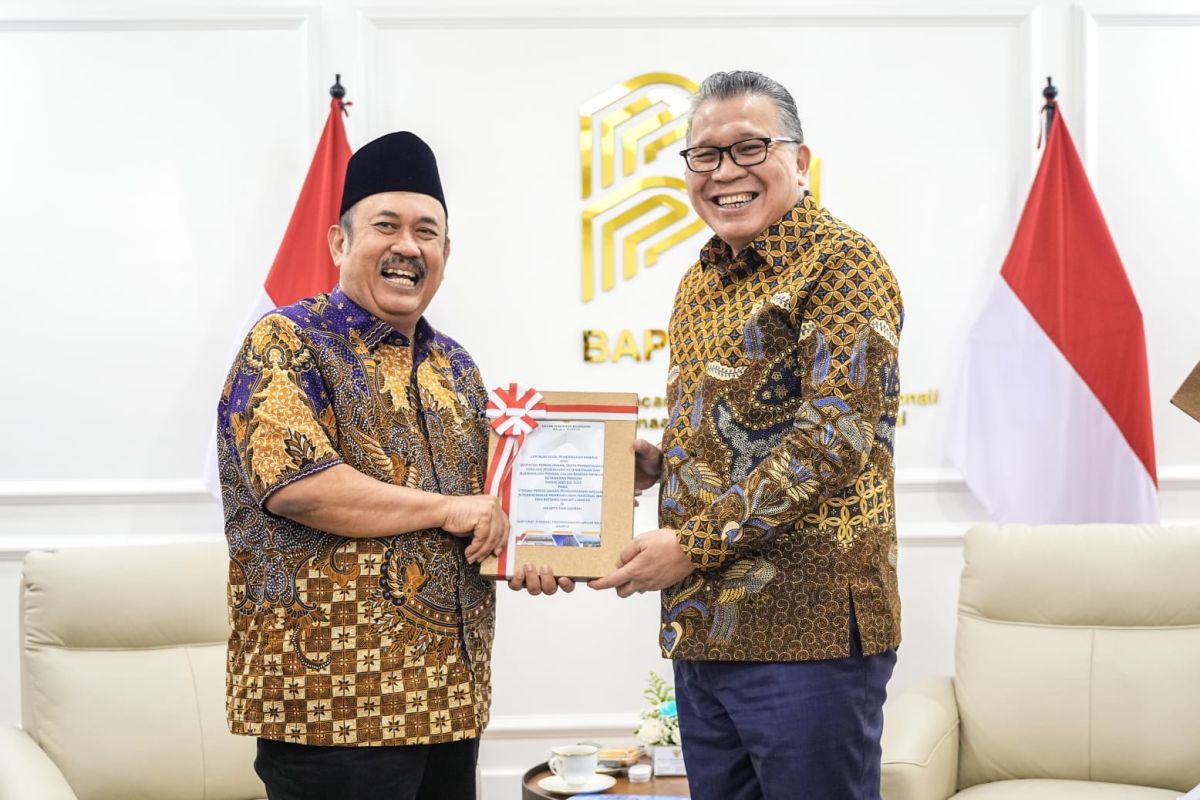
Jakarta (ANTARA) - Minister of National Development Planning/Head of the National Development Planning Agency (PPN/Bappenas) Rachmat Pambudy received the Audit Report (LHP) on the Effectiveness of Planning, Monitoring, and Evaluation for Fulfilling Food Availability and Affordability for 2023-2025.
Another report received was the Follow-Up Monitoring Report for Semester I and II of 2024 from the Supreme Audit Agency (BPK) audits.
Rachmat Pambudy appreciated the BPK’s active role in promoting improvements in development planning governance, particularly through performance audits that provide concrete inputs and recommendations for refining the national development planning and control business processes.
“The Ministry of PPN/Bappenas has followed up on some of the recommendations presented in the 2025 Food Security Programme Performance Audit document, one of which is through the preparation of the National Action Plan for Food and Nutrition (RAN-PG) for 2025–2029,” he said while receiving BPK RI Member II Daniel Lumban Tobing, quoted from an official Bappenas statement in Jakarta on Monday.
Bappenas was also recommended to promptly follow up on coordination with the Coordinating Ministry for Food and the National Food Agency regarding proposals to revise the Presidential Regulation on Strategic Food and Nutrition Policy.
Regarding food, the Minister of PPN continued, there is currently a change in policy strategy, including its relation to institutions.
In the context of macro planning related to food security, he said, those recommendations will be reviewed again so that their implementation can be synchronised with other institutions.
Rachmat Pambudy added that the main goal of all these processes is to ensure that planning is not only well-structured but also implementable and beneficial to the public. For this reason, strengthening integration and synchronisation between planning and development is needed.
“That is the challenge we must address. The various recommendations already provided by the BPK are the result of in-depth studies. We will follow up on all the recommendations provided, as this is also an effort to strengthen our food security strategy to make it more sustainable,” he stated.
The BPK also appreciated the efforts made by Bappenas regarding planning, monitoring, and evaluation of fulfilling food availability and affordability.
Daniel Lumban explained that the thematic audit on food security is part of the BPK’s contribution to supporting national strategic agendas, particularly achieving food self-sufficiency as outlined in the Medium-Term National Development Plan (RPJMN) 2025-2029.
Based on this audit, the BPK provided several constructive recommendations as part of efforts to refine policies and strengthen governance.
“The BPK also noted various positive initiatives that have been undertaken, including the development of RPJMN planning features through the KRISNA (Collaboration for Planning and Budget Performance Information) RPJMN application and IT support through the Integrated Digital Monitoring for Agriculture and Irrigation (IDMAI) system,” said Daniel.
In line with development dynamics, the BPK views that there is still room for strengthening in aspects of policy harmonisation, cross-ministry/institution planning integration, and refinement of monitoring and evaluation frameworks. The recommendations provided are expected to further enhance the effectiveness of national food security policy implementation.
Regarding the follow-up monitoring report on audit recommendations, the BPK noted that up to Semester II of 2024, most recommendations have been followed up in accordance with BPK’s directions. This is seen as reflecting the strong commitment from the Ministry of PPN’s ranks in improving accountability and the quality of development planning.