
Bappenas Launches 2025 Human Capital Index
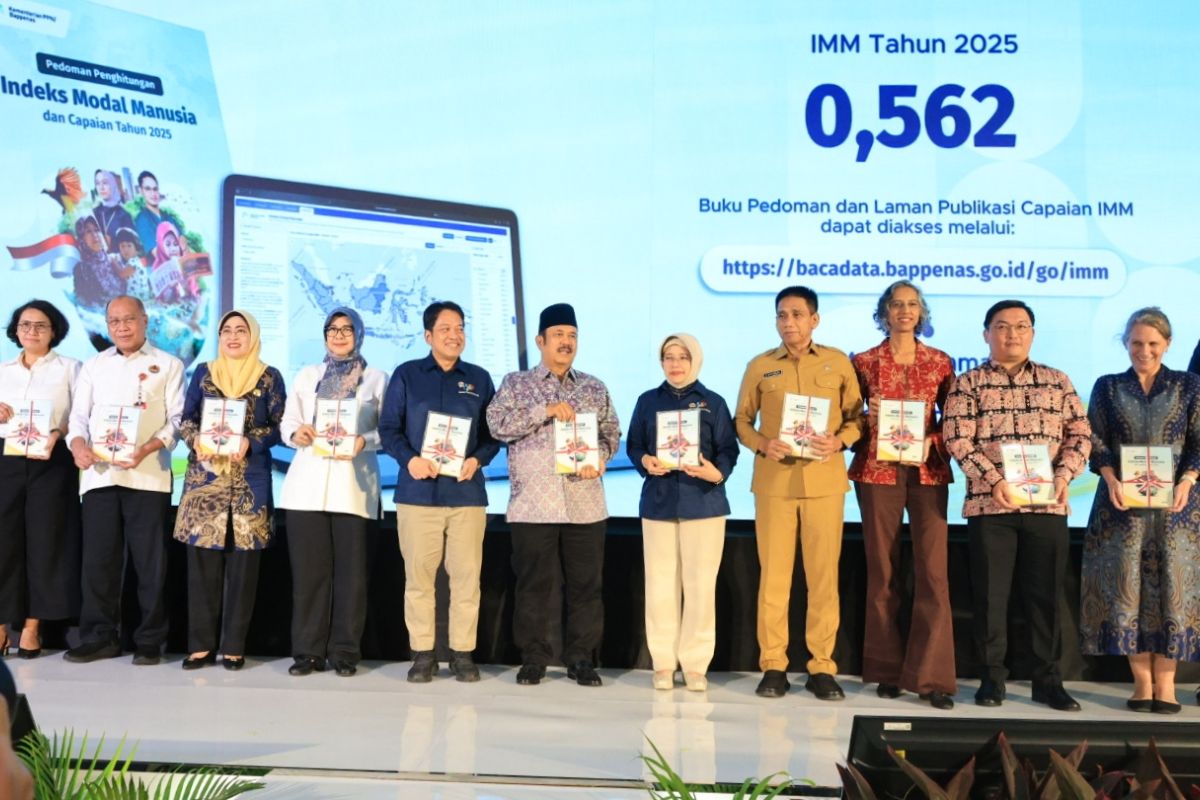
Jakarta (ANTARA) - The Ministry of National Development Planning/National Development Planning Agency (PPN/Bappenas) has launched the 2025 Human Capital Index (HCI) and the HCI Calculation Guidelines as a strategic step to strengthen the planning, monitoring, and formulation of human development policies in Indonesia.
The HCI Calculation Guidelines serve as a methodological reference to ensure that the calculation and interpretation of the HCI are conducted in a standardised, consistent, and accountable manner across various levels of government.
“These guidelines are expected to strengthen a shared understanding among stakeholders in utilising the HCI to support development planning, monitoring, and evaluation,” stated the Minister of PPN/Head of Bapplar, Rachmat Pambudy, in an official statement in Jakarta on Tuesday.
Human development is considered the primary foundation for achieving the Indonesia Emas 2045 vision. The quality of human capital built from the early stages of life will determine the productivity and competitiveness of Indonesia’s human resources in the future.
Within this framework, he continued, the HCI is introduced to complement the human development measurements previously conducted through the Human Development Index (HDI).
Using a life-cycle approach, the HCI views human development as a long-term investment based on survival, education, and health conditions obtained throughout the growth and development period to shape the potential productivity and competitiveness of Indonesian humans in the future.
Furthermore, he explained that the HCI is an adaptation of the World Bank’s Human Capital Index (HCI), adjusted to the data characteristics, context, and development needs of Indonesia.
“The Human Capital Index is an improvement over the Human Development Index. The core difference is that what was previously considered the object of development is now the subject of development. The most important aspect of a nation is its people, and the people are reflected in their human capital,” said the Minister of PPN.
“Human capital is reflected in health, and health begins in the womb. Therefore, from the womb, Indonesian humans must be healthy. We at Bappenas are planning so that Indonesian humans in 2045 are not just objects but subjects in achieving Indonesia Emas. That is why today we are launching the Human Capital Index (HCI),” said the Head of Bappenas.
In the 2025–2045 National Long-Term Development Plan (RPJPN), the HCI will be used as an indicator to measure the achievement of human resource competitiveness targets. These targets will then be translated into the 2025–20rag National Medium-Term Development Plan (RPJMN) 2025–2029, and become part of the development direction in the Strategic Plans of Ministries/Agencies (Renstra), the Government Work Plan (RKP), and regional development planning documents.
This integration ensures that the processes of planning, implementation, monitoring, and evaluation of human resource development are more directed, measurable, and evidence-based, at both national and regional levels.
Pungkas Bahjuri Ali, Deputy for Human Development and Culture at the Ministry of PPN/Bappenas, explained that the 2025 HCI figure serves as the initial baseline for measuring human capital in Indonesia. This measurement has produced HCI values at the provincial and regency/city levels, providing an initial overview of human capital conditions and regional variations.
In 2025, Indonesia’s HCI achievement was recorded at 0.562. This means a child born today is expected to reach 56.2 per cent of their optimal productivity potential by the time they reach working age. This achievement shows an increase from the 2020 HCI figure of 0.540 previously published by the World Bank, Pungkas said, but noted that hard work is still required to reach the target HCI of 0.590 by the end of the 2025-2029 RPJMN.
At the regional level, HCI achievements also vary, with the highest value of 0.705 in the Special Region of Yogyakarta and the lowest of 0.366 in the Highland Papua Province.
The development of the HCI is also part of the effort to strengthen integrated and evidence-based human development. In this context, improving the quality of human capital requires synergy across various interventions, ranging from maternal and child health, nutrition fulfilment, stunting prevention, and immunisation, to early childhood education, primary and secondary education, higher education, and the strengthening of skills and productivity during working age.
“Moving forward, the governance, methodology, and data quality of the HCI will continue to be refined to ensure measurements are increasingly accurate, consistent, and relevant to the dynamics of Indonesia’s development. Strengthening coordination between ministries/agencies and improving the quality and availability of data are essential parts of ensuring the HCI can be utilised optimally as an evidence-based development instrument,” he concluded.