
Bappenas: Economic Growth Must Be Accompanied by Productivity Increases
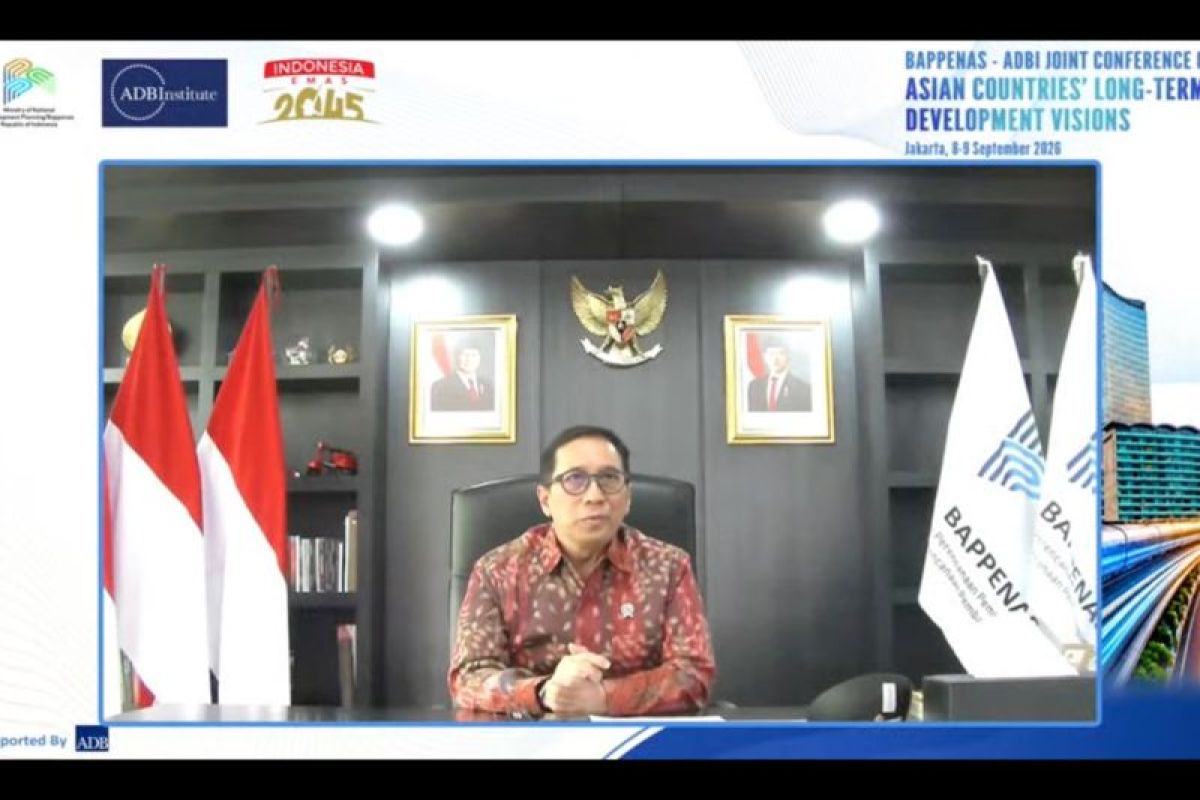
Jakarta (ANTARA) - The Deputy Minister of National Development Planning/Bappenas, Febrian Alphyanto Ruddyard, believes that economic growth cannot merely be pursued through figures; it must be accompanied by the strengthening of productive capacity to sustain the economy in the long term.
During a joint conference between Bappuitas and the Asian Development Bank Institute (ADBI) in Jakarta on Tuesday, he explained that strengthening productive capacity must be achieved through increased productivity, innovation, human resource quality, industrial strengthening, and more resilient institutions.
He explained that the current global economic environment faces various challenges, ranging from geopolitical tensions affecting trade and investment, technological developments altering production and work patterns, to climate change and the energy transition.
Therefore, long-term development must be directed towards building an economic foundation capable of adapting to these changes.
Febrian stated that the Indonesian government has set a development direction through the National Long-Term Development Plan (RPJPN) and the Indonesia Gold Vision 2045, aimed at bringing Indonesia out of the middle-income trap and becoming a high-income nation.
“However, a vision will only be useful if it can be translated into real action,” he said.
“For Indonesia, this means increasing productivity, accelerating innovation, improving the quality of human resources, and building institutions capable of supporting transformation for several decades,” he added.
He emphasised that planning should not be limited to producing documents.
According to him, planning must also assist the government in making better decisions, using data and evidence as the basis for policy, anticipating various scenarios, coordinating different sectors, and adjusting policies when circumstances change.
Furthermore, Febrian noted that every country has a different transformation path based on its individual experiences in industrialisation, productivity enhancement, infrastructure and human resource development, and institutional strengthening.
In his view, Indonesia does not need to mimic the methods of other nations but can learn from the experiences of countries within the region.
Consequently, he assessed that the conference is vital for discussing various issues that determine the sustainability of development, ranging from macroeconomic stability, structural transformation, productivity, and economic resilience to the green transition, human resource development, and institutional capacity.