
Bappenas Develops Policy Framework to Accelerate Development in Indonesia’s 3T Regions
Jakarta, CNBC Indonesia — The Ministry of National Development Planning, also known as the National Development Planning Agency (Bappenas), is drawing up a policy framework to accelerate development in underdeveloped, frontier and outermost regions (3T). The framework is intended to align government interventions so that development programmes in 3T regions are more focused and integrated.
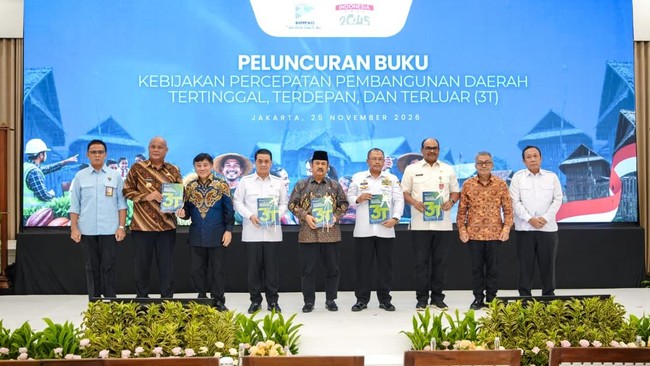
The policy framework is set out in a book entitled Policy for Accelerating Development in Underdeveloped, Frontier and Outermost Regions (3T), launched at the Bappenas building in Jakarta on Wednesday (25 November 2026). Medrilzam, Bappenas’ deputy for regional development, said the book was prepared as a shared reference for ministries and agencies to determine the needs and locations for development interventions.
“The purpose of this book is to bring everyone’s efforts together. We realise that, until now, policy interventions in 3T regions have been rather scattered. We have worked with various ministries and agencies to start aligning what needs to be done in these regions, how to do it, and, first of all, where we should intervene,” Medrilzam said at a media discussion in Jakarta on Wednesday (25 November 2026).
Medrilzam said identifying locations was the first step towards ensuring that programmes run by different ministries and agencies converged. This would prevent interventions from proceeding separately without a shared target.
“Otherwise, everything would end up going in all directions. By identifying locations, we can bring together the various activities carried out by ministries and agencies,” he said.
Medrilzam said the book has four main sections. The first provides a regional profile and diagnosis, covering socio-economic conditions, infrastructure, basic services, accessibility and governance. The second sets out policy direction and identifies intervention locations, including needs relating to connectivity, settlements, education and health.
The third section covers implementation strategies, including funding and oversight, based on five principles: one location, one data set, one plan, integrated funding from multiple sources, and one measure of success. The fourth sets out programme and project designs, including the provision of basic services and infrastructure, improved connectivity, local economic development, and stronger capacity among regional and village governments.
“We hope this book can be used as a reference and a shared guide, particularly to sharpen interventions under the 3T National Priority Programme, which was launched by the President. We also want programmes and funding from ministries, agencies and regional governments to be aligned with the locations identified in the book and with each area’s needs, down to the village level, as part of accelerating 3T development,” he said.
Edi Nurhabad, deputy for border-area infrastructure management at the National Border Management Agency and Remote Regions (BNPPDT), said development in 3T areas must take account of residents’ unmet basic needs. These include roads, clean water, electricity, access to education and healthcare, and orderly, clean cross-border services.
“Over the past few weeks I have visited several border areas. What I found was that people’s needs are mostly not complicated. On Rondong and Sama islands, residents and our soldiers are still struggling to access clean water, electricity and a signal,” Edi said.
He added that the needs of people in remote areas must not be overlooked simply because they are considered small in scale.
The challenges were also outlined by North Nias Regent Amizaro Waruwu, whose region is among those classified as 3T. He said 3,253 homes in the area still lacked electricity, while 42 locations had no internet coverage. Of the 971 kilometres of roads in North Nias, 667 kilometres were in very poor condition.
Meanwhile, National Development Planning Minister and Bappenas head Rachmat Pambudy stressed that accelerating development in 3T regions required a clear commitment to these areas and coordinated policies. He said every programme and budget must genuinely reach the regions that need them.
Through the policy framework, Bappenas hopes development interventions in 3T regions can be planned according to needs and priority locations, while strengthening coordination among stakeholders.
Source: jawawa.id (https://jawawa.id/newsitem/bappenas-develops-policy-framework-to-accelerate-development-in-indonesias-3t-regions-1795603974)
Originally published by CNBC Indonesia (https://www.cnbcindonesia.com/news/20261125165738-4-788458/bappenas-susun-kerangka-kebijakan-percepatan-pembangunan-daerah-3t), translated from Indonesian