
Bappenas Chief: El Niño Gradation Has Tremendous Impact
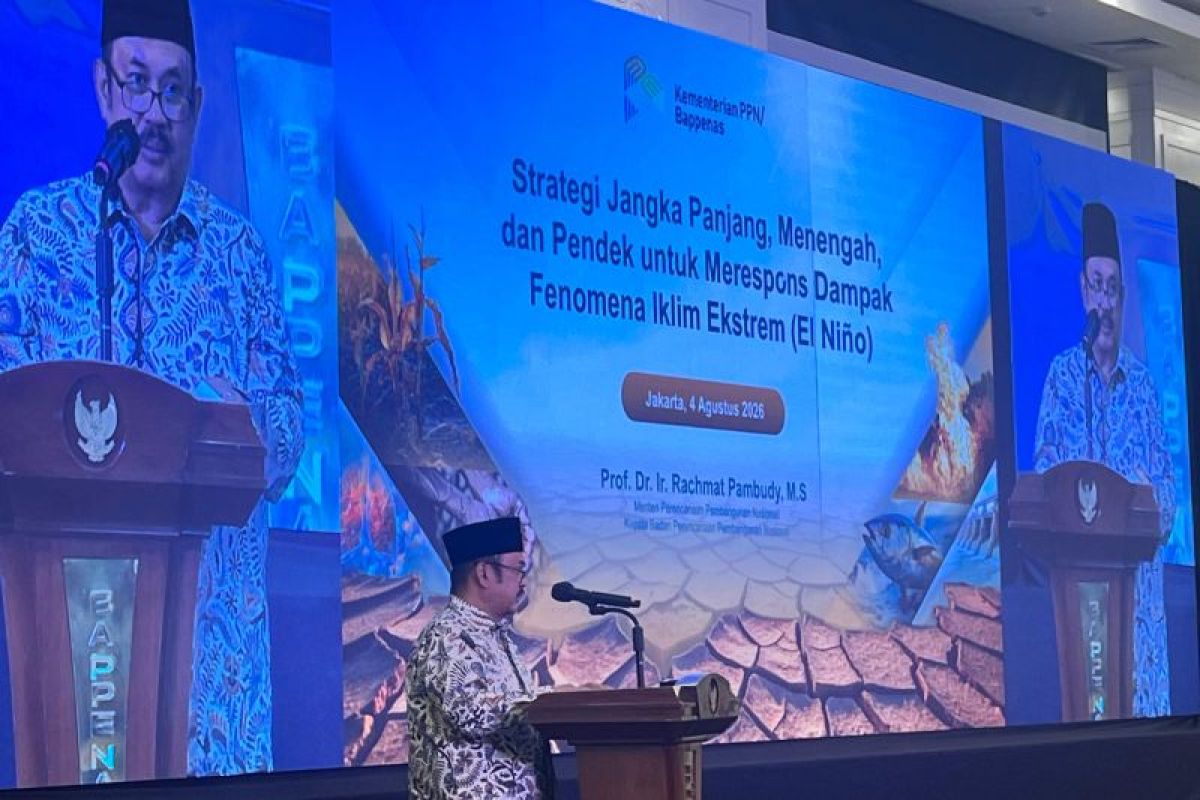
Minister of National Development Planning (PPN)/Head of the National Development Planning Agency (Bappenas) Rachmat Pambudy has stated that the increasing gradient of the El Nino phenomenon has an extraordinarily large influence.
“El Nino, La Nina, these are not something new, but their gradient, day by day, year by year, turns out to have an extraordinary impact,” said Rachmat Pambudy at the National Dialogue on “Strengthening Cross-Sector Responses in Facing the Impact of a Strong El Nino”, held at the Bappenas building in Jakarta on Tuesday.
He explained that climate issues cannot be taken lightly, because climate change, particularly concerning rising ambient temperatures, has a major influence on Indonesia’s natural conditions.
The climate issue itself, he noted, has been developing for more than 20 years and has been addressed by several countries such as India, which has prepared anticipatory measures to face drought, flooding, disease mitigation, and improvements to crops vulnerable to weather change.
In this context, Bappenas is responsible for national planning, especially regarding food, energy, and water issues that affect Indonesia’s climatic conditions.
“We must ensure that the responses we build (in facing climate change) are no longer merely reactive, but rather integrated, measurable early action firmly rooted in our climate analysis. With a foundation of science and cross-sector cooperation, we are not only safeguarding the sustainability of national development, but also proving the resilience of the Indonesian nation against global climate dynamics,” said the Bappenas Head.
Rachmat Pambudy emphasised that the Meteorology, Climatology, and Geophysics Agency (BMKG) is an institution that plays a crucial role in safeguarding the certainty of food, energy, and water.
Regarding water specifically, he reminded that as an archipelagic nation, Indonesia ought to have made its management a priority.
“An archipelagic country should never lack water and never have excess water, because both can be overcome. However, all of this depends on the readiness of the BMKG,” he said.
“Climate issues, particularly in Indonesia, should also be manageable by studying what has already happened. Looking to the future, the climate affects matters concerning our environmental pollution, and most importantly it influences the net zero emissions target that is our goal — the 2029 target, the 2060 target — which forms part of our national agenda,” the PPN Minister added.