
Bappenas Calls for Stronger Forest Fire Mitigation During 2026 El Niño
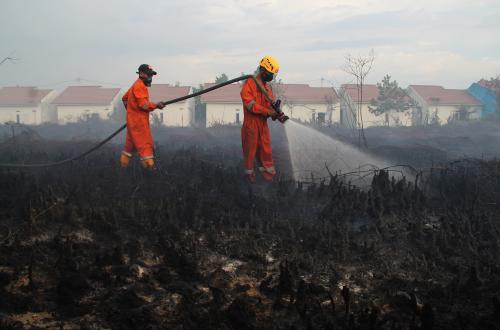
Minister for National Development Planning (PPN)/Head of Bappenas Rachmat Pambudy has called for strengthened mitigation efforts against forest and land fires (karhutla) during the strong El Niño of 2026. He warned that the impact of a drier dry season is already beginning to trigger hotspots in several regions and has the potential to increase the risk of forest and land fires.
Rachmat said the government has coordinated anticipatory measures across sectors, ranging from agriculture, drought prevention, forest and land fires, health, energy, to water resources. According to him, the preparedness of all ministries and agencies is key to ensuring the El Niño impact does not disrupt national stability.
“The current rainfall potential is below normal for the period of July to October. In fact, the impact has already begun to be evident today; clean water availability is disrupted, hotspots are starting to appear, acute respiratory infection (ISPA) cases will sooner or later emerge, and forest and land fires are increasing,” said the Minister for PPN/Head of Bappenas in Jakarta, as quoted on Wednesday (5/8/2026).
He stressed that government intervention must be focused on the most affected sectors, including forestry. Therefore, all ministries and agencies are asked to strengthen coordination so that the threat of El Niño can be mitigated early.
Meanwhile, Head of BMKG Teuku Faisal Fathani said that BMKG had predicted since March 2026 that Indonesia would face a dry season coinciding with El Niño. After the World Meteorological Organization (WMO) declared El Niño active on 2 June 2026, analysis results up to July show the phenomenon is now in a strong phase.
Faisal explained that El Niño is not the dry season itself, but a climate phenomenon that makes the dry season drier and last longer. The most affected areas are south of the equator, including East Nusa Tenggara (NTT), West Nusa Tenggara (NTB), Bali, Java Island especially coastal areas, southern Sumatra, and South Papua. The impact is expected to begin subsiding in mid-October with the arrival of the rainy season.
“The El Niño we need to be wary of is when it occurs simultaneously with the dry season, making the dry season drier and longer in duration,” said Faisal.
He added that BMKG continues to assist local governments through 191 technical implementation units (UPT) across Indonesia. This assistance covers the agriculture sector, water resource management, and forest and land fire handling.
The BMKG Deputy for Meteorology explained that reduced rainfall causes peatlands to become increasingly dry and thus more flammable. To reduce this risk, BMKG together with various stakeholders is carrying out weather modification operations using the peatland wetting method to maintain moisture and suppress fire potential.
In addition, weather modification operations are also conducted to increase water supply to reservoirs used for raw water needs, agricultural irrigation, and hydroelectric power plants (PLTA). BMKG stated that coordination with ministries and agencies will continue to be strengthened during the El Niño period to minimise the impact on various sectors.