
Bappenas and Press Council Synergise to Strengthen Mass Media Ecosystem
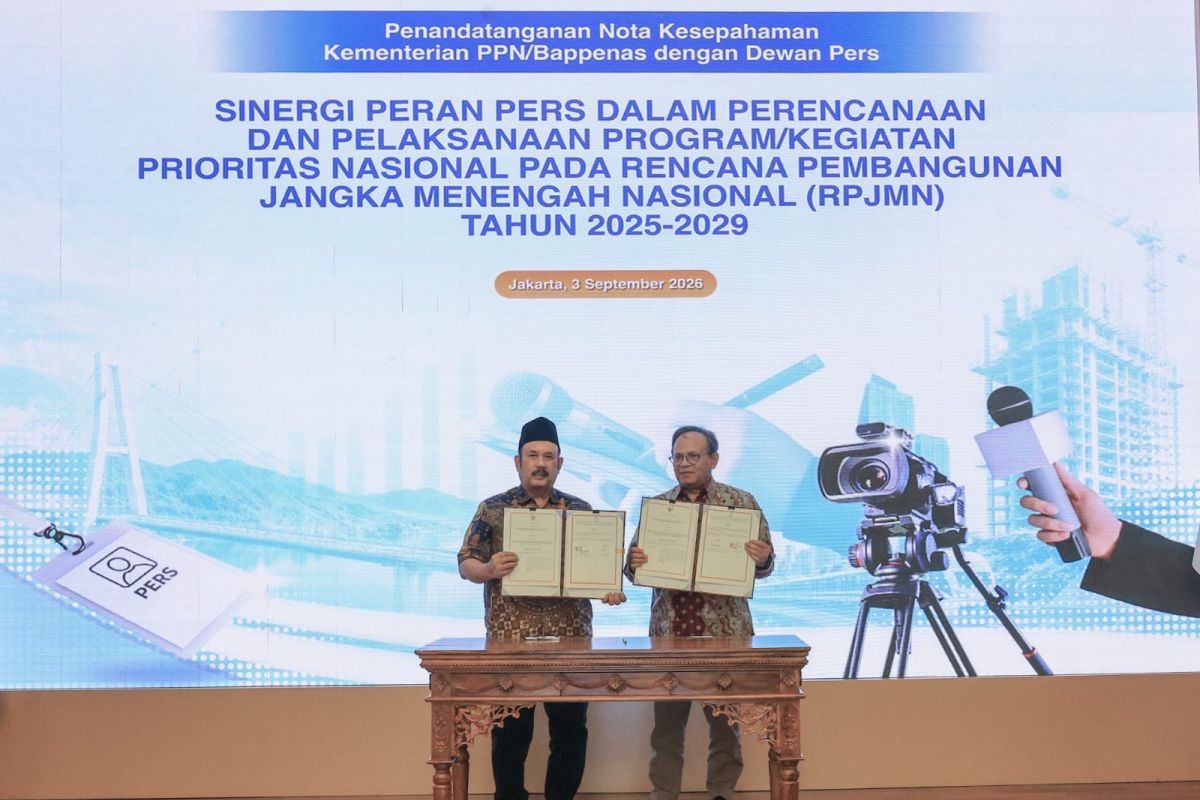
Cooperation between the government and the press must be built on a spirit of mutual growth, without compromising the independence of the press in performing its journalistic functions.
The Ministry of National Development Planning (PPN)/Bappramenas and the Press Council are synergising to strengthen the press and mass media ecosystem to support the planning and implementation of national priority programmes and activities.
“Cooperation between the government and the press needs to be built on a spirit of growing together, without reducing the independence of the press in exercising its journalistic functions,” said the Minister of PPN/Head of Bappenas, Rachmat Pambudy, during the signing ceremony of the Memorandum of Understanding regarding the Synergy of the Press Role in the Planning and Implementation of National Priority Programmes/Activities within the 2025-2029 National Medium-Term Development Plan (RPJMN), in Jakarta on Friday.
The effort to strengthen the press is in accordance with the mandate of Presidential Regulation Number 12 of 2025 regarding the 2025-2029 RPJMN under National Priority 1: Strengthening Pancasila Ideology, Democracy, and Human Rights. This includes the priority activity of strengthening a press and mass media industry that is responsible, educational, honest, objective, and healthy (BEJO’S).
These activities encompass three priority projects: increasing the capacity of press institutions, enhancing the competence and ethics of press personnel, and revitalising mainstream media.
“Our hope is for the press to grow together and become a beacon for Indonesia’s development aspirations. There is no reason for our people not to be more involved. With social media, our people’s reading ability and attention are becoming extraordinary. Therefore, we hope the press can become a partner in Indonesia’s development,” said Rachmat Pambudy.
“This memorandum of understanding is not the end of a process, nor is it merely a ceremonial document. It is a starting point for working together that must be translated into measurable agendas, targets, and results. Let us ensure that this cooperation continues to be built on one main principle: the government supports the strengthening of the press ecosystem, but the freedom and independence of the press must be fully maintained,” he added.
On the same occasion, the Deputy Minister of PPN/Deputy Head of Bappenas, Febrian Alphyanto Ruddyard, stated that the changing information landscape has presented new challenges for the press industry. Conventional media must now share space with digital platforms, social media, content creators, and algorithms, while the spread of misinformation and disinformation continues to expand.
“In a world with increasingly abundant information, trustworthy information is becoming even more valuable. Therefore, I believe the future of the global press should not only be discussed in the context of freedom of the press, but also in terms of the sustainability of credible journalism,” said the Deputy Head of Bappenas.
In the context of development, the Deputy Minister of PPN noted that the press plays a vital role in bridging the gap between the government and the public. The press is seen as not only helping the public understand the direction and policies of development but also bringing the voices of the people into the policy-making process.
The Ministry of PPN/Bappenas is currently drafting a Policy Sandbox Design for Strengthening the Press and Mass Media under the BEJO’S framework. This policy sandbox is expected to gather data, best practices, collaboration models, maps of local media needs, and policy recommendations that can be developed to strengthen the press and mass media ecosystem in other regions.
The Chairman of the Press Council, Komaruddin Hidayat, also emphasised the importance of the press working more intelligently and strategically amidst the expanding digital public sphere.
“The press has a responsibility to ensure that the public sphere develops healthily through accountable information, while preventing the dominance of emotion and virality in the formation of public opinion,” said Komaruddin.
This cooperation is expected to be a strategic step in strengthening a healthy press ecosystem, while ensuring that national development agendas are conveyed accurately and are easily understood by the public.
The synergy between the government and the press is also expected to expand public participation, strengthen the quality of information in the public sphere, and ensure that the community are not just recipients of development benefits, but are also involved in monitoring and providing input on its implementation.
As a follow-up to the implementation of this agenda, the Deputy for Politics, Law, Human Rights, Defence, and Security, Erwin Dimas, stated that a Cooperation Agreement (PKS) will be drafted, containing a more specific scope for cross-sectoral collaboration.
Source: jawawa.id (https://jawawa.id/newsitem/bappenas-and-press-council-synergise-to-strengthen-mass-media-ecosystem-1788516456)
Originally published by Antara (Indonesian) (https://www.antaranews.com/berita/5726052/bappenas-dan-dewan-pers-bersinergi-perkuat-ekosistem-media-massa), translated from Indonesian