
Bappenas: Aceh's Economic Recovery Focused on Productive Sectors
Banda Aceh (ANTARA) - The National Development Planning Agency (Bappenas) states that accelerating Aceh’s economic recovery post-disaster is focused on productive sectors such as MSMEs, agriculture, fisheries, and trade, as these are the main drivers of the economy there.
“Recovery from rehab-recon (rehabilitation and reconstruction) that we are now promoting focuses on the main drivers, particularly in productive sectors, so that Aceh’s economy can rise again,” said Deputy for Regional Development at the Ministry of National Development Planning/Bappenas, Medrilzam, in Banda Aceh on Monday.
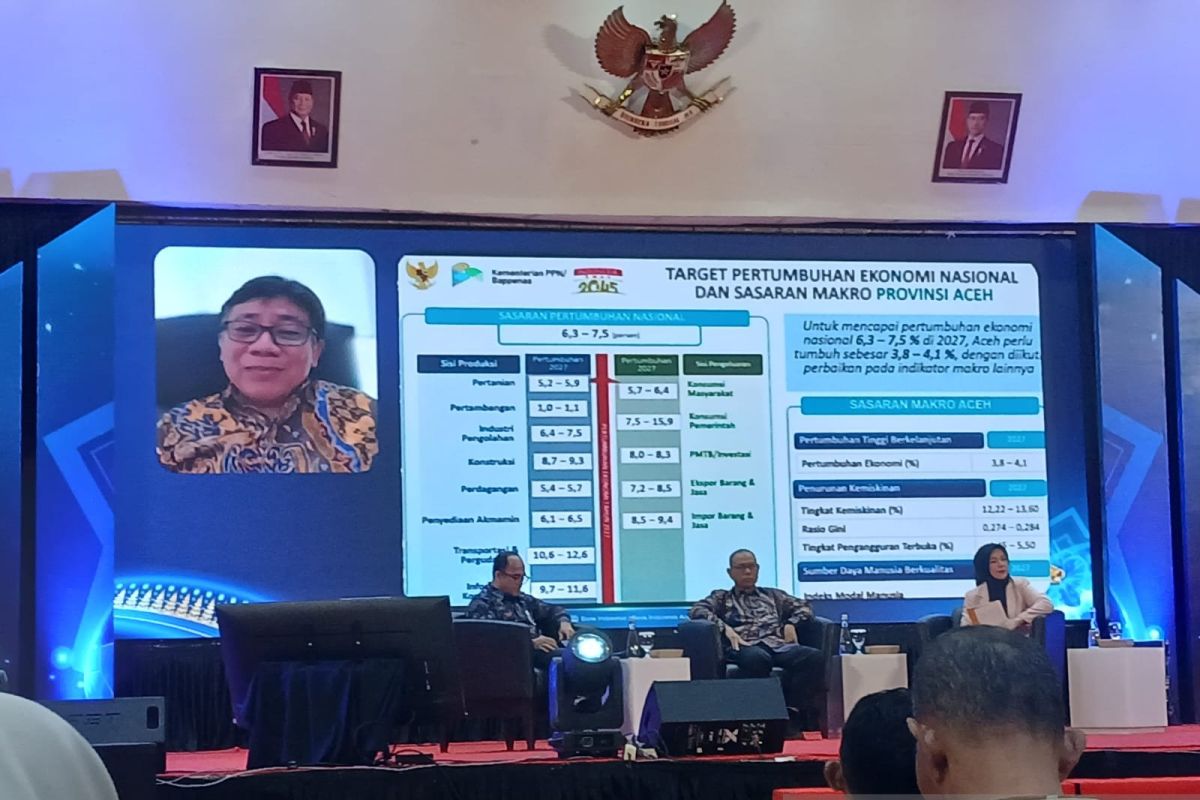
The statement was delivered as a speaker via Zoom at the Aceh Economic Forum titled “Accelerating Aceh’s Economic Recovery Post-Disaster Amid Increasing Global Uncertainty,” organised by the Aceh BI Regional Office (KPwBI Aceh), at the AAC Dayan Dawood Building, Banda Aceh.
For information, following the floods and landslides at the end of November 2025, Aceh’s economy in the fourth quarter of 2025 experienced a contraction of -1.61% year-on-year (y-on-y).
Then, Aceh’s economic growth throughout 2025 also slowed to only 2.97% compared to 2024’s growth of 4.46%.
He said that given the current conditions, Aceh needs to grow its economy by 3.8-4.1% by 2027 with improvements in macro indicators such as reducing poverty rates, open unemployment, and others.
Medrilzam explained that several rehab-recon strategies will involve strengthening economic infrastructure such as markets, warehousing, and logistics to ensure smooth supply chains, local economic stability, and sustainable livelihood recovery.
He outlined seven strategies that can be implemented: reconstruction based on multi-hazard resilience and climate change adaptation that goes beyond pre-disaster conditions. Then, risk-based planning and budgeting.
Next, prioritising critical economic infrastructure such as recovering main markets, food distribution centres, logistics warehouses, and transportation access that directly impact price stability and MSMEs.
Other strategies include strengthening supply chain resilience, diversifying distribution routes, increasing storage capacity, and digitalising logistics systems.
Fifth, he continued, innovative financing schemes by optimising the state and regional budgets (APBN/APBD) as well as other instruments. Governance and multi-stakeholder partnerships are also needed between government, private sector, and communities.
Seventh, synchronising physical rehabilitation with working capital support, MSME facilitation, and job creation.
“For the expected outcomes, the quick recovery of market and distribution functions, stable supply and prices, increased resilience of economic infrastructure against disaster risks, and accelerated recovery of the local economy based on MSMEs,” said Medrilzam.
In addition, he hopes that regions can strengthen their financial foundations by optimising locally generated revenue (PAD). Develop existing potentials and truly work on them.
He gave an example of the waste issue. The question is whether the funds go to the regional government, and the answer is no, because the money is spent at the collector level.
“Actually, that should be locally generated revenue. The regional regulation already exists, but it turns out it’s not implemented; that’s a small example, not to mention related to property tax, levies, and others,” he said.
Medrilzam reiterated that in efforts to recover Aceh’s economy, supply chains and distribution are key to maintaining price stability and goods availability. Then, strengthening people’s purchasing power through livelihood recovery and job creation.
“Then, optimise financing through synergy of state budget, regional budget, banking, and alternative schemes. As well as strengthening coordination between central government, regions, and Bank Indonesia in maintaining stability while driving economic recovery,” he said.