
Bappeda Synchronisation Meeting: West Java Provincial Government Promotes Data-Driven Planning
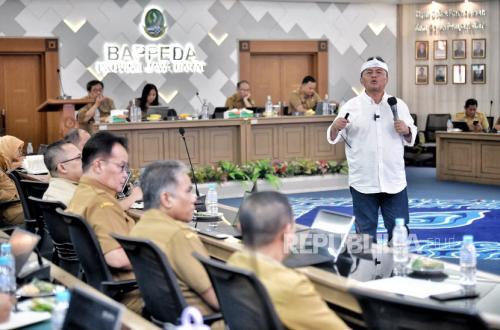
The West Java Provincial Secretary, Herman Suryatman, has called upon the Heads of Regional Development Planning Agencies (Bappeda) across 27 regencies and cities in West Java to ensure that development policies and sectoral problem-solving are truly aligned with the real needs of the community. This message was delivered by Herman while presiding over the Development Policy Synchronisation Meeting with Bappeda Heads from 27 regencies/cities in West Java at the West Java Bappeda Office, Bandung, on Monday (28/09/2026).
According to Herman, synchronisation between the province and regencies/cities is vital because West Java’s development achievements are ultimately an aggregation of the achievements of all regions. West Java Province possesses no territory or population of its own, as everything is distributed across the 27 regencies and cities.
“Provincial achievement is an aggregate. The province has no population of its own, nor does it possess an inch of territory. Everything is divided among the 27 regencies and cities,” said Herman.
Consequently, Herman emphasised the need for alignment starting from the Regional Long-Term Development Plan (RPJMD), the Regional Government Work Plan (RKPD), to the Regional Budget (APBD). He requested that Bappeda Heads not stop at the administrative function of planning, but rather act as guardians to ensure that regional development policies are accurately translated into budget priorities.
Herman also reminded that local governments have approximately three and a half effective years to ensure that the development targets of regional heads can be achieved by 2029. Evaluation starting now is necessary so that planning and budgeting do not continue with a ‘business as usual’ pattern.
“We are now evaluating the first one and a half years. There are about three and a half effective years remaining. We must mitigate risks starting now so that the macro indicators we aim to achieve by 2029 are truly met,” he said.
In this context, Herman requested that Bappeda Heads in the 27 regencies/cities utilise the ‘Satu Data Jawa Barat’ (SADA Jabar) as an instrument to strengthen data-driven planning.
SADA Jabar integrates various sectoral data, including education, health, employment, poverty, social issues, and population, and is connected to the National Single Social and Economic Data (DTSEN) and West Java development data. The system allows community issues to be mapped in greater detail, including on a ‘by name, by address’ basis.
“Heads of Bappeda must begin using data as a foundation. We must know the problems in detail so that interventions are precise,” said Herman.
On that occasion, Secretary Herman also highlighted several basic services that require attention, ranging from road and bridge infrastructure, street lighting, and irrigation to waste management and the provision of clean water. According to him, these priorities must be assessed based on the specific conditions of each region.
Waste Management Issues
Herman Suryatman also highlighted the issue of waste as a matter requiring cross-regional anticipation. According to Herman, this issue cannot be viewed merely as a technical waste management matter. If not addressed during the planning and budgeting stages, it could evolve into a much broader public service problem.
“Do not let basic matters be handled too late. Bappacy Heads must be the guardians of the Regional Budget (APBD), reminding the Regional Secretary and regional heads that, at the very least, minimum standards for basic services must be maintained,” he stated.