
Bapanas: Soybean Stabilisation Scheme Will Be Carefully Calibrated to Protect Tofu and Tempeh Makers
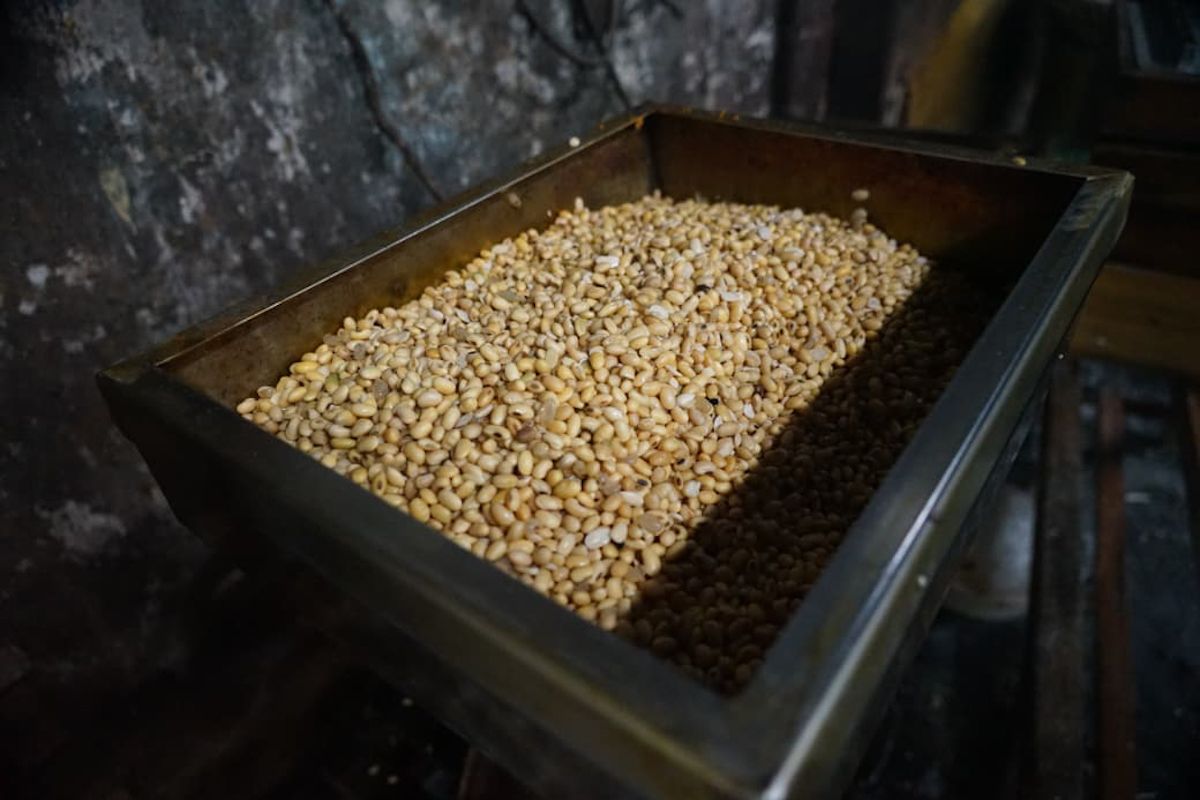
Jakarta (ANTARA) — The National Food Agency (Bapanas) has assured that its Food Supply and Price Stabilisation (SPHP) programme for soybeans will be implemented in a carefully calibrated manner to maintain price stability and protect the continuity of tofu and tempeh makers’ businesses amid market fluctuations.
“SPHP for soybeans is not a subsidy provided automatically at all times. It is implemented in a measured way, taking into account price movements, supply conditions and the applicable regulations,” Bapanas Deputy for Food Availability and Stabilisation Hermawan said in Jakarta on Saturday.
Bapanas said imported soybean prices remained stable and had not exceeded the Purchase Reference Price (HAP) for tofu and tempeh producers.
According to data from the Indonesian Association of Tempeh and Tofu Producers’ Cooperatives (Gakoptindo), the average price of imported soybeans in Java in the first week of October 2026 was around Rp11,573 per kilogram.
“Soybean prices are generally still relatively under control, particularly in Java, one of the main centres for tofu and tempeh producers. Most importantly, the government is not standing by or simply waiting for soybean prices paid by producers to rise,” he said.
Gakoptindo data for the week beginning 7 October showed that, in Java, Banten had the highest average imported soybean price approaching the HAP, at Rp11,900 per kilogram.
In Jakarta, West Java, Central Java and the Special Region of Yogyakarta, the highest average price was Rp11,850 per kilogram. However, soybeans were also available at the lower price of Rp11,300 per kilogram.
The HAP for imported soybeans at the tofu and tempeh producer level is capped at Rp12,000 per kilogram. The ceiling for locally produced soybeans is Rp11,400 per kilogram. These reference prices are set out in National Food Agency Head’s Decree No. 330 of 2026.
“The government does not look only at the national average price. It monitors prices, stocks, supply, distribution and the circumstances facing producers in each region, so that stabilisation measures can be tailored to what is actually happening on the ground,” Hermawan said.
Bapanas has prepared funding for the SPHP soybean programme, one of President Prabowo Subianto’s directives as an economic stimulus for the second half of 2026. The total allocation is Rp100 billion.
However, Bapanas must ensure that the programme is implemented in a targeted manner. The presidential directive says SPHP assistance should prioritise areas where soybean prices at the producer level exceed the HAP.
“The government is committed to ensuring that soybeans remain available, prices stay under control, and tofu and tempeh businesses continue to operate sustainably,” Hermawan said.
He added that the relatively stable prices of imported soybeans also demonstrated that importers and distributors were complying with efforts to maintain prices.
The government had previously called for cooperation to stabilise soybean prices for tofu and tempeh producers.
Bapanas Head and Agriculture Minister Andi Amran Sulaiman had asked soybean importers to work together to keep prices in check, particularly for tofu and tempeh makers.
Importers and distributors must cooperate with the government’s efforts to support small and micro-scale tofu and tempeh businesses.
“We will investigate if producers, including tofu and tempeh makers, are affected. We will check where the problem originates. Prices must not be raised arbitrarily,” Amran said.
Amran also stressed that soybeans are a strategic national commodity, as they are the main ingredient in tofu, tempeh and various processed foods consumed daily by the public.
He said Indonesia must move away from its dependence on imports and begin building domestic production self-sufficiency.
Agriculture Ministry data show that national soybean demand in 2026 is projected to reach 2.7 million tonnes. However, around 95 per cent, or 2.6 million tonnes, is still expected to be met through imports. This presents both a challenge and a major opportunity to increase domestic production.
Average national soybean production over the past five years has been around 227,000 tonnes a year, from 136,000 hectares of planted area, with average productivity of 1.6 tonnes per hectare. By April 2026, national production had reached 4,982 tonnes from 7,018 hectares.
Source: jawawa.id (https://jawawa.id/newsitem/bapanas-soybean-stabilisation-scheme-will-be-carefully-calibrated-to-protect-tofu-and-tempeh-makers-1792237847)
Originally published by Antara (Indonesian) (https://www.antaranews.com/berita/5793485/bapanas-program-sphp-kedelai-terukur-jaga-usaha-perajin-tahu-tempe), translated from Indonesian