
Bapanas chief affirms Indonesia is experienced in facing El Nino
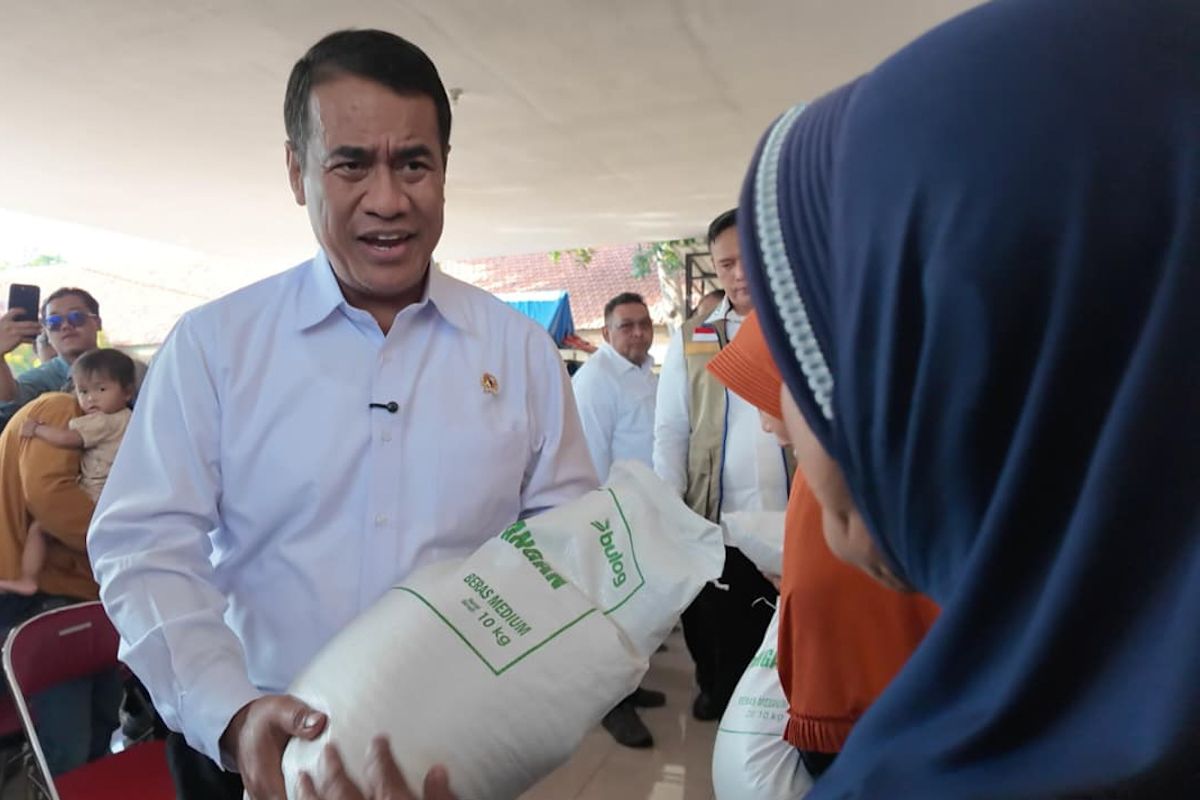
Jakarta (ANTARA) - Head of the National Food Agency (Bapanas) and Minister of Agriculture Andi Amran Sulaiman has affirmed that Indonesia is experienced in facing El Nino, supported by government rice reserves (CBP) reaching 5.2 million tonnes by mid-August 2026.
“We once had El Nino in 2016 and we survived. Back then, in a short time, we were able to hold on. Moreover, now we have experience of El Nino three times. But in 2023 and 2024, preparation was somewhat lacking, so imports reached 7 million tonnes. Now we have prepared for El Nino, our CBP stock is 5.2 million tonnes,” Amran said in a confirmed statement in Jakarta on Saturday.
The El Nino phenomenon affecting Indonesia has been reported by the Meteorology, Climatology and Geophysics Agency (BMKG) to have entered the strong category and has the potential to become very strong. This condition is projected to make the dry season drier and longer, especially in August and September.
In the food sector, the government has prepared a mitigation strategy in the form of strengthening the Government Rice Reserve (CBP) stock, which is supplied without imports.
The government’s support for domestic rice farmers has also strengthened farmers’ optimism and spirit, so that national production achieved rice self-sufficiency status in 2025.
According to Bapanas records, the CBP stock before the peak of El Nino in 2023, specifically in early September 2023, was still at 1.52 million tonnes. By 12 August 2026, the CBP stock had increased rapidly by 245.4 percent to 5.25 million tonnes.
The mitigation strategy of strengthening the CBP stock has been implemented since 2025 by accelerating the absorption of harvested grain from domestic farmers through Perum Bulog. The government adopted a policy of absorbing grain of any quality to support farmers.
“After absorption, Bulog will carry out the processing. If the rice has high moisture content, the burden is taken over from the farmers. In fact, if it is not absorbed, these farmers are very vulnerable to going bankrupt. This must be safeguarded by Bulog’s presence for 115 million farmers,” Amran said.
Based on the latest release from Statistics Indonesia (BPS), the index of prices received by farmers up to July 2026 reached 151.10. This is the highest level. This achievement reflects grain prices that are increasingly profitable for Indonesian farmers.
“Bulog’s presence is to stabilise prices, to safeguard farmers’ welfare, and to maintain consumer prices. Bulog is functioning. These are our farmers. These are Indonesians. We must not allow them to go bankrupt,” Amran added.
Amran also explained that the possibility of rice quality degradation as an implication of the policy of absorbing grain of any quality can still be handled by Bulog. The quantity is not significant compared to the total CBP of 5.25 million tonnes.
“If there is quality degradation, say yesterday there were 5 thousand tonnes, divided by 5.2 million tonnes, that is 0.00 something percent. Not significant. For example, if we store rice at home with only one sack, usually some is damaged. One litre, two litres. Moreover, this is 5.2 million tonnes and the largest in history for the first time,” Amran explained.
“God willing, Bulog can still be profitable. This year, it is profitable. Bulog is present for the state, for the Indonesian people, for farmers, for consumers,” he added.
Not only rice, the Government Food Reserve (CPP) stock in the form of other commodities has also been increased exponentially. The strengthening of the CPP stock is also in preparation for the possibility of El Nino in the future. The CPP is stock managed by Perum Bulog and ID FOOD.
The current CPP corn stock is 159 thousand tonnes. This has increased since September 2023, when it was still zero. Meanwhile, the CPP stock of broiler chicken meat has jumped 138.4 percent compared to September 2023, as today the stock is 38 tonnes.
According to Bapanas records, the current CPP stock also includes 2 thousand tonnes of consumption sugar and 1 thousand kilolitres of cooking oil. Then 6 tonnes of chicken eggs and 3 tonnes of beef. The majority of CPP supply comes from absorption of domestic food production.
For comparison, the CPP stock before the peak of El Nino in 2023, specifically in early September 2023, consisted of 1.52 million tonnes of rice, zero corn, 15.94 tonnes of broiler chicken meat, 37.87 thousand tonnes of granulated sugar, and 3.74 kilolitres of cooking oil.
Thus, the current quantity of CPP stock can be said to be stronger than the CPP stock before facing the peak of El Nino in 2023.