
Bapanas: 7.7 million tonnes of government rice reserves distributed to public during 2023-2025
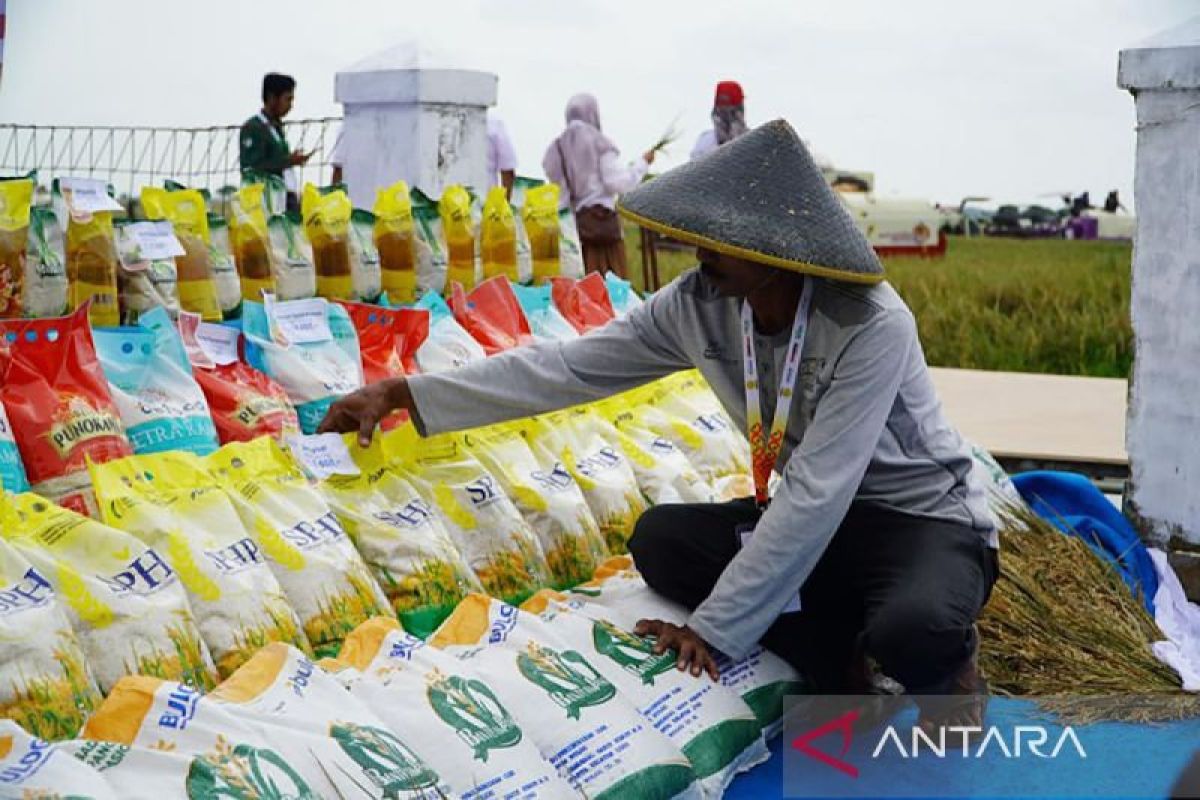
The National Food Agency (Bapanas) has recorded that a total of 7.7 million tonnes of government rice reserves (CBP) were distributed to the public throughout 2023 to 2025 to maintain supply stability, prices, and national food security.
Deputy for Food Availability and Stabilisation at Bapanas, I Gusti Ketut Astawa, stated that the CBP stock managed jointly with Perum Bulog continues to be utilised for the public interest, with distribution directed at safeguarding supply and price stability at the consumer level. “The total government rice reserves distributed in the period from 2023 to 2025 reached 7.75 million tonnes,” Ketut said when confirmed in Jakarta on Saturday.
He conveyed that the distribution is part of the government’s efforts to maintain food stability while strengthening public purchasing power. He detailed that the distribution of government rice reserves in 2023 reached 2.76 million tonnes. That figure then increased to 3.37 million tonnes in 2024, while throughout 2025 a total of 1.62 million tonnes has been realised.
Ketut explained that the distribution of government rice reserves is intended to provide an economic cushion for the public and improve access to rice at more affordable prices amid various food market dynamics. The government consistently distributes CBP stock to the public through numerous programmes, ranging from the rice supply and price stabilisation programme (SPHP) to food aid for 33.2 million beneficiary families. “Also to assist communities in regions experiencing natural disasters,” Ketut clarified.
The distribution of CBP stock in 2023, totalling 3.37 million tonnes, consisted of 1.49 million tonnes of rice food aid, 1.18 million tonnes of SPHP rice, 87,500 tonnes for budget allocation groups, and 2,300 tonnes for emergency response. Furthermore, CBP distribution throughout 2024 included 1.97 million tonnes of rice food aid, 1.4 million tonnes of SPHP rice, and 442 tonnes for emergency response.
Meanwhile, the distribution of CBP stock during 2025 recorded a total of 1.62 million tonnes, comprising SPHP rice which accounted for the largest portion at 802,900 tonnes. This was followed by 710,780 tonnes of rice food aid, 92,100 tonnes for budget allocation groups, and 13,160 tonnes for emergency response.
Ketut explained that these various beneficial programmes are still being continued in 2026. Moreover, the government is currently strengthening CBP stock by relying entirely on the absorption of domestic farmers’ production. “At present, the government is focusing on absorbing our farmers’ harvests for CBP. This is also accompanied by the implementation of distribution programmes to the public until the end of the year. These efforts must be continuously implemented so that upstream and downstream stability is always maintained,” said Ketut.
Bapanas noted that the realisation of CBP distribution for the 2026 budget had reached a total of 946,800 tonnes as of 18 June, consisting of 550,100 tonnes of rice food aid, 348,500 tonnes of SPHP rice, 36,800 tonnes for budget allocation groups, and 11,300 tonnes for emergency response. “The government has also decided to add three months of rice food aid allocation in the second half of this year,” he explained.
Meanwhile, the total rice stock held by Bulog as of 18 June 2026 stood at 5.2 million tonnes, sourced from domestic rice equivalent procurement since the beginning of 2026, which has reached 3.18 million tonnes. “This is also supported by the year-end 2025 stock of 3.24 million tonnes, with domestic production procurement realisation during 2025 at 3.43 million tonnes without any imports,” Ketut stated.
Head of Bapanas and concurrently Minister of Agriculture, Andi Amran Sulaiman, emphasised that national rice stocks are abundant, with reserves reaching 5.2 million tonnes, so the government does not desire rice imports amid availability that has recorded the highest level ever. “Our warehouse capacity is 3 million tonnes. We have rented 2.3 million tonnes, and this is the highest since independence. In the past, Bulog’s stock was only 1 million tonnes, then prices rose, and the conclusion was to import. Now it is different. We have a surplus. We are already self-sufficient,” said Amran.
Indonesia’s rice production achievement was also mentioned in the May 2026 edition of the Rice Outlook report released by the United States Department of Agriculture (USDA). The USDA reported that global rice production for the 2025-2026 period increased by 1.5 million tonnes. In the April Rice Outlook, it was 541.3 million tonnes, rising to a total of 542.8 million tonnes. Indonesia was cited as one of the countries with the highest annual rice production growth figures, alongside Nigeria, Ivory Coast, and Vietnam. However, compared to those three countries, only Indonesia has a total annual rice production figure exceeding 30 million tonnes. Nigeria stands at 5.9 million tonnes, Ivory Coast at 1.7 million tonnes, and Vietnam at 26.2 million tonnes.