
Bapanas: 5.3 million tonnes of rice stock strengthens Indonesia amid global dynamics
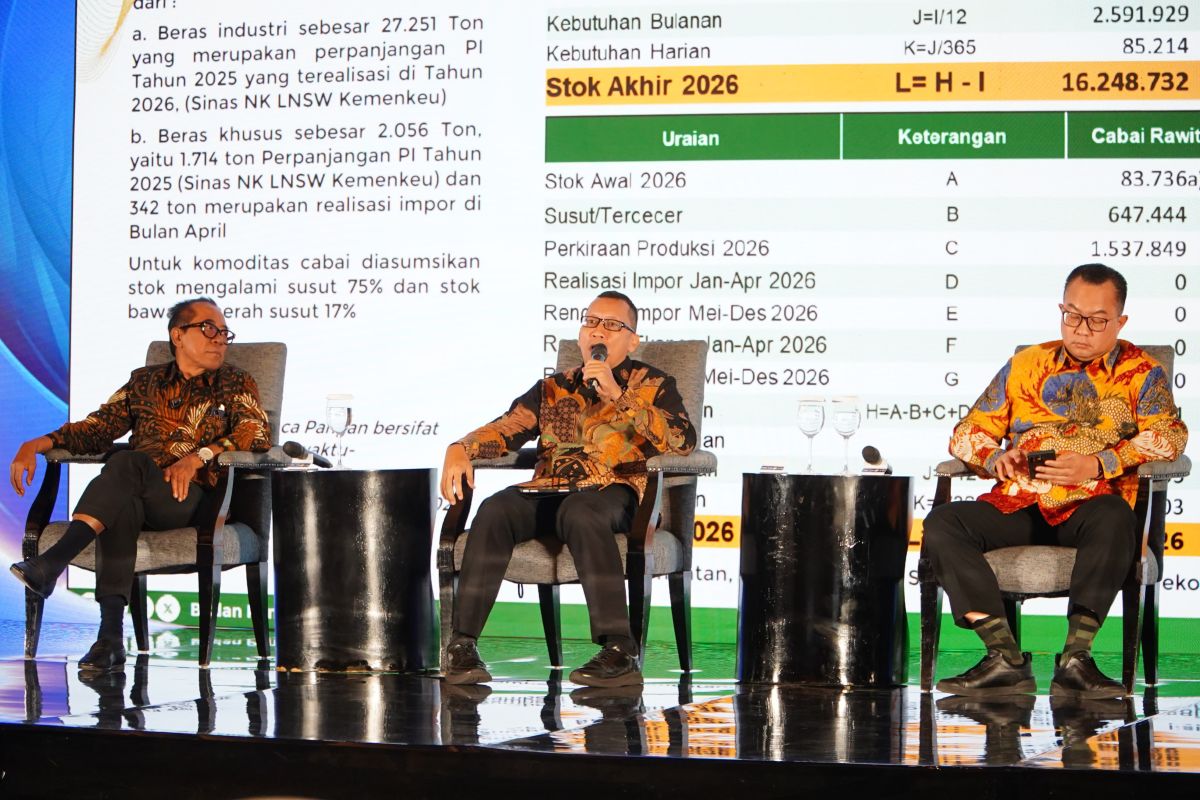
Jakarta (ANTARA) - The National Food Agency (Bapanas) stated that the national government rice reserve (CBP), which has reached 5.3 million tonnes, is strengthening Indonesia’s food security in facing global dynamics and world food inflation pressures.
Head of the Bapanas Food Supply Stabilisation Working Team, Yudhi Harsatriadi Sandyatma, said Indonesia’s food security is entering an increasingly robust phase. The CBP managed by Perum Bulog has now reached 5.3 million tonnes, the highest achievement in the history of national records.
“The strong availability of rice reinforces Indonesia’s position in maintaining food supply amidst various global challenges and the dynamics of world food inflation,” Yudhi said during the Economic Conference of The National Sustainable Food Programme in Jakarta on Thursday.
He said the current national food balance sheet is in a good situation, especially for the rice commodity which is the backbone of public consumption.
“And we need to convey that our government rice reserve figure managed by Bulog as of today has reached 5.33 million tonnes. That is an extraordinary achievement for all of us, as the highest achievement throughout the history of this republic,” Yudhi stated.
According to him, strengthening food stocks is an important factor in maintaining the balance between food availability and affordability. These two aspects are the main foundation in controlling food inflation and protecting people’s purchasing power.
“In the contextualisation of food inflation control, the two pillars of food availability and affordability are important. They are like two sides of a coin that cannot be separated, and are closely related to the stabilisation of food supply and prices,” he explained.
Meanwhile, to ensure food is affordable for the public, Bapanas is strengthening market supervision through the formation of the 2026 Task Force for Clean Sweep of Price, Quality, and Food Safety Violations (Saber).
The task force, which involves various ministries, agencies, local governments, and law enforcement officials, is tasked with overseeing the implementation of the Highest Retail Price (HET), Sales Reference Price (HAP), quality, and food safety in the field.
“What is the task of this team? The first is to identify and verify various potential violations of the Government Reference Price and the Highest Retail Price applicable in this republic,” Yudhi said.
Thus, the team not only takes action against potential violations but also anticipates potential price increases and violations in terms of quality and food safety.
Bapanas also continues to run various instruments for stabilising food supply and prices. One of them is through the Cheap Food Movement (GPM). As of 8 June 2026, the implementation of GPM has reached 5,237 times across 36 provinces and 377 districts/cities.
“This programme is one of the main instruments in dampening price fluctuations while strengthening public access to staple foods,” Yudhi said.
The strengthening of national food security also received strong support from Bank Indonesia (BI) through the Inflation Control and Prosperous Food Movement (GPIPS), which collaborates with the Central Inflation Control Team (TPIP) and Regional Inflation Control Teams (TPID).
The Central Statistics Agency (BPS) recorded that national inflation remains under control. Annual inflation (year-on-year) was recorded at 3.08 percent, still within the national target range.
Meanwhile, monthly inflation (month-to-month) in May was at 0.28 percent, corrected from the previous month’s level of 0.13 percent.
At the same event, BI Deputy Governor Ricky P. Gozali emphasised that all food inflation control programmes are directed at three main objectives: keeping food inflation under control, ensuring supply continuity across time and regions, and increasing supply chain efficiency so that the benefits can be felt by both consumers and farmers.
“This target is not just about maintaining price stability today, but also about building a national food system that is increasingly resilient to climate change, global challenges, and rising needs towards a Golden Indonesia 2045,” Ricky said.