
Banyu Bening Rainwater School Officially Becomes a Learning Hub for Various Groups
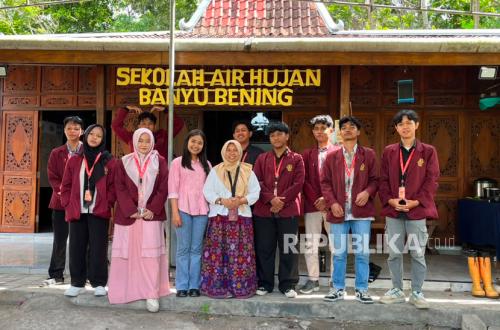
Morning had not yet fully broken. The atmosphere in Tempursari Hamlet, Sardonoharjo Village, Ngaglik District, Sleman Regency, Special Region of Yogyakarta, was still quiet. Even so, Suwarni, a local resident, was already walking carrying a large container towards the water collection point at an open outlet provided by the Banyu Bening Rainwater School (SAH).
This activity has been part of Suwarni’s routine for years. Every two days, usually after dawn prayers, she collects rainwater that has been treated at SAH Banyu Bening to meet her family’s drinking needs. Suwarni brings her own container and returns when the water supply at home runs low.
For Suwarni, the water processed at SAH Banyu Bening is no longer something unfamiliar. She has used it since the early days of the community’s journey. In fact, Suwarni has been one of the witnesses to Banyu Bening’s development, from its initially modest activities to its current status as a widely recognised learning centre for visitors from various regions.
“It has been 14 years. I collect one large jumbo container every two days. I usually go after dawn prayers. Every two days without fail,” Suwarni said during a conversation with Republika in Tempursari Hamlet on Wednesday (29/7/2026).
Her introduction to Banyu Bening water began when her husband was undergoing treatment at a hospital. At that time, their family was advised to try drinking the water processed at Banyu Bening. Since then, the natural water has become part of the family’s daily needs.
“My husband was ill at the time. At the hospital, we were told to try giving him this water. ‘Mbah, drink this water,’ they said. So we collected it and drank it. It took some adaptation. At first it felt like having a constant cold, then constant drowsiness. But over time, we felt our bodies were better and healthier,” Suwarni said.
Suwarni’s husband also drank Banyu Bening water after receiving treatment from the hospital. “His body felt better. Since then, we have continued drinking that water and feel healthy. The children also all drink it,” she explained.
Before getting to know SAH Banyu Bening, Suwarni’s family had always relied on groundwater and wells that were processed for drinking needs. However, after becoming familiar with the treated rainwater, habits in their family began to change.
“We used to drink tea with sugar. But since having Banyu Bening water, we just drink plain water. If we want it warm, the water is boiled and then drunk,” Suwarni said.
She admitted she was pleased to see the development of SAH Banyu Bening, which has attracted attention from various groups. According to her, more and more people are coming to learn, visit, and use the water provided openly.
“Now many people come from various regions to learn and visit here. Bu Ning also travels everywhere to give talks. I feel proud. I hope it becomes a blessing for many people,” she said.
Although she lives not far from the site, Suwarni noted that not all surrounding residents have made use of the treated rainwater. She therefore hopes that more people will become aware of and use Banyu Bening water according to their needs.
“People from far away come to use it. If those of us who live nearby do not use it, it is actually a shame. This needs to be improved further so that more people benefit,” Suwarni explained.
The benefits of Banyu Bening are indeed not only felt by residents around the site. Over more than a decade, the place has developed into a shared learning space about rainwater, the environment, and sustainable water resource management.
One group that came to learn was students from the State Islamic University (UIN) Sunan Kudus. They visited SAH Banyu Bening as part of their Field Experience Practice (PPL) activities with an ecotheology theme.
UIN Sunan Kudus student Muamar Gunawan said Banyu Bening is one of the recommended places for studying the relationship between humans, the environment, and the use of natural resources. Before coming to SAH Banyu Bening, he admitted he had views not much different from most people.
“Our initial aim in joining the PPL from campus was to learn about ecotheology. One of the recommended places is the Banyu Bening Rainwater School. Here we learn how rainwater is managed as effectively as possible so it can be drunk or used for daily needs,” Muamar said.
For him, rainwater was only understood as ordinary water often associated with discomfort when caught in the rain or even with disasters such as floods. However, Muamar’s view changed after learning about the rainwater treatment process and its various uses.
He had the opportunity to see first-hand the installation used to collect and treat rainwater. “In my opinion, it is not complicated. The process is almost the same as managing refillable water. But this is the rainwater version, not using groundwater,” he said.