
Banten Provincial Government Strengthens Oversight of Free Nutritious Meals Programme
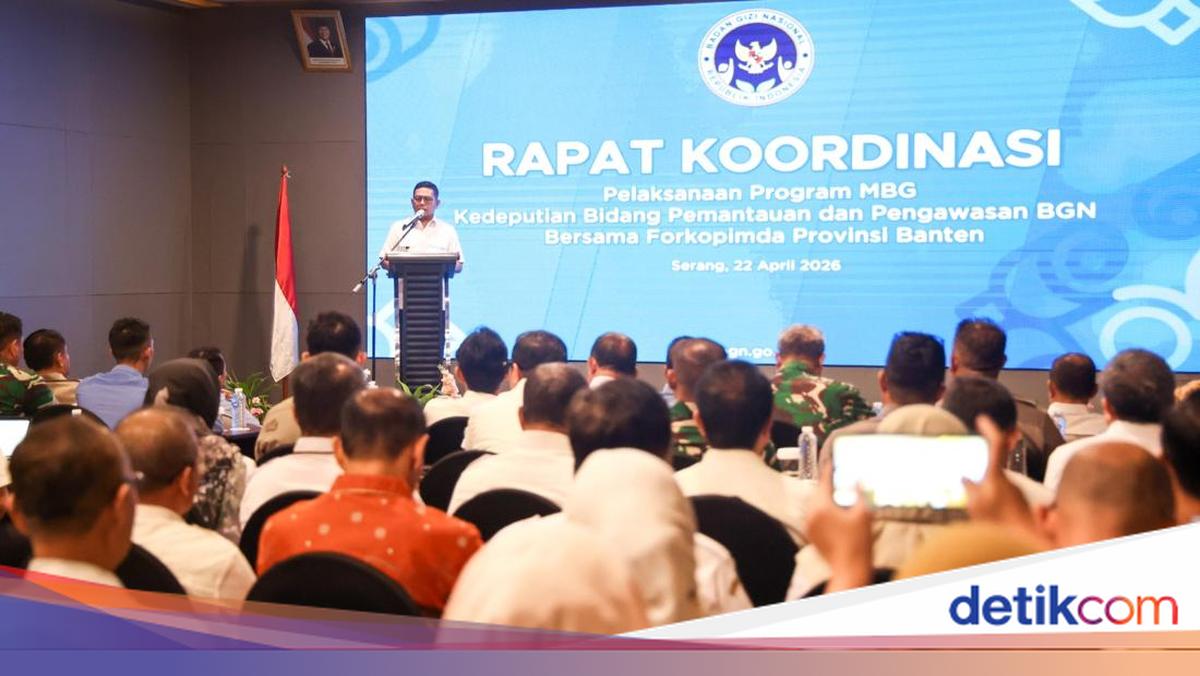
The Banten Provincial Government is strengthening its commitment to overseeing the implementation of the Free Nutritious Meals (MBG) programme to ensure it runs optimally, on target, and with high quality through integrated cross-sectoral supervision.
“We need to ensure that all regional heads in Banten become the main part of the success of the Free Nutritious Meals programme,” said Banten Governor Andra Soni in a written statement on Wednesday (22/4/2026).
This was conveyed by Andra while attending the Coordination and Evaluation Meeting on the Implementation of the MBG programme with the National Nutrition Agency (BGN) and the Regional Leadership Coordination Forum (Forkopimda) at the Aston Serang Hotel.
He emphasised the importance of involving local governments in programme supervision. According to him, supervision is key to maintaining the quality and sustainability of the programme.
“We ask the BGN to actively involve regions in supervision. A good programme must be balanced with supervision to run optimally, not to find faults, but to ensure balanced implementation,” he said.
Andra Soni revealed that currently, around 2.7 million children in Banten Province have received MBG benefits every day for five days a week.
“This is an extraordinary achievement. Local governments would not be able to provide such large-scale services to the community without support from the central government,” he stated.
He added that regional heads, along with the Education and Health Departments, have important roles in ensuring the programme runs well and impacts child growth.
Meanwhile, the Deputy for Monitoring and Supervision of the BGN, Lieutenant General TNI (Retired) Dadang Hendrayudha, emphasised that the success of MBG greatly depends on strict supervision involving all stakeholders in the regions.
“We ask governors, regents, mayors, all Forkopimda elements, to task forces to jointly monitor the implementation of this programme in the field,” he said.
Dadang explained that supervision is not only administrative but also covers the entire process chain, from production kitchens to distribution to schools. For this reason, the BGN encourages regional governments in regencies/cities to build digital-based monitoring systems.
“One form of strengthening supervision is through digital platforms. With that system, regional heads can directly monitor the number of kitchens, beneficiaries, to daily menus just via mobile phones,” he explained.
He assessed that digitalisation will increase transparency and speed up responses to potential problems in the field.
In addition, Dadang stressed the importance of local economic empowerment through regional supply chains. According to him, MBG raw materials must be sourced from local potentials to directly impact the community.
“We hope the supply chains in the regions can be fulfilled from livestock, fisheries, and other local sectors, so that farmers and business actors also feel the benefits,” he said.
Dadang stated that the BGN also sets strict standards for kitchen operations, from hygiene, nutritional quality, to production time management. Every partner must meet these standards with a gradual sanction mechanism for violations.
“We will take action on every violation. Starting from warnings to operational closures if there is no improvement,” he asserted.
Furthermore, Dadang emphasised that the MBG programme is oriented towards nutritional quality, not just providing satiety.
“What we pursue is not just filling stomachs, but nutritious eating. The composition must be clear, the process correct, and the kitchens hygienic,” he said.
The BGN also requires the involvement of professional personnel, such as chefs in menu preparation, and encourages active roles from all schools in providing recommendations on food quality.
“We ask schools to participate in supervision. If there is an unworthy menu, immediately provide recommendations to us,” he added.
On the other hand, the Director of Region II of the Deputy for Monitoring and Supervision of the BGN, Albertus Dony Dewantoro, revealed that his side has taken firm action against field violations.
“About 20 SPPG in the Banten region have been suspended by us because they do not meet standards,” he said.
He explained that common violations relate to kitchen sanitation, lack of Wastewater Treatment Installation (IPAL), and unworthy food quality.