
Banten DLHK Investigates Suspected Cisadane River Pollution, Takes Samples from 3 Industries
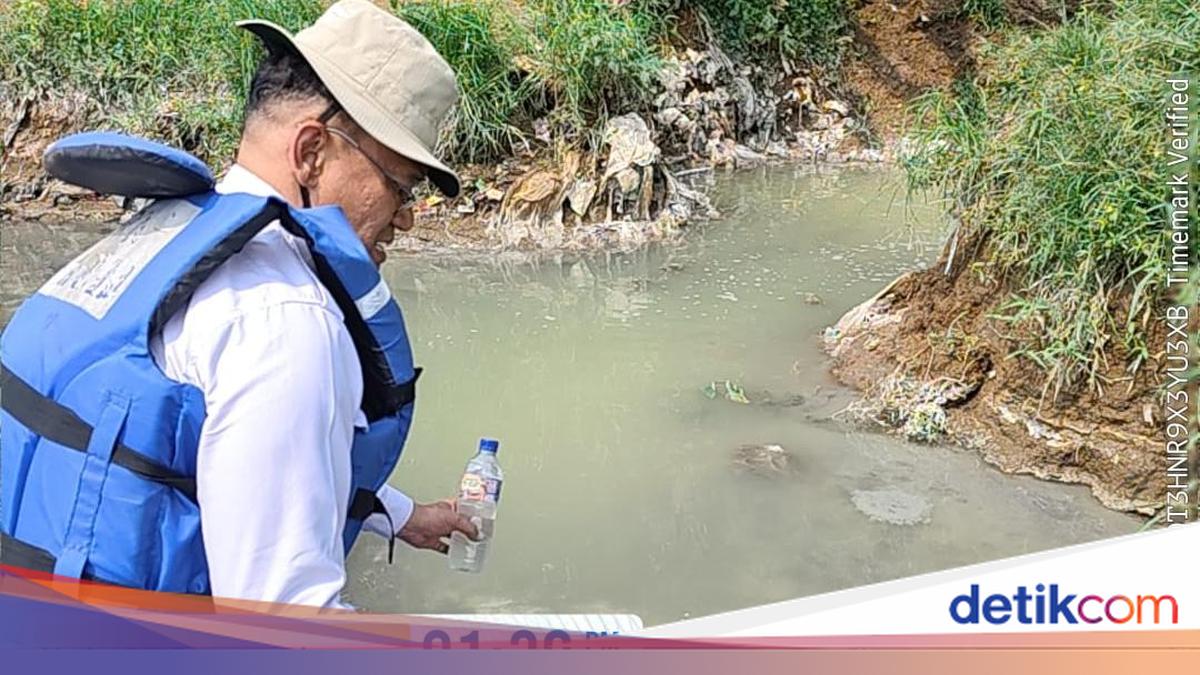
The Banten Environment and Forestry Service (DLHK) received a report from the Banksasuci Foundation River Care Community regarding suspected pollution of the Cisadane River in Greater Tangerang. Officers subsequently took water samples at three industrial outlets around the Cisadane River.
Secretary of the Banten Provincial DLHK, Budi Darma Sumapradja, led the water sampling conducted on Wednesday (26/8/2026). Officers took samples at three industrial outlet locations in the Greater Tangerang area, namely PT PUP (North Serpong area), PT ST (Kelapa Dua area), and PT Y (Pinang District, Tangerang City).
During the inspection, the team found initial indications including turbid water conditions, waste outlet channels flowing directly into the Cisadane River, piles of rubbish on the riverbanks, as well as illegal waste disposal site activity and illegal waste burning.
“This supervision is a commitment and firm instruction from the leadership in maintaining environmental sustainability in Banten. The field observation results are initial indications. Water samples have been secured for testing at the Banten DLHK Environmental Laboratory to ascertain parameters such as BOD, COD, TSS, pH, and heavy metal content in accordance with environmental quality standards. The certainty of whether or not there is a violation is purely based on scientific laboratory data,” said Budi.
Banten DLHK emphasised that the polluter pays principle and environmental law enforcement will be applied absolutely.
If laboratory test results prove pollution exceeding quality standards, the company will face firm consequences in accordance with Law Number 32 of 2009 on Environmental Protection and Management.
“Firstly, administrative sanctions with a deterrent effect, ranging from written warnings, government coercion (temporary suspension of production activities/freezing of waste channels), freezing of environmental permits, to revocation of business licences,” said Budi.
In addition, Budi explained that there is an obligation for restoration and compensation. Companies are required to repair the source of pollution, clean the river water, and restore damaged ecosystems with costs fully borne by the business actor.
“If elements of intent or negligence exceeding wastewater quality standards are found, the case will be referred to the criminal realm with a maximum prison sentence of 10 years and fines of up to IDR 10 billion,” he stressed.
Budi asserted that his party is committed to continuing coordination with district/city governments throughout Greater Tangerang to process laboratory results expected to be released in the coming days, as well as to curb illegal waste disposal sites along the riverbanks.
“The entire process continues to prioritise the principle of caution and the presumption of innocence until valid test results are issued,” he said.