
Bank Mandiri Taspen Partners with ITB to Turn Organic Waste into Poultry Feed
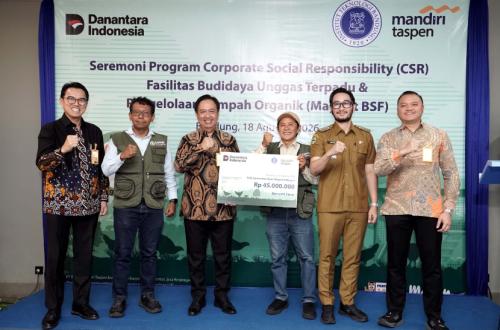
Organic waste that has so far ended up in final processing sites can be processed into maggot feed for poultry farming while generating economic value. The concept was developed by PT Bank Mandiri Taspen together with the Bandung Institute of Technology (ITB) through an integrated poultry farming facility and organic waste management using maggots, or black soldier fly (BSF) larvae, in West Bandung, West Java. Under this model, organic waste becomes food for maggots, which are then used as chicken feed. The chickens in turn produce eggs that can be consumed, sold, or used to support community social needs.
PT Bank Mandiri Taspen President Director Panji Irawan said the model could become a productive activity opportunity for pensioners while helping communities manage organic waste in their surroundings. “We see that Dr Linus’s use case can be replicated everywhere. Pensioners can fill their days together with residents so that organic waste becomes a food source for maggots, and the maggots can be eaten by chickens, and then the chickens lay eggs. Thus, a circular economy emerges and pensioners as senior citizens have an income,” Panji said after the Bank Mandiri Taspen CSR Programme Ceremony through the Integrated Poultry Farming Facility and Organic Waste Management through BSF Maggots in West Bandung, West Java, on Tuesday (18/8/2026).
Panji said the facility could serve as a pilot model with the potential to be applied in various regions. Bank Mandiri Taspen is also ready to provide financing support for pensioners who wish to develop poultry and maggot farming businesses. “If this succeeds, it can be disseminated everywhere. We want to see the model, we want to see the use case. This could become one of the sources of activity for senior citizens,” he said.
Currently around 12 percent of Indonesia’s population are senior citizens. Meanwhile, the number of pensioners who are Bank Mandiri Taspen customers reaches around 670,000 people across Indonesia. According to Panji, developing a circular economy model requires collaboration between academics, the community, and financial institutions. ITB plays a role in technology and innovation, the community acts as both participants and managers, while Bank Mandiri Taspen provides financing support.
“There is technology and innovation coming from ITB experts. There are the actors coming from the community, including our customers. And we as bankers fully support them sustainably. This is very important within one ecosystem, as we see it,” Panji explained. He cited Bank Mandiri Taspen’s support in the form of financing of around Rp45 million for pensioners who want to open a laundry business. According to Panji, the capital requirement for a poultry and maggot farming facility is in a relatively similar range.
“For a facility like this, that figure is feasible, and could even be lower. There are experts working with us. There are mentors, coaches, and there is a use case that can serve as a model,” he said.
The originator of the maggot apartment concept from ITB, Dr Linus Ampang Pasasa, M.S., said the technology is capable of decomposing organic waste within about two days. The technology used is relatively simple and can be applied at a cost that is not too large. “One maggot apartment unit costs around Rp45 million and can be used to raise up to 100 chickens with a land dimension as narrow as 1x6 metres. However, the number of chickens in one unit is currently only around 40 because the available supply of organic waste is still limited. If there are too many chickens while the waste is limited, they will certainly lack food,” Linus said.
Linus said the waste processing capacity can reach around 250 kilograms per day, depending on the number of units and waste supply. The raw material can come from households as well as hotels, restaurants, and cafes. The system produces maggots and chicken eggs as products with economic value. Maggots become chicken feed, while the eggs can be sold to finance the operations of the managing group or used for community social needs.
“The eggs can be sold to cover the costs of those who manage the facility, or distributed for stunting prevention through community health centres and so on. It just depends on the management,” Linus explained.
Bank Mandiri Taspen Business Director Mahrauza Purnaditya said the company’s CSR programme is now more focused on the environmental sector, with business development as a follow-on effect. One of the issues of concern is waste accumulation, with around 60 percent of waste at final processing sites being organic waste. “It happens that there is a programme related to environmental problems, namely waste accumulation. And it turns out that final processing sites produce 60 percent organic waste,” he said.
Mahrauza said the chicken farming programme had previously been running, but is now combined with organic waste management through maggots to form an integrated system. The egg harvest can meet the needs of the surrounding community or be developed into an individual business. “And the follow-on effects, starting from the egg harvest, at least meet the needs of the surrounding area, or later this model can also be carried out privately by individuals,” he said.
He said the programme is an extension of Bank Mandiri Taspen’s efforts to prepare pensioners to remain productively active. During the pre-retirement period, the bank introduces the Mantap Sejahtera programme, including Warung Mantap Sejahtera, hydroponics, and laundry services.
Source: jawawa.id (https://jawawa.id/newsitem/bank-mandiri-taspen-partners-with-itb-to-turn-organic-waste-into-poultry-feed-1787057585)
Originally published by Republika (https://esgnow.republika.co.id/berita/tjysip416/bank-mandiri-taspen-gandeng-itb-ubah-sampah-organik-jadi-pakan-unggas), translated from Indonesian