
Bank Mandiri Taspen and PNM Help Disabled Master Industry-Sought Skills
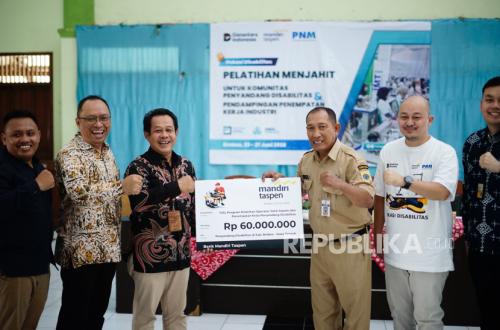
The opportunity to secure decent employment remains a challenge for many persons with disabilities in Indonesia, despite possessing the same potential to grow, work, and contribute to economic activities. One of the persistent obstacles is limited access to skills training and job placement services. Consequently, many individuals with disabilities possess the necessary abilities but struggle to enter the formal workforce or develop independent businesses.
Data from the Central Bureau of Statistics (BKS) shows that the labour participation rate for persons with disabilities remains relatively low. Meanwhile, Ministry of Manpower data recorded that 702 persons with disabilities secured job placements through Disability Service Units (ULD) throughout 2023. This challenge is further evidenced by the limited number of ULDs across various regions; currently, ULDs are only available in 28 provinces, or approximately 73.7 per cent of Indonesia’s total provinces. At the regency and city levels, the number has only reached 179 units, or about 34.82 per cent of the 514 regions.
This situation makes skills training a vital instrument for expanding job access for persons with disabilities. Through training tailored to industrial needs, participants gain not only technical abilities but also greater opportunities to enter the labour market. Based on this, PT Bank Mandiri Taspen and PT Permodalan Nasional Madani (PNM) Tegal Branch organised a Disability Vocational Programme in Brebes Regency, Central Java, involving 30 participants from the local disability community.
The training focused on sewing skills under a Footwear Sewing Operator scheme, facilitated by Ruang Amal Indonesia. Over the course of one week, participants received training specifically adjusted to the requirements of the footwear industry.
Agus Suyana, Head of the Bank Mandiri Taspen Pekalongan Branch, stated that shoe sewing skills were selected due to the high demand for labour in the industrial sector. “Sewing shoes is a specific technical skill with low risk and limited physical movement requirements, making it suitable for persons with both physical and motor disabilities. We hope that once skilled, they can be immediately absorbed by MSMEs and industries,” said Agus.
In addition to providing skills, the programme connects participants with companies in need of labour. Thus, the training does not stop at capacity building but also opens access to more concrete employment. Sutanto, Leader of the PNM Tegal Branch, noted that persons with disabilities require equal opportunities to develop their potential and improve their standard of living.
“Every person has the potential to grow if given the right opportunities and access. Through this programme, we hope participants not only acquire skills but also have a greater chance to become independent, create work, and improve their quality of life,” said Sutanto.
Upon completing the training, participants will undergo a job placement process within footwear industries operating in the Brebes area. This step is expected to strengthen the link between skills training and labour requirements in the industrial sector. For persons with disabilities, access to training and employment is not merely about income; such opportunities serve as a pathway to increasing independence, self-confidence, and broader participation in social and economic life.