
Bank Mandiri states that policy synergy supports Indonesia's economic growth
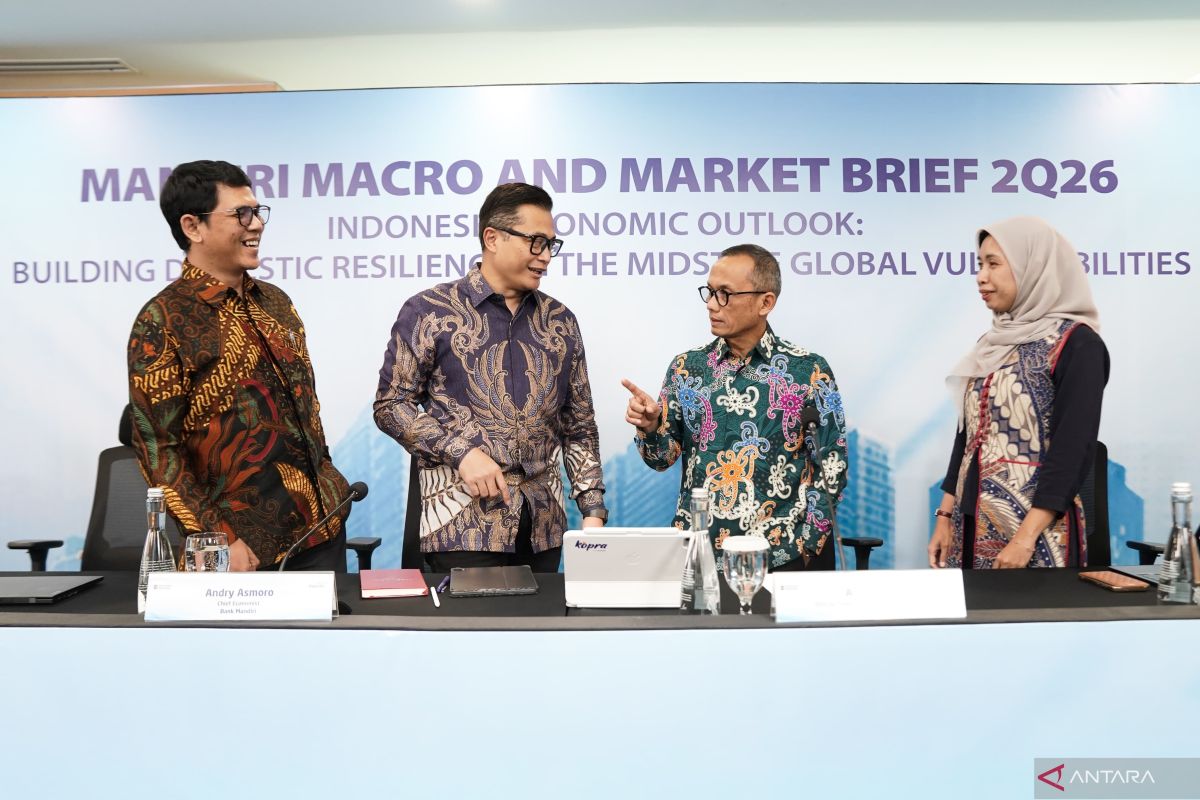
Looking ahead, global challenges will persist, but behind every challenge lie opportunities that can be optimised through the right strategies.
Jakarta (ANTARA) - PT Bank Mandiri Tbk (BMRI) assesses that several government policies are supporting Indonesia’s economic growth amid ongoing volatile geopolitical dynamics.
As is known, Gross Domestic Product (GDP) grew by 5.61% in the first quarter of 2026, strengthening from 5.4% in the fourth quarter of 2025. This was supported by consumption of 5.52% year-on-year (yoy) and an acceleration in government spending of 21.8%, in line with the expedited implementation of national priority programmes such as Free Nutritious Meals (MBG), Red and White Village Cooperatives (Kopdes Merah Putih), and the construction of people’s schools.
Bank Mandiri’s Director of Treasury & International Banking, Ari Rizaldi, views the synergy between accommodative fiscal and monetary policies as a continued pillar of growth moving forward.
“Looking ahead, global challenges will continue to exist, but behind every challenge also lie opportunities that can be optimised through appropriate strategies. With the synergy of accommodative fiscal and monetary policies, we believe economic growth can be maintained sustainably,” said Ari during the Mandiri Macro and Market Brief for Q2 2026 in Jakarta on Monday.
Ari further mentioned that the US-Iran conflict has indeed pushed oil prices above US$100 per barrel and triggered volatility in global financial markets. However, coordination between the government, Bank Indonesia (BI), and the Financial Services Authority (OJK) is seen as a positive factor capable of maintaining a balance between promoting growth and preserving financial stability.
BI is viewed as continuing to implement a policy mix, including exchange rate interventions, to safeguard the stability of the rupiah, which depreciated by 3.9% throughout 2026.
The acceleration of fiscal spending and the synergy among these three authorities are believed to still be able to support economic growth throughout the year.
Ari conveyed that optimism is also reflected in the banking sector, with intermediation performance remaining solid.
Industry credit grew by 9.49% (yoy) as of March 2026, with the Non-Performing Loan (NPL) ratio maintained at 2.14%. Third-Party Funds (DPK) for the industry grew by 13.55% (yoy), with the Loan to Deposit Ratio (LDR) at 84.63%, reflecting adequate liquidity.
Bank Mandiri recorded an acceleration surpassing the industry average.
The bank’s credit as of March 2026 reached Rp1,530 trillion, or grew 17.4% yoy. DPK strengthened to Rp1,675 trillion, or up 21.1% yoy, with Current Account Saving Account (CASA) reaching Rp1,201 trillion, growing 12.7% yoy.
Consolidated net profit was recorded at Rp15.4 trillion, or grew 16.6% yoy, with Return on Equity (ROE) at 22.1%, Capital Adequacy Ratio (CAR) at 19.7%, and the BOPO ratio improving to 58.0%.
“Bank Mandiri is optimistic about maintaining solid performance throughout 2026. Moving forward, we will continue to execute business strategies in a disciplined and measured manner, while strengthening our role as a strategic partner to the government in supporting sustainable national economic growth,” said Ari.
The company’s commitment as a strategic partner to the government continues to be strengthened. This is reflected in the realisation of People’s Business Credit (KUR) by Bank Mandiri, which reached Rp11 trillion up to Q1 2026, reaching more than 87,000 MSME actors in various productive business sectors.
In the Free Nutritious Meals (MBG) programme, around 6,000 Nutrition Fulfilment Service Units (SPPG) use Virtual Accounts from this bank with the BMRI issuer code for accountable and transparent financial management.
The company also finances around 2,300 housing units in the 3 Million Houses Programme and supports the growth of around 80,000 Red and White Village Cooperatives to strengthen the economic driver ecosystem.