
Bank Mandiri records sustainable financing reaching Rp320 trillion as of March
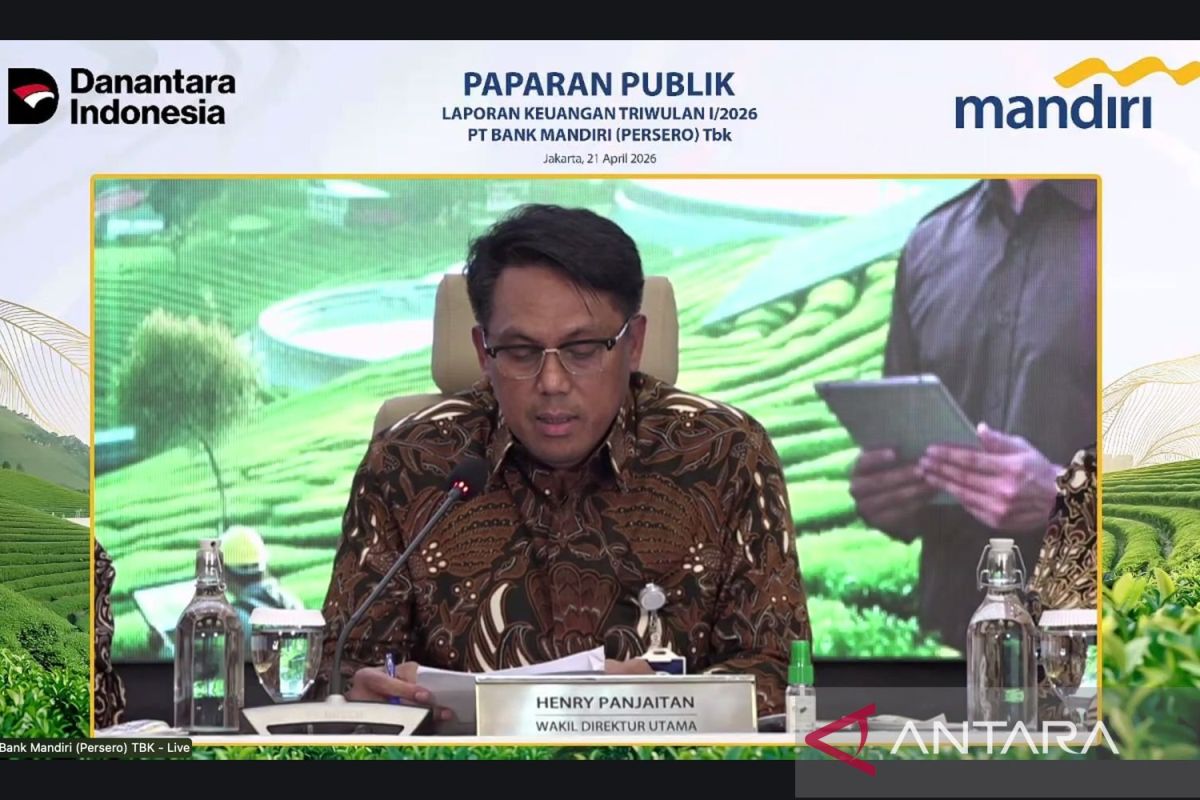
PT Bank Mandiri (Persero) Tbk has recorded an 8.8% year-on-year (yoy) growth in its sustainable financing portfolio, reaching Rp320 trillion as of March 2026.
Deputy Director Henry Panjaitan stated that this figure comprises green financing of Rp167 trillion, up 12.6% (yoy), and a social portfolio of Rp153 trillion, up 5.1% (yoy).
“Currently, Bank Mandiri continues to maintain its position as the market share leader in the green portfolio, reaching more than 35%, larger than the other three major national banks,” Henry said during an online press conference in Jakarta on Tuesday.
In this quarter, the company recorded new financing of Rp3.6 trillion in the green building sector and Rp5.2 trillion in the biological natural resources management (SDA) sector.
Bank Mandiri is also strengthening its funding side, as reflected in the full allocation of Phase II Green Bond funds amounting to Rp5 trillion, with 72% for biological natural resources management and 28% for environmentally friendly transportation.
This step aligns with the Financial Services Authority Regulation (POJK) that encourages the development of sustainable financial products.
When asked by reporters about the potential for Bank Mandiri’s sustainable financing this year, Henry said the company is optimistic that financing in this sector will grow around 7-9% (yoy), in line with the bank’s overall credit growth target.
“Amid the still dynamic domestic and global macro conditions, Bank Mandiri prioritises the principle of prudence in financing expansion. We maintain a balance between business growth and asset quality so that the expansion carried out remains healthy, measured, and able to provide added value to society and the national economy,” Henry explained.
He added that this optimism is supported by a solid pipeline, where 77% of the total pipeline is supported by sectors aligned with the national development agenda.
First, through financing for energy resilience projects that include environmentally friendly transportation, renewable energy development, and energy efficiency improvements.
Second, financing for eco-efficient products that support resource efficiency while strengthening the competitiveness of the manufacturing sector through more environmentally friendly production processes.
Third, inclusive housing financing with the FLPP programme as part of support for housing access for low-income communities.
Fourth, strengthening SME financing, including KUR and productive micro-financing, as part of efforts to expand financial inclusion and create broader economic impact.
To maintain the largest market share and Bank Mandiri’s position as the leader in green financing in Indonesia, Henry revealed that the company has a strategy focused on three main aspects.
These are strengthening pipeline quality, comprehensive customer ecosystem acquisition, and selective expansion in sectors with long-term growth prospects that align with national priorities.
Henry added that Bank Mandiri actively participates in various focus group discussions and roundtable discussions, as well as pilot projects with regulators, policymakers, and ministries.
The company’s involvement also includes strategic initiatives such as waste-to-energy, which provides opportunities for Bank Mandiri to continue exploring and developing new financing schemes in national priority sectors.
“With this approach, Bank Mandiri not only maintains market share but also strengthens its role as a strategic partner in supporting Indonesia’s transition to a low-carbon economy,” said Henry.
Source: jawawa.id (https://jawawa.id/newsitem/bank-mandiri-records-sustainable-financing-reaching-rp320-trillion-as-of-march-1776779454)
Originally published by Antara (Indonesian) (https://www.antaranews.com/berita/5536309/bank-mandiri-catat-pembiayaan-berkelanjutan-capai-rp320-t-per-maret), translated from Indonesian