
Bank Mandiri Projects Slower Economic Growth of Around 5.1-5.5 Percent in Q2 2026
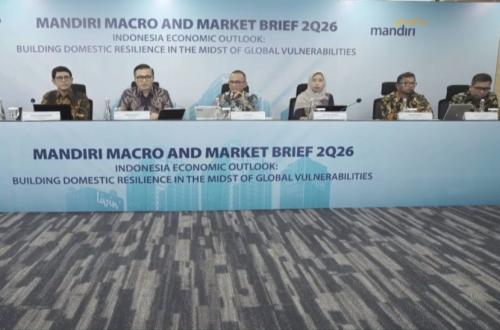
PT Bank Mandiri (Persero) Tbk projects that Indonesia’s economic growth in the second quarter of 2026 will moderate compared to the previous quarter. However, economic growth is expected to remain solid above 5 percent on an annual or year-on-year (yoy) basis.
“We see an opportunity for Indonesia’s economic growth to remain stable in the range of 5.1-5.5 percent in the second quarter of this year 2026,” said Head of Macroeconomic and Financial Market Research at Bank Mandiri, Dian Ayu Yustina, during the Mandiri Macro and Market Brief Q2 2026 press conference held online on Monday (11/5/2026).
It is known that the realisation of economic growth in the first quarter of 2026 reached 5.61 percent (yoy). Dian explained that in the first quarter of 2026, there were several factors that catalysed economic growth and will not recur in subsequent quarters. For example, the momentum of Ramadan and Eid al-Fitr which took place in mid-February to March 2026.
“This means growth in the second quarter may slow down,” she said.
Dian outlined projections for economic data in the second quarter of 2026 through to the end of 2026. She conveyed that amid the ongoing war sentiment in the Middle East, there are several risks facing the domestic economy.
The rupiah exchange rate against the US dollar has already depreciated by around 3.9 percent (year to date/ytd). Crude oil prices are also at around $82 per barrel, higher than the 2026 state budget macro assumption of $70 per barrel.
Inflation rates remain quite controlled. At the end of the first quarter of 2026, inflation was at 3.48 percent, and in April 2026 it reached 2.42 percent. However, Dian projects that inflation movements could increase due to factors such as rises in non-subsidised fuel (BBM) and LPG prices.
Adjustments to non-subsidised BBM and LPG prices are estimated to add around 0.15 percent to inflation. Combined with the El Nino factor, Bank Mandiri projects inflation could reach 3.5 percent (yoy) by the end of the year, breaching the target of 2.5 percent plus or minus 1 percent.
Furthermore, Dian explained the impact of the war in the Middle East amid the second term of US President Donald Trump on financial markets, which is worse than the first period in 2019. The US stock index is highly volatile, with US Treasury yields rising significantly compared to previous periods.
“This is ultimately reflected in the domestic financial markets. We see pressure in the financial markets from the stock market, bond market, and rupiah exchange rate sides. Indeed, the main driver of our markets is sentiment from the US and Iran,” she clarified.
“Last week the market sentiment was positive, but today it has turned negative again. So, with this high uncertainty, we certainly need to continue monitoring developments, especially related to sentiment in the Middle East, particularly flows in the Strait of Hormuz,” she added.