
Bank Mandiri Projects Rupiah at Rp17,135, Overshadowed by Middle East War
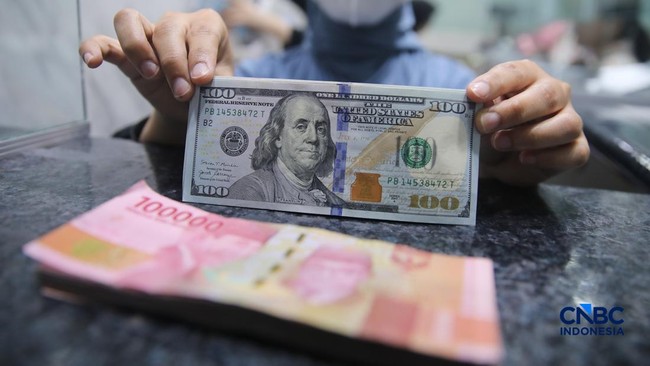
PT Bank Mandiri (Persero) Tbk. (BMRI) projects the rupiah exchange rate to be at the level of Rp17,135. The Office of Economist Group at Bank Mandiri assesses that the current pressure on the rupiah and Indonesia’s financial markets is more influenced by global factors, particularly geopolitical tensions between the United States and Iran.
As seen last week when the market was temporarily positive due to hopes of an improving US-Iran situation, but this week the sentiment has turned negative again. The closure of the Strait of Hormuz has become the main focus of the market, as any disruption could cause upheaval in oil prices.
Due to the high uncertainty, foreign investors have been withdrawing funds (capital outflow) from developing countries, including Indonesia. Funds exiting the Indonesian stock and bond markets are putting pressure on the rupiah.
Moreover, according to Diah Ayu Yustina, Head of Macroeconomics and Financial Market Research at Bank Mandiri, foreign capital flows have not fully returned to Indonesia since the pandemic because the world continues to be hit by various global and geopolitical risks.
“We see that the capital outflow from the stock and bond markets is quite significant on an annual basis. Since the pandemic, we have still experienced capital outflows and have not fully returned to the domestic market due to a series of events, especially related to global geopolitics, which continue to occur. This is indeed the main risk at the moment,” explained Diah during the Mandiri Macro and Market Brief 2Q26 in Jakarta on Monday (11/5/2026).
She then mentioned CDS (Credit Default Swap), an indicator of a country’s risk of defaulting on debt. If CDS rises, it means investors see the risk for developing countries as increasing. In early 2026, it rose temporarily, then fell again, but remains volatile because the market is not yet calm.
“It is still quite volatile because the global emerging market financial markets are indeed affected by the sentiment of the US-Iran war, as well as its impact on currencies,” said Diah.
The impact of the US-Iran war is not only felt in Indonesia but also on emerging market currencies globally. Many developing country currencies have weakened, but the movements are mixed.
Diah noted that the Singapore Dollar and Malaysian Ringgit have strengthened, while the Japanese Yen and Chinese Yuan have weakened.
She reiterated that global sentiment has a significant influence on Indonesia’s financial markets.
Nevertheless, Diah stated that Indonesia’s economic fundamentals remain relatively strong, as reflected in the country’s 5.6 per cent economic growth in the first quarter of 2026.