
Bank Indonesia Stays Awake 24 Hours to Safeguard the Rupiah, from New York to Hong Kong
Bank Indonesia has stated its full commitment to safeguarding the stability of the rupiah exchange rate. The effects of the war between Iran, the United States, and Israel have spilled over into the weakening of the rupiah against the US dollar.
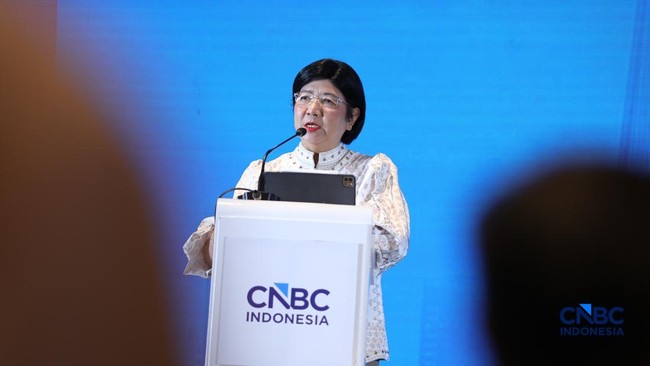
Senior Deputy Governor of Bank Indonesia, Destry Damayanti, delivered a firm message: “Bank Indonesia will continue to be in the market!” she said during her keynote speech at the Central Banking Forum 2026 in Jakarta on Monday (13/4/2026).
Destry stated that Indonesia’s central bank would be in the market 24 hours a day to maintain rupiah stability, especially when the world is not faring well.
“So Bank Indonesia is now open 24 hours, ladies and gentlemen,” Destry emphasised.
“So when it’s open in Singapore, within an hour or in Hong Kong we’re already open too. Then we close at 3, but Europe is still running. Then colleagues rest a bit, and at 8 or 9 in the morning, in America it’s around 8 or 9 at night for us, we open,” Destry explained.
Bank Indonesia will optimise its overseas representative offices to maintain rupiah stability through interventions to keep the exchange rate stable, thereby holding and even restoring investor confidence.
This is because a country’s exchange rate is one of the indicators for investors in the financial markets to assess a nation’s economic condition. Thus, through BI’s market interventions, it is hoped that the rupiah can be prevented from worsening amid a potentially slowing global economy.
“We will enter the spot market, we will enter DNDF—Domestic Non-Deliverable Forward—and we will also enter NDF. NDF is the offshore market, and we will also expand the base of participants for NDF abroad,” said Destry.
What is the state of the rupiah?
According to Refinitiv data, the Garuda currency closed trading on Monday (13/4/2026) in the red zone with a depreciation of 0.06% to Rp17,095/US.Althoughstillweakening, thispositionshowstherupiahholdingbelowthepsychologicallevelofRp17, 100/US.
Throughout trading, the rupiah once touched Rp17,135/US$, but the pressure gradually eased until it closed lower than that level.
The Garuda currency has experienced significant weakening since the Middle East war began, reflected in stable movements within the Rp16,950-17,100 range per US$. Nevertheless, Destry said that this weakening does not mean the rupiah is the world’s weakest currency.
In fact, weakening has also occurred in regional and global currencies in general. Even so, the rupiah is among those able to hold firm against the intense global shocks.
“So if we look at whether Indonesia is alone? No. Since the attack in Iran, several countries including Korea, Thailand, and the Philippines have experienced quite deep depreciations. We too have experienced a minus of 1.91%, and this is the year-to-date position since the beginning of the year,” said Destry.
At least there are two factors impacting the rupiah’s weakening against the greenback. The first is the outflow of capital from emerging markets, including Indonesia, to safer places.
“So it’s not just to Indonesia, but inflows to emerging markets have also decreased, and in Indonesia we are feeling it. Overall, we are still seeing outflows of around Rp21 trillion,” said Destry.
In addition, according to Destry, the factor of foreign capital outflows is the search for safe havens, one of which is the US. Including the involvement of the United States as the largest global financial hub in the military confrontation with Iran, which has also made the dollar index thrive.
“So that means players in the financial sector are trying to stay away from risk; they don’t want to take risks. This causes safe haven activity. So for safety, they seek markets that are relatively safe for them, and like it or not, the flows end up going to advanced economy countries,” she added.
“Including, we also see that in America itself, the DXY has continued to rise. So the dollar index and other major currencies have continued to strengthen.”
For information, the US dollar index (DXY) at 3:00 PM WIB was observed strengthening 0.26% to 98.906.
“So this means there is risk causing global uncertainty, the DXY rises, the 10-year yield also rises, capital flows decline, and various currencies strengthen.”
Therefore, BI’s market interventions in times of full uncertainty are important. Moreover, BI’s ammunition is solid, with foreign exchange reserves equivalent to six months of imports, far from the international adequacy standard for external buffers of three months of imports.
“In essence, the steps taken include interventions both globally through NDF and DNDF, and through the spot market,” said the Head of the Monetary and Securities Asset Management Department (DPMA) of Bank Indonesia, Erwin Gunawan Hutapea, at the same event.
Source: jawawa.id (https://jawawa.id/newsitem/bank-indonesia-stays-awake-24-hours-to-safeguard-the-rupiah-from-new-york-to-hong-kong-1776131457)
Originally published by CNBC Indonesia (https://www.cnbcindonesia.com/market/20260414072014-17-726483/bi-24-jam-tak-tidur-jaga-rupiah-dari-new-york-sampai-hong-kong), translated from Indonesian