
Bank Indonesia Projects Indonesian Economy to Grow Between 5.2–6 Per Cent in 2027
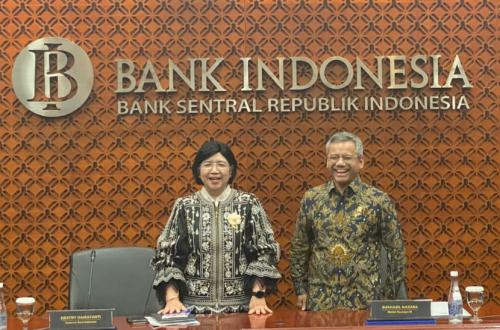
Bank Indonesia (BI) expects economic growth to experience an increase by 2027, potentially reaching 6 per cent. This projection is driven by the investment sector, which is set to be intensified by the Daya Anagata Nusantara Investment Management Agency (BPI Nusantara) next year.
“From Bank Indonesia, we estimate that the Indonesian economy will grow at a level of 4.9–5.7 per cent for the year 2026, and will increase to the level of 5.2–6 per cent in 2027, assuming, of course, that we hope for an increase in private investment, which also includes investment from Danantara,” said BI Governor Destry Damayanti during a Working Meeting with Commission XI at the DPR RI Complex, Jakarta, on Monday (28/9/2026).
Destry explained that BI predicts both global and domestic economic conditions will improve next year, after successfully navigating 2026, which tends to be characterised by ‘higher for longer’ trends.
“The economic outlook for 2026 globally is somewhat gloomy; however, an improvement is expected in 2027. Several international institutions, including ourselves, also see that 2027 globally will be better compared to the position in 2026,” she noted.
Regarding global economic challenges, Destry explained that several strategic global and domestic environments will shape BI’s future policy direction. These include geopolitical conflicts, which, when balanced with tight global monetary policies and a ‘flight to quality’, will affect Indonesia’s balance of payments performance, including exchange rate stability.
This condition is known as the ‘higher for longer’ phenomenon, which ultimately puts pressure on emerging markets, including Indonesia, particularly regarding capital flows.
Other challenges include the rise in global oil prices, which have once again breached the US$100 per barrel level, as well as high global inflation that is driving the tightening of global monetary policies.
Furthermore, the Federal Reserve’s interest rate policy continues to cast a shadow. The strengthening of the US dollar index resulting from such policies will, downstream, create capital flight from emerging markets to developed countries, particularly the US.
“From the domestic side, what we need to be wary of and which will form the basis of our future policy direction is the need to encourage the strengthening of new sources of economic growth, amidst the risks of inflation and exchange rates that we must remain vigilant about,” she said.
Consequently, BI is responding to these challenges through an adaptive and integrated policy mix, aligned with a monetary policy framework directed towards being more pro-stability. Other policies, namely macroprudential and payment systems, are directed towards further encouraging economic growth (pro-growth).