
Bank Indonesia prepares six initiatives to support Sharia economy as new growth engine
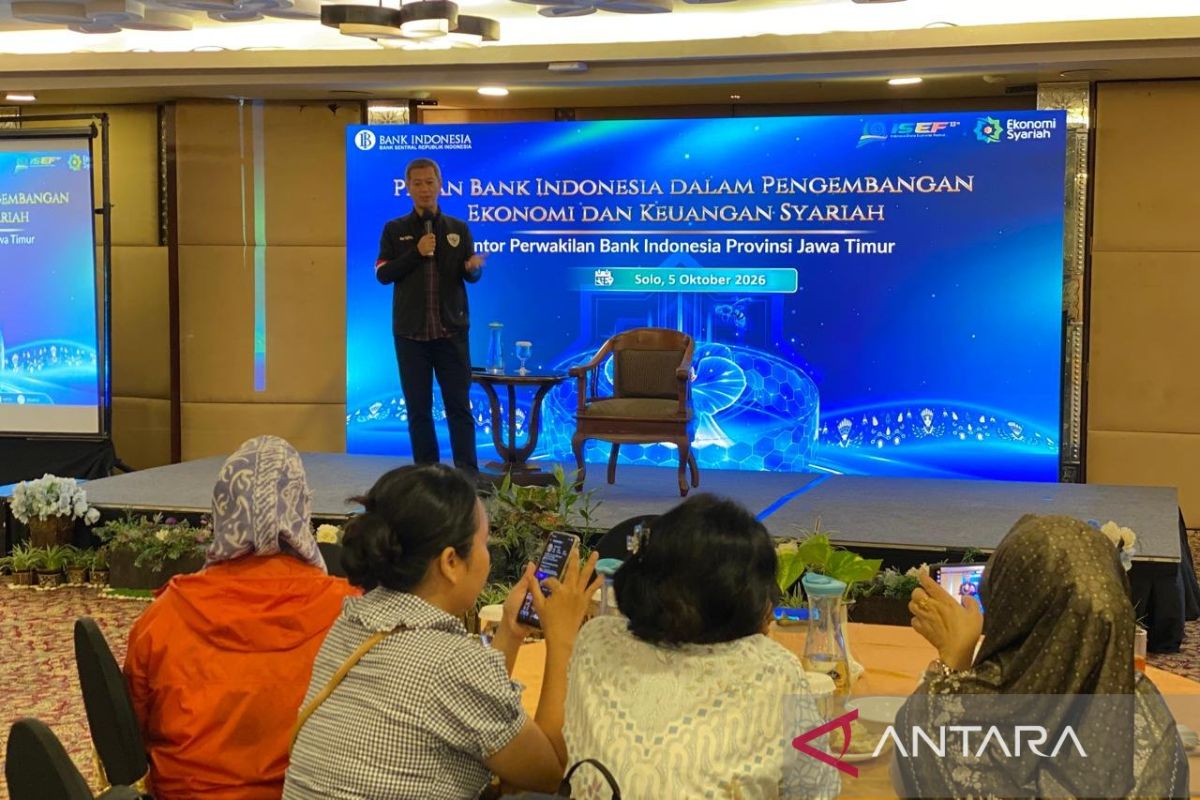
Surakarta, Central Java (ANTARA) - Bank Indonesia (BI) is preparing six strategic initiatives to strengthen the Islamic economic and financial ecosystem (eksyar) so that its vast market potential can be optimised as a new source of economic growth for Indonesia.
The Deputy Director of the Bank Indonesia East Java Representative Office, Yono Haryono, stated that Indonesia possesses strong capital to develop the Sharia economy, although several sectors still require strengthening to increase global competitiveness.
“Indonesia has strong capital in the development of the Sharia economy, but there are still several sectors that need to be strengthened so that our competitiveness increases and our contribution to the global Sharia economy becomes greater,” said Yono during a Capacity Building event themed ‘Sharia Economy Development’ in Surakarta, Central Java, on Wednesday.
According to him, this potential is reflected in Indonesia’s position, which ranks fourth in global Islamic economic development based on the State of the Global Islamic Economy (SGIE) Report.
Global Sharia economic consumption, Yono noted, reached approximately US$2.60 trillion in 2024, with Sharia financial assets at around US$9.72 trillion.
Meanwhile, Indonesia holds an advantage in the modest fashion sector, which ranks first globally, and halal food, which ranks fourth.
On the other hand, Yono mentioned that Indonesia still faces challenges in Muslim-friendly tourism, which dropped from second to sixth place, and halal pharma and cosmetics, which fell from second to fourth place.
To address these challenges, BI is developing six initiatives: Gerbang Santri, Jawara Ekspor, strengthening the halal ecosystem, Sapa Syariah, Kanal Ziswaf, and Lentera Emas.
Gerbang Santri is aimed at increasing the productivity and business management of Islamic boarding schools (pesantren) through digitalisation, including the development of drinking water industries and greenhouse projects based on the Internet of Things (IoT).
Jawara Ekspor aims to encourage Sharia-compliant businesses to strengthen their products and capacity to penetrate international markets.
Strengthening the halal ecosystem will be conducted through collaboration between the government, businesses, financial institutions, pesantren, and the community, in line with the mandatory halal certification requirement effective October 2026. Meanwhile, Sapa Syariah is designed to connect trading activities with access to Sharia financing.
BI is also developing Kanal Ziswaf to optimise zakat, infaq, alms, and waqf (Ziswaf) for economic empowerment and social protection, noting that the potential for cash waqf, based on calculations by the Indonesian Waqf Board, reaches approximately Rp180 trillion per year, while the accumulated realisation is only around Rp4 trillion.
Lastly, Lentera Emas focuses on strengthening literacy, inclusion, education, digitalisation, and human resource capacity. It is hoped that these six initiatives will be able to expand public participation while transforming the vast potential of the Sharia economy into productive and sustainable economic activity.
Source: jawawa.id (https://jawawa.id/newsitem/bank-indonesia-prepares-six-initiatives-to-support-sharia-economy-as-new-growth-engine-1791345595)
Originally published by Antara (Indonesian) (https://www.antaranews.com/berita/5774632/bi-siapkan-enam-inisiatif-dukung-eksyar-jadi-sumber-pertumbuhan-baru), translated from Indonesian