
Bank Indonesia introduces ITP with features to ease exploration for foreign tourists
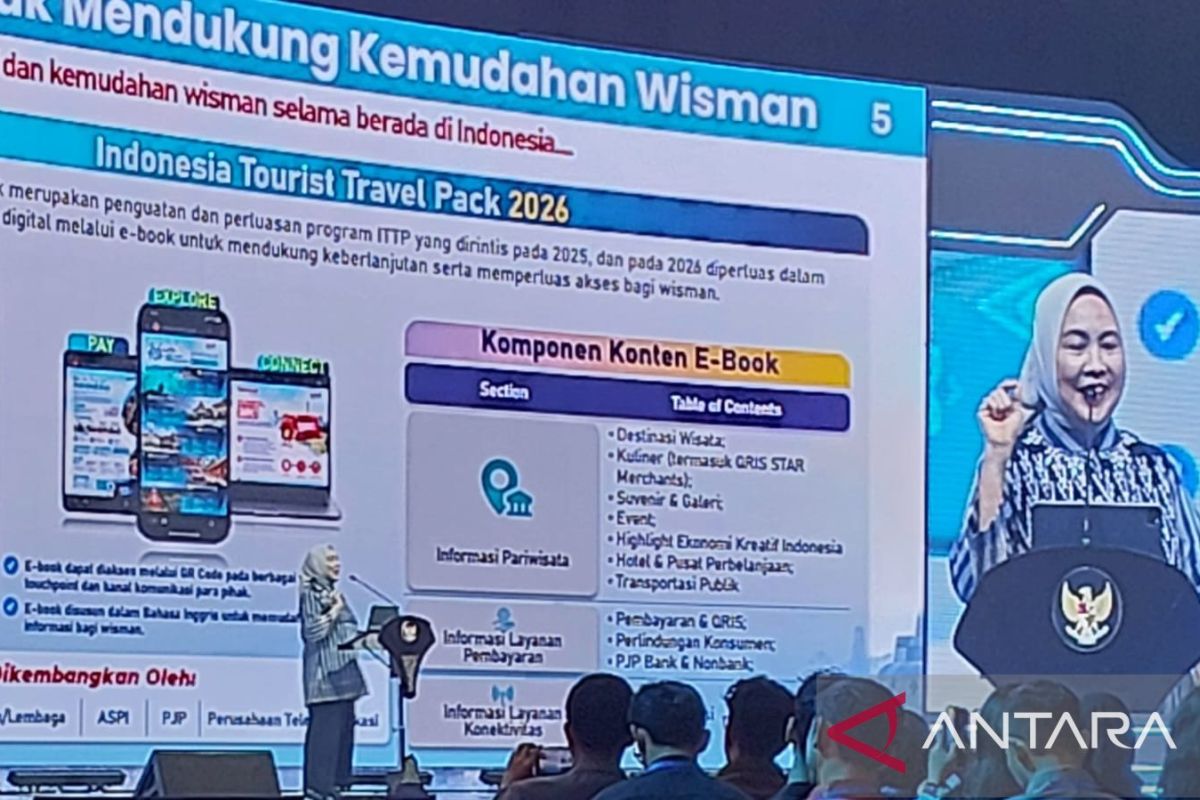
Jakarta (ANTARA) - Bank Indonesia (BI) has officially launched the Indonesia Travel Pack (ITP) 2026, featuring the latest tools to help foreign tourists more easily explore various destinations and discover information regarding diverse MSMEs during their stay in Indonesia.
Senior Deputy Governor of Bank Indonesia, Aida S. Budiman, stated that the ITP integrates several tourist needs, ranging from digital connectivity and destination information to payment services, ensuring that travellers can transact more easily when visiting various regions across Indonesia.
The launch, held during the Indonesia Digital Economic and Financial Festival (FEKDI) and the Indonesia Fintech Summit Expo (IFSE) 2026 in Jakarta on Saturday, introduced a key ITP feature: a digital e-book. This allows foreign tourists to scan intended tourist attractions even from their home countries before commencing their journey.
“The Indonesia Travel Pack, or ITP, will now feature a digital format, or e-book. It is simple; you just scan it and it works. Scanning does not even require the tourist to arrive in our country first. If they can view it from their home country, they can scan it immediately,” said A. Budiman.
Budiman noted that the information within the ITP will be regularly updated and sourced from official channels. Furthermore, access to these services will not be limited to a single location but will be expanded through various visitor touchpoints.
This ecosystem encompasses airports, telecommunications networks, tourist areas, and merchants within destinations. Budiman mentioned that several locations, such as TMII, Sarinah, and other tourist zones, will be part of this ecosystem.
Budiman explained that the ITP relies on three main features known as EPC: Explore, Payment, and Connect. The ‘Explore’ feature allows tourists to obtain information regarding destinations and MSMEs in various regions.
The ‘Payment’ feature provides access to payment services integrated within the ITP. Meanwhile, ‘Connect’ is supported by connectivity via SIM cards or e-SIMs, ensuring tourists remain connected throughout their travels.
“To achieve all of this, the Ministry of Communication and Digital (Komdigi) must ensure connectivity. Therefore, SIM cards or e-SIMs are provided to support digital connectivity,” she said.
Budiman stated that the development of the ITP is part of the effort to build a digital economic and financial ecosystem involving various players within the payment system.
Bank Indonesia will also continue to promote cross-border payment connectivity through the expansion of cross-border QR codes, the development of fast payments through regional connectivity, and the use of local currency transactions (LCT).
Budiman added that this payment connectivity is not only intended for retail and MSME transactions but is also directed towards supporting trade and investment.
Through these developments, Bank Indonesia aims for the payment system to provide services that are fast, easy, inexpensive, secure, and reliable, while simultaneously supporting Indonesia’s digital economic and financial transformation.