
Bank Indonesia Confident Rupiah Will Stabilise and Strengthen Soon Despite Breaching Rp 17,500 per US Dollar
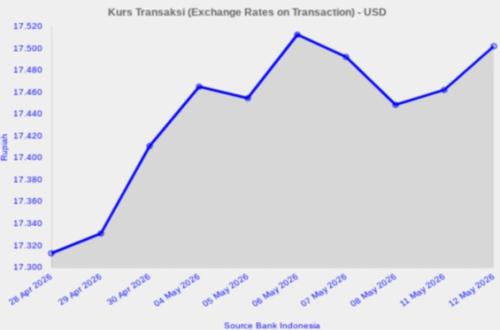
Bank Indonesia (BI) is confident that the rupiah exchange rate will soon move towards stability and even strengthen, amid the intervention efforts being rolled out. The central bank assesses that the fairly deep correction in the rupiah, which has now breached around Rp 17,500 per US dollar, will move in the short term.
Head of BI’s Communication Department, Ramdan Denny Prakoso, stated that the main sentiment affecting the rupiah’s weakening is global factors. In particular, the war in the Middle East, combined with pressure from US central bank interest rate policies.
“Since the end of February 2026, exchange rate movements in various countries have been heavily influenced by global dynamics, especially the Middle East conflict which has caused oil prices to rise by more than 40 percent,” said BI Communication Department Head Ramdan Denny Prakoso to reporters at the BI Complex in Jakarta on Wednesday (13/5/2026).
In addition, global dynamics are also influenced by the tendency for increasing interest rates in the US. Currently, the 10-year US Treasury is approaching 4.5 percent, up around 10 percent from its position at the end of February 2026 at 4 percent.
The ongoing strengthening of the US dollar index is also causing significant pressure on emerging market currencies. Not only the rupiah, but also the Philippine peso, Thai baht, Indian rupee, and Korean won.
As for domestic factors, the rupiah’s weakening is partly due to high demand for US dollars. This is occurring amid the dividend repatriation season, foreign debt payments (ULN), and needs for the Hajj season.
“BI is very aware of this situation, so BI continues to strengthen seven steps to stabilise the rupiah and make it tend to strengthen. We remain confident that with the steps taken, the rupiah will stabilise and tend to strengthen, because we believe Indonesia’s economic fundamentals are very good compared to other countries,” he explained.
Indonesia’s economic fundamentals are strong, including the economy’s growth rate in the first quarter at a fairly high 5.61 percent. In addition, the inflation rate tends to be stable at 3.48 percent, still within the target range of 2.5 percent plus or minus 1 percent.
“Therefore, BI will continue to be present in the market, both domestic and foreign markets. So, once the Jakarta market closes, we stand by in the European market, the US market, and others to maintain the rupiah exchange rate movement, which outside the country is influenced by NDF transactions, to remain stable,” he explained.
Denny emphasised that the seven steps instructed by Indonesian President Prabowo Subianto will be implemented to the maximum. Synergy with various stakeholders is also being strengthened to optimise those steps.
“BI continues to be in the market with seven strategic steps to stabilise the rupiah. Of course, we are confident that with synergy between BI and ministries/institutions, it will be able to make the rupiah stable and tend to strengthen, because there is no reason for the rupiah not to be stable,” he clarified.
Previously, it was known that the rupiah has indeed been experiencing a fairly deep weakening trend, amid high geopolitical and geo-economic uncertainty. BI Governor Perry Warjiyo, along with the Financial System Stability Committee (KSSK) team, met with Indonesian President Prabowo Subianto at the State Palace on Tuesday (5/5/2026) evening, discussing economic data, including the rupiah’s weakening.
Perry revealed that Prabowo gave him directions to take various steps to stabilise the rupiah exchange rate. There are at least seven things instructed to BI.
First, BI will continue to intervene, both in the domestic market through the spot market and DNDF, as well as in the offshore market through NDF. Interventions will include those in Hong Kong, Singapore, London, and New York. Foreign exchange reserves are claimed to be more than sufficient to stabilise the rupiah exchange rate.
Second, using SRBI instruments to attract foreign funds (capital inflow), as an effort to counter capital outflows from SBN, bonds, and stocks.
“Currently, SBN is experiencing outflows (capital outflow), and stocks, although there has been inflow in recent weeks, are still outflow year to date. So we agreed that for now, SRBI needs inflow to cover the outflow from SBN and stocks. That is to strengthen the rupiah exchange rate,” explained Perry in Jakarta on Tuesday (5/5/2026).
Third, BI will continue to purchase SBN from the secondary market. This is a step that BI has taken since the beginning of the year, as a result of coordination between fiscal and monetary authorities. According to Perry, year to date, up to now BI has purchased SBN from the secondary market amounting to Rp 123.1 trillion.
“Fourth, we, along with the Minister of Finance (Purbaya Yudhi Sadewa), are maintaining liquidity in banking and the market more than sufficiently, indicated by the double-digit growth in primary money,” he said.
Fifth, imposing restrictions on dollar purchases in the domestic market without underlying, reduced from 100,000 US dollars per person per month to 50,000 US dollars per person per month. This policy has been implemented by BI since April 2026. Perry stated that the nominal amount is planned to be reduced further.
“We are preparing to lower it again to 25,000 US dollars per person per month, so purchases of dollars above 25,000 US dollars must have underlying,” he said.