
Bank Indonesia: Agriculture as the Backbone of the Economy, Evidence of a Strengthening Food Sector
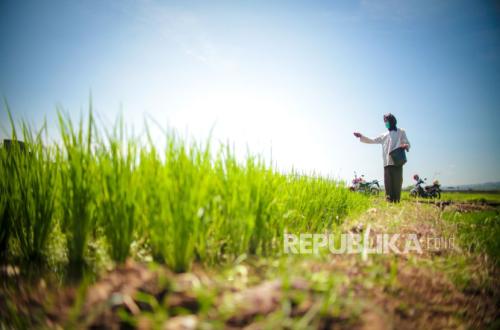
REPUBLIKA.CO.ID, JAKARTA – The strategic role of the agriculture sector as the backbone of national economic resilience has been reaffirmed in the results of the Business Activity Survey (SKDU) released by Bank Indonesia (BI). In the first quarter of 2026, business activity remained in positive territory with a Weighted Net Balance (SBT) of 10.11%, slightly down from 10.61% in the fourth quarter of 2025. Director of Bank Indonesia’s Communication Department, Anton Pitono, explained that the survey results indicate that business conditions remained stable at the start of the year. “The SKDU results indicate that business activity performance in the first quarter of 2026 is maintained,” he stated in an official remark quoted on Saturday (18/4/2026). The majority of business fields recorded positive performance, particularly the financial services sector, agriculture, forestry and fisheries, processing industry, as well as wholesale and retail trade. This stable business activity was driven by increased public demand during the period of national religious holidays such as Chinese New Year, Nyepi Holy Day, Ramadan, and Eid al-Fitr 1447 Hijriah, which coincided with the harvest season. From an operational perspective, the utilised production capacity in the first quarter of 2026 was recorded at 73.33%, an increase from 73.15% in the previous quarter. This increase was mainly supported by the agriculture, forestry and fisheries sector, as well as the processing industry. Business financial conditions were also assessed as remaining good, both in terms of liquidity and profitability, and supported by relatively easier access to financing. Entering the second quarter of 2026, business is expected to experience improved performance. BI projects the SBT to reach 14.80%, driven by the agriculture sector in line with the continuation of the harvest season for food commodities and plantation crops. “Respondents predict that business activity in the second quarter of 2026 will increase with an SBT of 14.80%,” said Anton. In response, Minister of Agriculture (Mentan) Andi Amran Sulaiman emphasised that this achievement is concrete evidence that the agriculture sector is increasingly strong and plays a role as the main foundation of the national economy. “Agriculture today is not just a buffer, but the main driver of the national economy. When other sectors face pressure, agriculture emerges as a solution and the main pillar,” said Minister Amran on Saturday (18/4/2026). The Minister added that the strengthening of the agriculture sector is inseparable from various strategic steps that have been implemented by the government, starting from accelerated planting, land optimisation, pompanisation, to improvements in irrigation and fertiliser distribution. “This is structured and sustainable work. We ensure production increases, farmers are protected, and food remains available. The results are now starting to show and are recognised by various parties,” he emphasised. Based on the value of agricultural exports (fresh and processed), there was an increase of Rp 166.71 trillion or growth of 28.26%, while imports fell by Rp 41.68 trillion or a correction of 9.66%. This performance shows that Indonesia’s agriculture sector is becoming increasingly competitive in the global market while able to reduce dependence on foreign products. Just a few moments ago, the Minister emphasised that this achievement is the result of a large integrated strategy from upstream to downstream. “This is not the work of one programme but a grand orchestration. Our production is up, exports are sharply increasing, imports are being curbed. This means our agricultural foundation is getting stronger and more independent,” said Minister Amran. Previous data also shows a trend of strengthening in the agriculture sector. Production of major commodities such as rice and corn has increased, and the government’s rice reserves (CBP) are in a very safe condition. The CBP is approaching 5 million tonnes, not just mere rhetoric; the agricultural export performance continues to show a positive trend in line with increasingly effective import controls. “Our reserves are at the highest level in history. This is not just about numbers, but about security for the Indonesian people. 4.8 million tonnes, by the end of April 5 million tonnes, this is already visible. We ensure sufficient stocks, stable prices, and farmers remain profitable,” stressed Minister Amran. Positive performance is also evident from the farmers’ welfare perspective. The Farmers’ Exchange Rate (NTP) reached 125.35, the highest in the last 34 years, indicating a significant increase in farmers’ purchasing power and income. The agriculture sector also recorded impressive economic growth. The agricultural sector’s GDP in 2025 grew by 5.74%, the highest in the last 25 years, making this sector one of the main pillars of national economic growth. The Ministry of Agriculture (Kementan) is optimistic that the agriculture sector will continue to be the engine of the national economy as well as the forefront in maintaining food security. “If agriculture is strong, the national economy will certainly be strong. This is what we continue to maintain and accelerate,” concluded Minister Amran.