
Bangladesh’s ousted dictator vows to return home
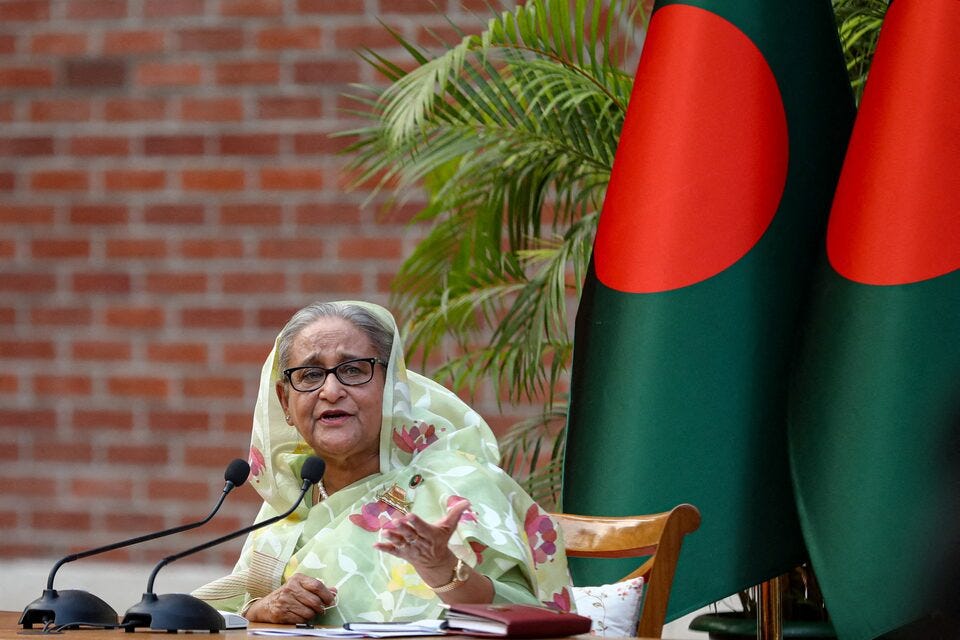
Bangladesh’s ousted dictator vows to return home
Dhaka government says if she does, she will be arrested
By: Nava Thakuria
In a much-anticipated press conference by ousted Bangladesh premier Sheikh Hasina in New Delhi that drove relations between the two countries to a new low, Hasina reiterated that she intends to return to Bangladesh in December but did not disclose a specific date or travel plan, avoiding spelling out a roadmap. Her son, Sajeeb Wazed Joy, joined the briefing from the United States and acknowledged India’s continued support for his mother since she left Dhaka two years earlier, following the student-led uprising that ended the Awami League government.
Dhaka expressed dismay over Hasina’s appearance, charging that New Delhi had allowed a convicted individual to address journalists. Bangladesh’s foreign ministry objected to what it described as an opportunity for Hasina and her allies to attack the state and people of Bangladesh. The ministry said the event was an affront to Bangladesh’s sovereignty and an insult to those killed during the July Revolution, while adding that Bangladesh still sought a constructive and forward-looking relationship with India based on sovereign equality, mutual respect, non-interference and national dignity.
Reactions from Bangladesh over the Hasina event were sharp and strong, with the country’s home minister, Salahuddin Ahmed, criticizing New Delhi for allowing Hasina to repeatedly address the media, including some global news agencies, from Indian soil. Reiterating Dhaka’s wish for friendly ties with New Delhi, the minister argued that Hasina’s presence in India has emerged as a source of discomfort in bilateral ties between the two countries. Earlier, a statement from the Bangladeshi foreign ministry said that Dhaka was outraged over an absconder’s open press briefing in New Delhi. It asserted that “convicted mass murderer Hasina and her mafia enterprise will never have a place in the polity of Bangladesh.”
It also raised questions about the timing, as on that particular date the people of Bangladesh observed the second anniversary of the Monsoon Revolution that deposed Hasina’s autocratic government. Dhaka said New Delhi had been informed in advance about the potential negative consequences of the Hasina event on bilateral relations, but its concerns were not taken into consideration, which it interpreted as an insult to the July-August martyrs. Insisting on a constructive, mutually beneficial and forward-looking relationship with India based on non-interference in each other’s internal affairs and respect for national dignity, the statement described the Delhi program as detrimental to bilateral ties. It also called for Hasina’s extradition to Bangladesh under the 2013 extradition treaty without delay. When Dhaka repeated its demand for Hasina’s repatriation, New Delhi responded that the matter remained under legal scrutiny.
New Delhi responded that the event had been organized by an independent press club made up of journalists from Indian and international media organizations, and that the Indian government neither organized the briefing nor endorsed the views expressed. A foreign ministry spokesperson said India had no role in the program and added that, even if Hasina had been granted shelter, she was not permitted to conduct political activity from Indian soil against another sovereign state. New Delhi is not expected to press Hasina to leave India unless it receives assurances from Dhaka that she would be treated in accordance with due legal process after her return.
New Delhi clarified that Hasina’s event was organized by an independent press club comprising journalist-members from national and international media organizations and that the Indian authorities do not endorse any views expressed during the press briefing. The Indian authorities had no role in the program, a foreign ministry spokesperson said, adding that even though Hasina has been granted asylum, she is not allowed to pursue political activities targeting another sovereign nation from Indian soil. It is understood that New Delhi would not insist that Hasina leave India unless it receives assurances from Dhaka that she would be treated in accordance with legal provisions upon her arrival in Bangladesh. However, New Delhi reiterated that it does not endorse the comments made by either Hasina or Joy, both of whom were highly critical of the current BNP government in Dhaka.
Hasina, 78, has lived in New Delhi in self-imposed exile since August 2024. In what was billed as her first public media interaction in two years, she repeated comments already reported, saying that “whatever fate awaits” her, she would return home. Recalling the struggles of her father, Bangabandhu Sheikh Mujibur Rahman, during the 1971 liberation war and the sacrifices of the Muktijoddhas, or freedom fighters, Hasina said fear for her life would not determine whether she returned. She said December was an appropriate month because Bangladesh marks Victory Day on 16 December, commemorating the 1971 surrender of Pakistani forces.
Referring to the July-August 2024 unrest, Hasina alleged that organized groups had infiltrated the job-quota reform movement and transformed it into a campaign demanding her resignation. She said what began as a peaceful protest turned violent, with demonstrators attacking public infrastructure and law-enforcement personnel. Hasina argued that the escalation forced her to leave Bangladesh but did not sever her connection with the people. She also claimed that the February national election was stage-managed because the Awami League was barred from participating, leaving citizens, in her words, under fear, repression and economic hardship.
The government led by Professor Muhammad Yunus took charge in August 2024, after Hasina fled shortly before a mob entered the prime minister’s residence. Eighteen months later, the caretaker administration sponsored a general election in