
Bangladesh Garment Workers’ Protest Turns Violent as They Demand 140% Pay Rise; Police Vehicle Set Ablaze
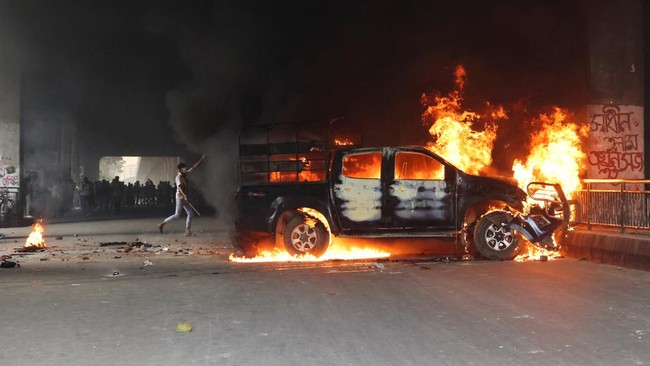
Thousands of garment workers in Bangladesh have taken to the streets in expanding protests marked by clashes with security forces. Workers blocked roads and set fire to a police vehicle as they urged the government to more than double the current monthly minimum wage.
The country, with a population of around 170 million, is the world’s second-largest clothing exporter after China. Its garment industry supplies major international brands and is one of the main pillars of Bangladesh’s economy.
AFP reported on Monday (2 November 2026) that hundreds of workers in Gazipur, north of the capital Dhaka, blocked the Dhaka–Tangail Highway. Several vehicles were damaged during the protest, while large crowds also gathered in Mirpur district.
Police dispersed demonstrators with tear gas. As the protests unfolded, some workers also set fire to a police vehicle.
The unrest came despite the government announcing the previous day that it planned to establish a wage board to review minimum pay in the garment sector. The industry employs millions of people and generates most of Bangladesh’s export earnings.
But labour leaders say establishing the board alone will not resolve workers’ problems. They have also highlighted soaring inflation and rising household costs.
Workers are demanding a monthly wage of 30,000 taka, or about US$241. That is more than double—an increase of 140%—their current earnings, which Kalpona Akter of the Bangladesh Center for Workers Solidarity puts at around 13,000 taka a month.
In Ashulia, an industrial suburb of Dhaka that is home to some of Bangladesh’s largest factories, police fired stun grenades and tear gas to disperse the crowds.
Rising prices for everyday necessities are among the main reasons workers have taken to the streets. Mamum, a 28-year-old factory worker, said the cost of food, cooking gas and electricity bills had continued to rise.
“Food prices, cooking gas and electricity bills are all going up. The government must lower the prices of essential goods or raise our wages,” he said.
Sharmin, a 24-year-old machine operator, also urged the government to listen to workers, who she said were sustaining the country’s economic activity.
“We are the ones keeping the economy moving. They must listen to us,” she said.
Home Affairs Minister Salahuddin Ahmed warned that the government would take firm action to stop the protests. He made the remarks after meeting industry leaders on Monday.
“Anyone involved in illegal activities and conspiracy under the guise of a labour movement will be dealt with an iron hand,” Ahmed said.
Ahmed had earlier said that Prime Minister Tarique Rahman had issued instructions to government officials after holding an emergency cabinet meeting on Sunday night. Rahman told the government to ensure workers’ rights were protected and their living standards improved.
The prime minister also instructed officials to ensure that production and exports continued without disruption.
Meanwhile, Bangladesh’s main association of garment and knitwear manufacturers warned of the potential long-term effects of the unrest. According to a report by the state news agency BSS on Monday, the association said continued instability could disrupt production, delay export shipments and affect Bangladesh’s commitments to international buyers.
Kamrul Hasan, secretary-general of the Ekota Garments Sramik Federation, told AFP that some labour leaders had gone into hiding as the situation became increasingly difficult to control.
“We were not prepared for this unrest either, because the wage board had been formed,” he said. “But now workers are protesting over wages and various other unresolved issues.”
Ashulia also saw running clashes between security personnel and demonstrators. Workers fled into narrow alleys to avoid the authorities, while tear gas spread into densely populated residential areas, where many families live in small rooms.
A 24-year-old resident, Kamona, said tear gas had even been fired into her housing compound.
“Police fired tear gas into our compound. We have children, but they do not care,” she said.
Industry representatives said workers at at least 529 factories in Dhaka and surrounding industrial areas had left their workplaces on Sunday. The areas include Savar, Ashulia, Jirani and Gazipur.
Source: jawawa.id (https://jawawa.id/newsitem/bangladesh-garment-workers-protest-turns-violent-as-they-demand-140-pay-rise-police-vehicle-set-ablaze-1793631076)
Originally published by CNBC Indonesia (https://www.cnbcindonesia.com/news/20261102173815-4-781655/demo-buruh-berujung-chaos-tuntut-gaji-naik-140-mobil-polisi-dibakar), translated from Indonesian