
Bang! The Fed Holds Interest Rates: Fierce! Largest Split Vote Since 1992
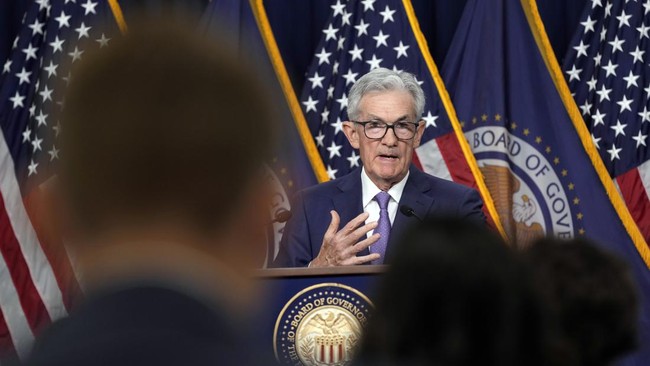
The US Federal Reserve (The Fed) has once again held its interest rate at 3.50-3.75%. This decision was taken amid significant divisions within The Fed.
The Fed announced the interest rate on Wednesday US time, or early Thursday Indonesian time (30/4/2026), following a two-day Federal Open Market Committee (FOMC) meeting.
As known, The Fed held the interest rate until August 2025 at 4.25-4.50% before cutting it in September, October, and December 2025 to 3.50-3.75%. From January to April 2026, The Fed maintained the benchmark interest rate.
The Fed Divided
Yesterday’s meeting was the last under Chair Jerome Powell. The meeting was marked by a wave of officials opposing the statement that further interest rate cuts remain possible.
FOMC member votes were split 8-4, with officials having different reasons for their choices. The number of dissenting votes is the highest since October 1992, or the last 34 years.
Governor Stephen Miran again voiced dissent to support a 25 basis point interest rate cut, as he has done since joining the central bank in September 2025.
The other three “no” votes came from regional Fed Presidents: Beth Hammack from Cleveland, Neel Kashkari from Minneapolis, and Lorie Logan from Dallas. They agreed to hold the interest rate but rejected the dovish bias in the official statement.
The main issue of disagreement was the following sentence:
“In considering the size and timing of any additional adjustments to the target range for the federal funds rate, the Committee will carefully assess incoming data, evolving outlooks, and the balance of risks.”
This phrase indicates that the next step is likely a rate cut, as the use of “additional” suggests that The Fed’s last action was a cut.
Hammack, Kashkari, Logan, and several other officials have warned of the dangers of persistent inflation. Higher prices usually mean higher interest rates as well.
In its official statement, The Fed wrote, “Inflation remains high, partly reflecting recent increases in global energy prices. Developments in the Middle East are also contributing to high uncertainty about economic prospects.”
This sentence is a change from the previous meeting, which described inflation as only “somewhat” high.
Over his eight-year tenure, Powell has generally maintained strong consensus within the committee, even as The Fed struggles to tame inflation and faces aggressive political pressure from the White House.
For the record, US inflation surged to 3.3% in March 2026, the highest level since May 2024. Inflation is feared to rise again in line with the surge in oil prices.
On the other hand, under The Fed’s dual mandate, concerns about the labour market are starting to ease. March nonfarm payrolls rose by 178,000, better than expected, while the unemployment rate fell to 4.3%. For April, ADP reported average weekly private payroll growth of around 40,000, indicating a still healthy but not overly strong labour market.
Earlier on the same day, the US Senate Banking Committee passed the nomination of Kevin Warsh as the next Fed Chair through a party-line vote. The full Senate is expected to approve, paving the way for the first leadership change since Powell took over in 2018.
In his press conference, Powell also congratulated Warsh on the progress of his appointment process.
He also signalled that he will remain on the Board of Governors for an undetermined time. He said he is still waiting for a thorough, transparent, and final investigation into the renovation of The Fed building.
Market Response
US stock markets, Wall Street, weakened in response to The Fed’s decision. The Dow Jones index fell 280.12 points or 0.57% to 48,861.81, marking five consecutive days of decline. The S&P 500 fell slightly by 0.04% to 7,135.95, while the Nasdaq Composite rose slightly by 0.04% to 24,673.24.
“In a tenure generally marked by consensus and few dissenting votes, Chair Powell ends his term with 4 dissents,” said Brent Schutte, CIO of Northwestern Mutual, quoted from CNBC International.
The large number of dissents indicates the possibility of similar divisions continuing when the new chair, who wants to change The Fed’s direction, takes over. This also reflects short-term economic prospect uncertainty due to conflicting labour market and growth signals amid inflation persisting above 3% since the end of 2023.
Jerome Powell’s tenure as Federal Reserve Chair ends on 15 May, but his separate term as a highly influential member of The Fed Board of Governors only ends in January 2028.