
Bandung Grand Mosque Must Become a Centre of Goodness and Strength for the Ummah
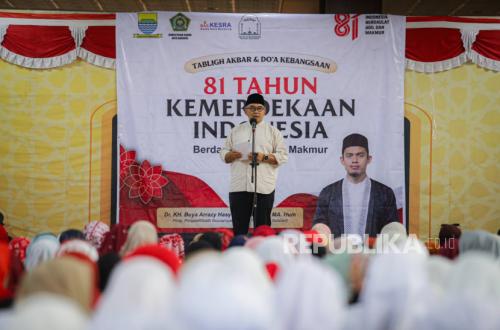
Bandung Mayor Muhammad Farhan has stated that the Grand Mosque of Bandung is not merely a historic building, but a legacy of the city’s founders and an asset of the Muslim community that plays an important role in the religious life of the people. Farhan made the remarks while attending a Tabligh Akbar combined with a Tasyakur Bini’mah to welcome the 81st anniversary of Indonesian independence at the Grand Mosque of Bandung on Saturday (15/8/2026).
The mosque, which has stood for nearly two centuries, is now fully endowed (wakaf). Its continuity and prosperity are therefore the responsibility of the community. ‘This mosque does not belong to the government but belongs 100 percent to the ummah. Its continuity must no longer depend on the government. This mosque must be sustained by the Muslims of the entire city of Bandung,’ Farhan said.
According to him, the government can still provide support in the form of stimulus and collaboration. However, the primary role in prospering the mosque must come from the community. Farhan explained that prospering a mosque is not always synonymous with financial matters. Public attendance, religious activities and various social programmes that benefit residents are also an important part of efforts to make the mosque thrive.
He revealed that the Bandung city government, together with Baznas, is exploring opportunities to raise public funds through Sharia capital market instruments. The idea was inspired by the financing management of Istiqlal Mosque. ‘We, together with Baznas, recently visited the Indonesia Stock Exchange to explore the possibility of carrying out an effort similar to what Istiqlal Mosque has done, namely raising public funds through the stock exchange so that Sharia financial investment products can be channelled to mosques that are already 100 percent wakaf,’ he said.
Farhan also noted positive developments in the religious activities regularly held at the Grand Mosque of Bandung. He said the number of worshippers attending continues to increase compared with previous events. In his view, this condition demonstrates the strength of religious life among the people of Bandung. ‘This means it is becoming increasingly clear that Bandung is one of the cities with very strong Islamic religious activities, and this must continue to be developed,’ he explained.
Farhan expressed hope that the Grand Mosque of Bandung will continue to serve as a gathering space for the public, not only for worship but also for spreading goodness in the midst of the city’s commercial, governmental, economic and social activities.