
Bandung City Government to Process Waste through 300 Tonne/Day TPSOS Facility
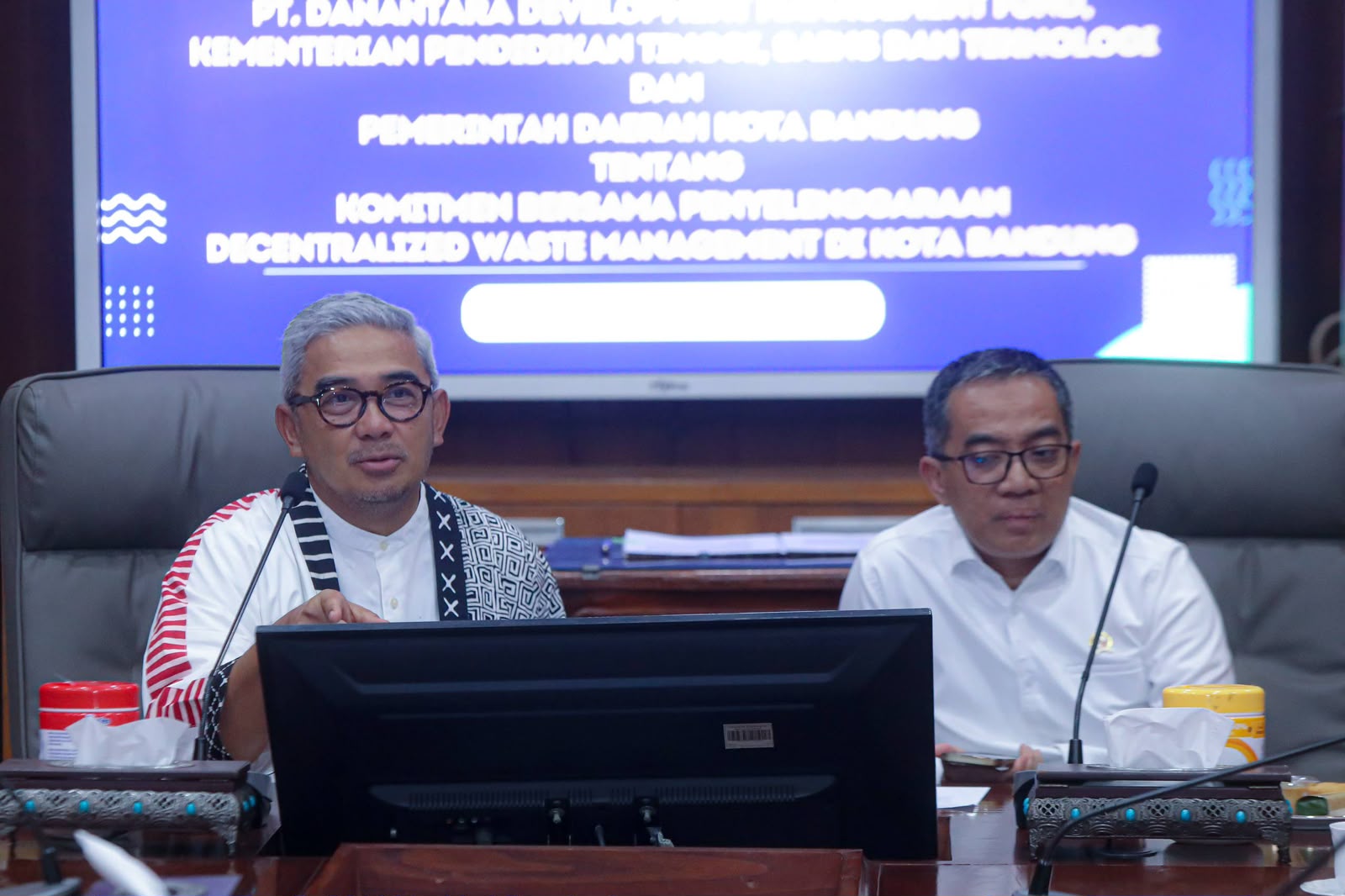
The Bandung city government, together with the Ministry of Higher Education, Science, and Technology (Kemdiktisaintek) and the Danantara Investment Management Agency (BPI), is preparing the development of a waste processing facility with a capacity of up to 300 tonnes per day at the Gedebage Organic and Circular Waste Processing Site (TPSOS).
The commitment was marked by the signing of a cooperation agreement between the Bandung city government, Danantara, and Kemdiktisaintek at Bandung City Hall on Friday (21/8). The development of the facility is a swift step taken by the Bandung city government to deliver a waste management solution using new technology.
“There has been a joint agreement, a joint commitment between the Bandung city government, PT Danantara Development Management Fund, and Kemdiktisaintek. In this case, we will build a waste processing facility using a new technology,” explained Bandung Mayor Muhammad Farhan.
According to Farhan, the facility will be built in the Gedebage area. The Bandung city government and related parties have previously conducted a site survey and assessed that the area is feasible for development as a waste processing facility with a capacity of up to 300 tonnes per day. This step is important because Bandung has so far still depended on final processing facilities managed by the West Java Provincial Government.
“Frankly, Bandung is the only provincial capital that does not have its own landfill. So we are very dependent on the landfills built by the province, both in Sarimukti and the one currently under construction in Legok Nangka,” he said.
Farhan added that the construction of Legok Nangka still requires time. Therefore, Bandung needs to move to prepare a waste management solution while waiting for that facility to become operational.
“The Governor has given us homework. While waiting three years for Legok Nangka to be completed, what can you do? Well, this is one of the breakthroughs we are making,” he stressed.
Farhan is targeting the construction and preparation of the facility to be accelerated so that it can begin operating by the end of 2026 or early 2027. Administrative aspects of government will also be prepared immediately, including the finalisation of the 2026 budget revision and the preparation of the 2027 General Budget Policy. He hopes that the development of the facility in Gedebage will become a concrete solution to strengthen Bandung’s waste management system while reducing dependence on landfills.
Chief Technology Officer of BPI Danantara, Sigit Puji Santosa, said that the technology being prepared embraces the concept of decentralised waste processing. Not all waste needs to be taken to a final disposal site, but can be handled in each respective area.
This is a solution called decentralisation. “It means it does not need to be taken to the landfill, the final disposal site, but we handle it in each respective region. This technology will process waste into Solid Recovered Fuel (SRF), a material with high calorific value that can be used as fuel for refineries, factories, and boilers.”
“The concept not only reduces waste accumulation but also produces a product that has economic value and can be utilised for industrial needs. The selected technology must also meet environmental and social aspects. One of them is by ensuring that the processing does not produce odours that disturb the surrounding community. We ensure that the technology we choose is contained and captured technology so that no odour disturbs the surrounding environment,” he explained.
From an investment perspective, Sigit said the value of building a facility with a capacity of 300 tonnes per day is still in the financial calculation stage. Based on the benchmarking process, the investment requirement is estimated to be in the range of Rp50 billion to Rp60 billion. The facility in Gedebage is the initial stage or pilot project. If successful, a similar concept can be developed in other locations, including in several sub-city areas in Bandung and other regions.
Meanwhile, the Minister of Higher Education, Science, and Technology, Prof. Brian Yuliarto, explained that the development of this technology is part of higher education’s support in accelerating the resolution of waste problems in various regions of Indonesia. Higher education institutions are conducting various studies to obtain technological approaches that can be applied according to regional needs. This is in line with the President’s directive for higher education institutions to conduct various studies to support the acceleration of waste resolution in various regions of Indonesia.
“The technology being developed processes both organic and non-organic waste through different approaches, including the use of maggots for organic waste and SRF for materials that can be processed into fuel. The study also enriches technologies that have been developed in a number of countries, including Turkey, to obtain technology deemed suitable for the needs of Bandung,” he said.
Brian said this initial stage is a pilot project. If it succeeds, his party hopes that each sub-city area can also be developed so that waste resolution in Bandung can hopefully be completed and will become a model for other regions.
Brian hopes that the collaboration between the Bandung city government, Kemdiktisaintek, Danantara, and higher education institutions can produce a waste management model that not only solves environmental problems but also has economic value and can be replicated in other regions.
The development of the waste processing facility at TPSOS Gedebage is expected to be the first step in building a more decentralised waste management system in Bandung, with an initial capacity of up to 300 tonnes of waste per day and an operational target of early 2027.
Source: jawawa.id (https://jawawa.id/newsitem/bandung-city-government-to-process-waste-through-300-tonne-day-tpsos-facility-1787914248)
Originally published by Media Indonesia (https://mediaindonesia.com/jabar/berita/927092/pemkot-bandung-olah-sampah-melalui-fasilitas-tpsos-berkapasitas-300-tonhari), translated from Indonesian