
Bandung City Government and Baznas Distribute Rp 2.03 Billion for NTT Earthquake Victims
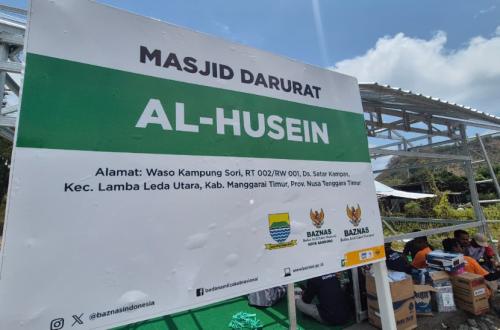
The Bandung City Government, through the Bandung City National Board of Zakat (Baznas), has distributed humanitarian aid worth approximately Rp 2.032 billion for communities affected by the earthquake in East Nusa Tenggara (NTT), specifically in the East Manggarai Regency.
This aid is the result of collections from various elements of the Bandung City community, including civil servants (ASN), Bandung residents, and Bank BJB. The assistance has been entrusted to the National Baznas (Baznas RI) to be managed and distributed based on the results of needs assessments in the affected areas.
The Chairman of Bandung City Baznas, Momon Ahmad Imron Sutting, stated that the aid is directed towards meeting the needs of earthquake-affected communities, particularly in supporting the post-disaster recovery process.
“The aid provided includes educational costs and facilities for school-aged children, the construction of mosques, the provision of temporary housing, and basic living necessities such as food packages,” Momon said on Thursday (1/10/2026).
According to Momon, while Bandung City Baznas handled the fund collection, the management and distribution process at the disaster site is carried out by the National Baznas. This scheme was implemented to ensure that aid can be tailored to the community’s needs based on field assessments.
“The implementation of aid distribution at the location is managed entirely by National Baznas. Today, we handed over and personally inspected the physical aid prepared by National Baznas,” he said.
Momon noted that the total funds entrusted to National Baznas reached approximately Rp 2.032 billion. The funds are allocated for several aid programmes and are not concentrated in a single point, although the majority of the distribution is taking place in Kampung Waso.
The details of the aid programme were presented by the Director of Distribution of National Baznas. Implementation is being carried out in stages, adjusting to the conditions and needs of the communities in the affected region.
“We hope the aid from the people of Bandung City will be beneficial, especially for the residents of East Manglarai Regency. Given that the needs there are still very high, we hope the concern of Bandung residents can continue,” he added.
Meanwhile, the Director of Distribution of National Baznas, Ahmad Fikri, stated that his organisation, alongside Bandung City Baznas, the Bandung City Government, and Bank BJB, is delivering several aid programmes to support the community as they enter the post-earthquake recovery period.
The aid includes emergency mosques, temporary housing, family logistics packages such as basic food supplies, and school supplies.
“This area is in great need, as many ruins and debris from buildings caused by the earthquake are clearly visible,” said Ahmad Fikri.
He explained that post-earthquake handling is currently entering the early recovery phase. During the previous emergency response phase, aid was focused on urgent needs such as health services, public kitchens, and sanitation facilities (MCK).
As the early recovery period begins, community needs are shifting towards rebuilding infrastructure for daily life. One such priority is the provision of temporary housing for residents whose homes were damaged by the earthquake.
Furthermore, damaged public facilities also require attention. National Baznas is also providing support for the provision of emergency classrooms for affected schools and emergency mosques to replace places of worship that were destroyed.
“The aid needed right now is temporary housing, emergency physical structures such as classrooms for destroyed schools, and emergency mosques for damaged places of worship so that the community can continue their activities as usual,” he said.
In addition to building emergency facilities, National Baznas continues to distribute family logistics packages. This aid remains essential as the community’s economic condition has not yet fully recovered following the disaster.
“Residents are still focused on rebuilding homes and meeting children’s schooling needs. Health services are also ongoing, considering residents are still living in emergency tents and their physical condition is quite disrupted,” said Ahmad Fikri.
He added that support for the earthquake-affected community does not end with the initial distribution of aid. National Baznas remains open to providing support and assistance throughout the recovery process.
This assistance is expected to be required for approximately six months to one year, depending on the development of the community’s condition and the post-disaster reconstruction process.
“We estimate that for the next six months to one year, we will still need to accompany them so they can recover and resume their activities as before,” he concluded.