
BAN-PT socialises latest university accreditation system in Mataram
Universities need to establish internal quality assurance systems that operate sustainably.
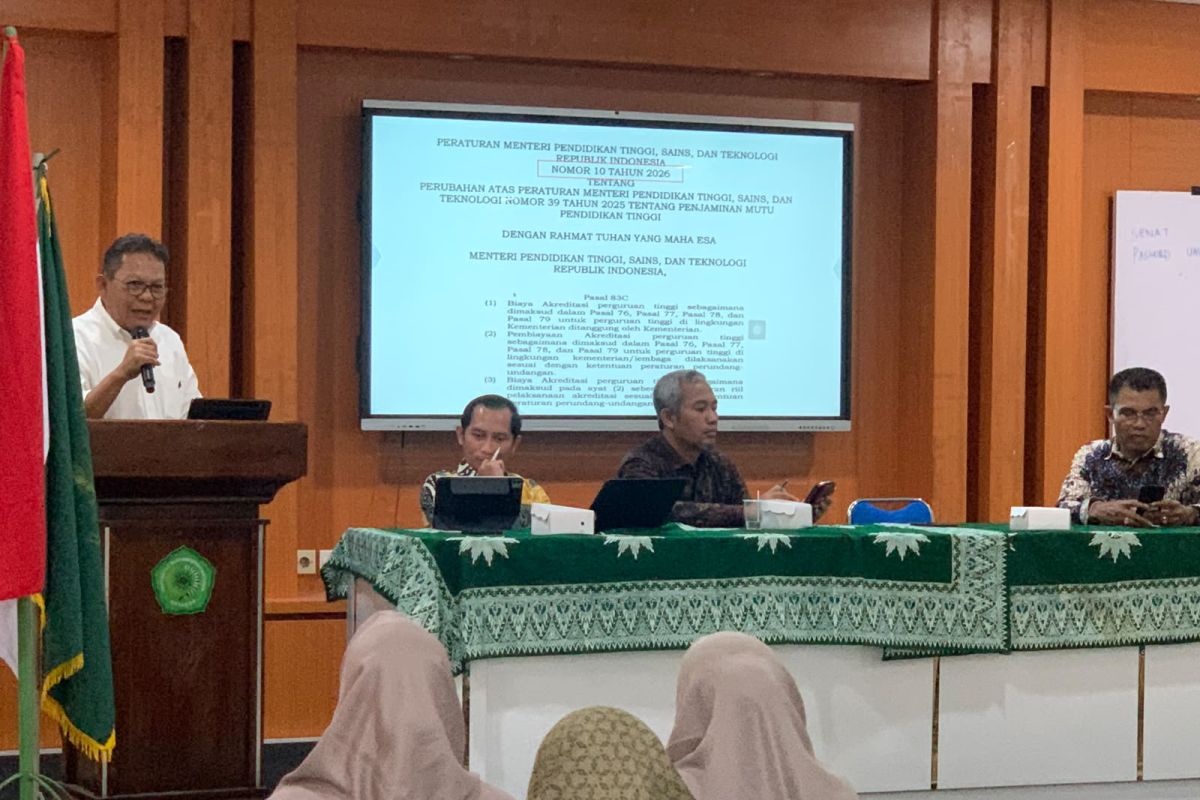
The Director of the Executive Board of the National Accreditation Board for Higher Education (BAN-PT), Prof. Dr. Ari Purbayanto, Ph.D., conducted a socialisation session regarding the accreditation system for universities and study programmes, in accordance with the latest regulations, at the Muhammadiyah University of Mataram (UMMAT) in West Nusa Tenggara (NTB).
The activity was held alongside the Higher Education Service Institution (LLDIKTI) Region VIII Bali and Nusa Tenggara as part of an effort to provide understanding to universities regarding changes in the quality assurance system and higher education accreditation.
In his presentation, Ari explained that the accreditation system is undergoing a transformation following the implementation of the Minister of Higher Education, Science, and Technology Regulation (Permendiktisaintek) Number 39 of 2025 concerning Higher Education Quality Assurance, which was subsequently updated through Permendiktisaintek Number 10 of 2026.
“Accreditation is no longer merely a fulfilment of administrative requirements, but tangible evidence of the nation’s competitiveness on the global stage,” Ari stated during his presentation on Friday.
He explained that the latest regulation establishes two primary accreditation statuses: Accredited and Excellently Accredently (Terakreditasi Unggul). The ‘Accredited’ status is granted to universities that meet the National Standards for Higher Education (SN Dikti), whereas ‘Excellently Accredited’ indicates that a university has exceeded those standards.
According to Ari, the change in the system also positions a culture of quality as a vital aspect of accreditation assessment. In addition to the culture of quality, the assessment criteria include the relevance of the ‘tridharma’ (the three pillars of higher education), accountability, and the differentiation of the university’s mission.
“Universities need to build internal quality assurance systems that run sustainably,” said the former Education and Culture Attaché of the Indonesian Embassy in Kuala Lumpur.
He emphasised that the higher education quality assurance system encompasses both internal and external quality assurance, which are interconnected. The implementation of this system is directed towards ensuring compliance with Higher Education Standards and producing high-quality, relevant, and impactful higher education.
Ari outlined several new provisions regarding accreditation obligations. Based on Permendiktisaintek Number 39 of 202lar, study programmes are required to hold a status of first accreditation, accredited, or excellently accredited to graduate students and issue diplomas.
Universities and study programmes that are not yet accredited or have not yet applied for accreditation are also required to submit applications in accordance with the new provisions no later than one year after the regulation was enacted.
During the socialisation, Ari explained the new accreditation instruments, namely IAPS 5.1 for study programmes and IAPT 4.1 for universities. These instruments contain criteria, indicators, assessment procedures, systems and assessment references, as well as guides for preparing self-evaluation documents and performance reports.
He introduced the implementation of SAPTO 2.0 in the accreditation application process. This new system integrates qualitative data within the accreditation instruments with valid data sources, provides features to track the application process, and reduces the need for re-entering data that is already available in the system.
“Universities must ensure that the data reported through PDDIKTI is accurate and up-to-date, as this data is a vital part of the accreditation process,” said Ari.
Through this socialisation, universities are expected to understand the regulatory changes while preparing their quality assurance systems, data, and accreditation documents in accordance with the applicable provisions.
Meanwhile, a speaker from LLDIKTI 8 Bali Nusra, Wayan Sudarma, stated that the accreditation process for UMMAT has been underway since 2024.
“We are designing the process to improve university quality so that in the NTB region, we can promote excellence, ensuring that superior projects are established in NTB to enhance all activities for universities within the region,” he said.
His office hopes that by this year, there will already be universities in NTB that have achieved ‘Excellently Accredited’ status.