
Bamsoet Urges Inmates to be Equipped with Skills Before Release
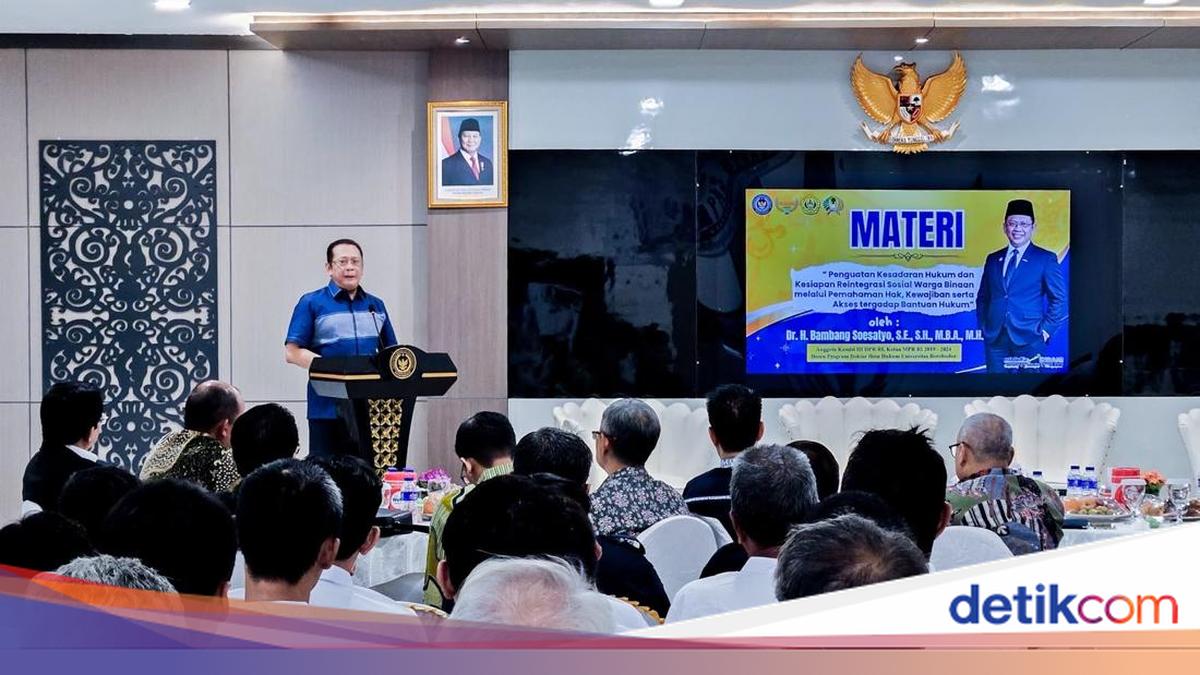
Bambang Soesatyo (Bamsoet), a member of the Indonesian House of Representatives (DPR RI) from the Golkar Party, Chairman of the MPR RI, and postgraduate lecturer, has asserted that the correctional system must be positioned as a vital part of the law enforcement process oriented towards behavioural change, recovery, and social reintegration. Inmates remain legal subjects possessing dignity, rights, and obligations; therefore, their period of imprisonment should be utilised to improve themselves and prepare for life upon returning to society.
This aligns with Law Number 22 of 2022 concerning Corrections, which positions the correctional system as a subsystem of the criminal justice system performing functions of service, development, community guidance, care, security, and observation.
“Imprisonment does limit an individual’s freedom, but it must not strip away their human dignity. The principle of a state based on law requires that every person be treated humanely. Therefore, prisons must serve as places for development, education, character building, skill enhancement, and preparation for a better life after release,” Bamsoet stated in a briefing on Friday (18/9/2026).
He explained that inmates possess several rights strictly guaranteed under Law Number 22 of 2022. According to Article 9, prisoners have the right to practice their religion, receive physical and spiritual care, access education and instruction, receive healthcare and adequate food, obtain information, receive legal counsel and assistance, and submit complaints through available mechanisms.
These rights must be understood alongside the obligation to obey regulations and participate in development programmes.
“Rights and obligations are two sides of the same coin in legal life. Inmates need to understand their rights, but at the same time, they must understand their obligations. Adhering to regulations, participating in development, maintaining security and order, respecting others, and exercising self-control are all part of the training before returning to live within the community,” said Bamsoet.
Bamsoet noted that Article 2 of Law Number 22 of 2022 clearly directs the implementation of corrections towards the protection of rights, the improvement of the quality of personality and independence of inmates, and preparation for social reintegration.
This means the measure of success for the correctional system should be judged by how far the development process can help an individual realise their mistakes, improve their behaviour, acquire skills, and avoid reoffending. Prisons should be viewed as development centres with a future-oriented focus.
“The question every inmate needs to answer is not merely how much prison time remains, but what has been prepared for life after release. What skills have been acquired, what habits have been corrected, what work will be undertaken, and how to rebuild relationships with family and society,” Bamser explained.
He reminded that the greatest challenges often arise after inmates leave prison. Social stigma, difficulty finding employment, fractured family relationships, and the possibility of returning to old environments can serve as serious barriers to social reintegration.
Therefore, preparation for release must encompass mental, social, economic, familial, and skill-based aspects, as well as legal compliance. The Correctional Centre (Bapas) also plays a vital role in the process of guidance, assistance, and supervision of correctional clients.
“Freedom must be prepared long before someone leaves prison. We must ensure that when the prison gates open, the person exiting is not merely someone who has finished their sentence, but someone who lacks a life plan. What must emerge is an individual possessing new awareness, new skills, new responsities, and a clear life plan,” said Bamsoet.
Bamsoet added that the success of social reintegration cannot be placed solely on the shoulders of the inmates. Families play a crucial role in rebuilding communication, trust, and responsibility.
Society must also provide space for former inmates who have undergone the legal and developmental process to prove their change through productive behaviour. Opportunities for work and entrepreneurship are essential factors in ensuring they have legal means of livelihood and do not return to environments that encourage criminal activity.
“Stigma cannot be fought with anger or violence. Trust must be built bit by bit through honesty, hard work, discipline, and consistency. On the other hand, families and society must also provide opportunities. Social reintegration is a shared responsibility,” concluded Bamsoet.