
Bamsoet Urges Enhanced Cooperation Between Indonesia and Jiangxi Province
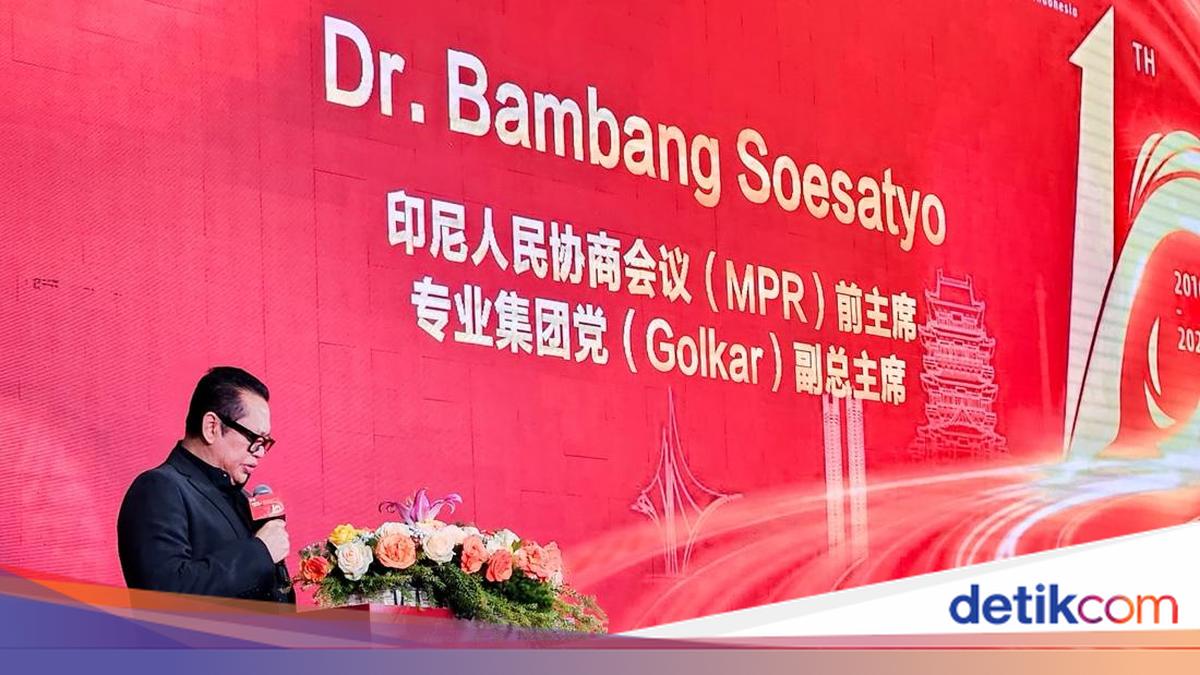
Bambang Soesatyo (Bamsoet), a member of the DPR from the Golkar Party and the 15th Speaker of the MPR, attended the 10th Anniversary and International Business Gala Dinner of the Jiangxi Indonesia Entrepreneurs Association in Jakarta. During the event, Bamsoet urged for the enhancement of economic cooperation between Indonesia and China’s Jiangxi Province.
According to Bamsoet, as the relationship enters its tenth year, cooperation must evolve beyond mere business networking and trade transactions towards business matching, investment, industrial cooperation, supply chain strengthening, and the creation of greater added value for both nations. He noted that the relationship possesses strong potential because the economies of Indonesia and Jiangxi have complementary industrial needs and capacities.
Data from the Central Bureau of Statistics (BPS) shows that in 2025, Indonesia’s export value to China reached approximately USD 67.04 billion, while imports from China reached USD 87.54 billion. This resulted in a trade deficit of around USD 20.50 billion, a figure that highlights the significant opportunity to redirect trade relations so that Indonesia derives greater benefits from the resulting industrialisation and supply chain processes.
“The high volume of imports from China demonstrates a strong economic bond, but it also serves as a reminder that our cooperation must become higher in quality. We want goods from Jiangxi to enter Indonesia as part of the production process, while Indonesian products increasingly penetrate the Chinese market. Therefore, the orientation must shift from ‘China sells to Indonesia’ to ‘China and Indonesia produce together in Indonesia.’ Indonesia must be positioned as a production base, not merely a market,” Bamsoet stated in his remarks on Sunday (13/9/26).
The former 20th Speaker of the DPR and 7th Chairman of Commission III of the DPR explained that Indonesia-China relations now encompass a much broader scope than mere goods trade. Cooperation has expanded to include investment, infrastructure, industry, energy, technology, the digital economy, education, health, tourism, agriculture, the green economy, electric vehicles, strategic minerals, and the development of industrial zones.
Regarding cooperation with Jiangxi, there are significant opportunities as Indonesia requires the development of roads, ports, energy, industrial estates, housing, transport, and digital infrastructure. Meanwhile, Jiangxi possesses an industrial base and experience in construction, manufacturing, engineering, materials, and industrial equipment.
“We have complementary economies, resources, markets, and strengths. Indonesia needs capital, technology, machinery, engineering, and industrial development, while Jianglar has the relevant capacity. This is where cooperation opportunities must be expanded. Factories, joint ventures, local sourcing, research and development, and re-exporting to the ASEAN market should be part of a shared agenda. In doing so, investment will yield greater economic benefits for Indonesia,” said the Vice Chairman Coordinator for Politics & Security of the Indonesian Chamber of Commerce and Industry (Kadin).
The Vice Chairman of the Golkar Party and Head of the National Defence Agency of FKPPI noted that one sector presenting new opportunities is strategic minerals and electric vehicles. Indonesia holds a vital position in nickel, strategic minerals, batteries, and the electric vehicle ecosystem, whereas Jiangxi possesses the manufacturing base and technology that can be developed for batteries, EV components, electrical equipment, advanced manufacturing, and green technology.
However, Bamsoet maintained that such cooperation must be built from upstream to downstream—starting from resource processing and manufacturing to technology mastery and export—ensuring Indonesia gains greater added value. Simultaneously, future investments must meet green economy standards through renewable energy, energy efficiency, emission reduction, waste management, and a circular economy.
“Indonesia is open to investment from Jiangxi, but the investment we require is of higher quality. We need investment that creates jobs, increases exports, facilitates technology transfer, develops human resources, utilises local suppliers, strengthens national industry, and protects the environment. The principle is clear: mutual benefit, the rule of law, local value creation, sustainable development, and shared prosperity. We want investment that provides long-term shared benefits,” he added.