
Bamsoet Discusses Legal Certainty of Employment Status for Online Transport Drivers
The development of the digital economy over the past decade has created millions of new jobs but has not been accompanied by adequate legal certainty for online transport drivers, who until now have been placed within a partnership scheme.
Against the backdrop of growing public reliance on online transport services, drivers’ employment status, income protection, and social security remain uncertain.
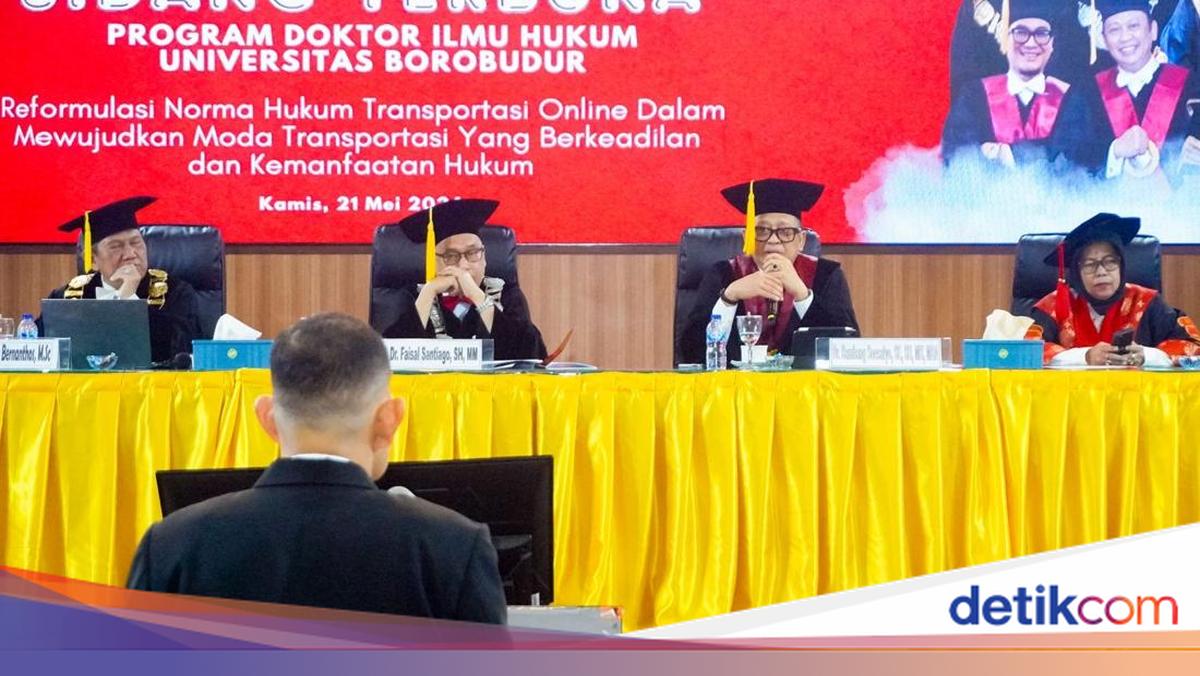
This was stated by Bamsoet when he served as an examiner at the open viva voce examination for the Doctor of Law programme at Borobudur University, Police Commissioner M. Adi Putra, with a dissertation titled ‘Reformulation of the Legal Norms of Online Transportation in Realising a Just and Beneficial Mode of Transport’, at the Borobudur University Campus in Jakarta, today.
Joining examiners were other officials such as the Rector of Borobudur University, Prof. Bambang Bernanthos; the Director of Postgraduate Studies, Prof. Faisal Santiago; Prof. Henny Nuraeny; Promoter Prof. Suparji Ahmad; and Co-Promoter Dr. Ahmad Redi.
On the other hand, the financial performance of online transport platform companies has continued to improve. In 2025, PT GoTo Gojek Tokopedia Tbk (GOTO) posted net revenue of Rp 18.32 trillion, up 15.27 percent. Meanwhile, consolidated financial statements of Grab Holdings Limited show that net revenue for PT Grab Teknologi Indonesia reached around US$268 million, or about Rp 3.36 trillion, Bamsoet said in a statement, Thursday (21 May 2026).
He explained that these data show online transport has grown into a high-value sector with the ability to generate significant revenue through a multi-sided platform business model that connects millions of driver partners, consumers, and micro, small and medium-sized enterprise (MSME) merchants.
It is time for Indonesia to have specific regulations governing online transport work in a clearer and fairer manner. When app companies can record revenue growth and expanding business value year after year, it is only right that the welfare and certainty of drivers’ status should also become a priority,” Bamsoet said.
Bamsoet explained that, up to now, the relationship between app companies and drivers has been built through partnership agreements. Legally, the model positions drivers as independent partners, so the companies do not bear full obligations such as minimum wage, protection against dismissal, pension guarantees, leave, or general social protection customary for workers.
Yet in practice, drivers are highly dependent on the app system, order assignment algorithms, incentive mechanisms, and suspension policies wholly determined by the app. This situation creates an imbalance in bargaining power that becomes more evident when incomes fall or unilateral policy changes occur.
When someone works daily, meets targets, follows operational rules, accepts system evaluations, and even their earnings are determined by the app, a big question arises: is that relationship still purely a partnership or is it approaching an employment relationship? This question must be answered through regulation, not left to develop without certainty,” Bamsoet said.
Bamsoet noted that Indonesia can learn from various countries that have taken advanced steps to protect online transport drivers. In the United Kingdom, the Supreme Court in 2021 ruled that Uber drivers are entitled to worker status with rights to minimum wage and paid holiday.
In Spain, the government has implemented the Riders Law requiring platforms to recruit drivers and couriers as employees. The Netherlands, through a court ruling, recognises online transport drivers as workers entitled to wages, allowances, and employment protection, he said.
Chile since 2022 has developed a two-category worker model for online transportation workers, while New Zealand also moves toward worker recognition for online transport drivers. Neighboring countries such as Singapore and Malaysia are moving through approaches to social protection and welfare standards for online transport drivers.
Experience in several countries shows that the digital economy need not conflict with labour protection. United Kingdom, Spain, the Netherlands, Chile, New Zealand, Singapore, and Malaysia demonstrate that a nation can safeguard innovation while ensuring online transport workers obtain decent basic rights. Indonesia needs to study the best model suited to national conditions,” Bamsoet said.
Bamsoet regards the government’s issuance of Presidential Regulation Number 27 of 2026 on the Protection of Online Transport Workers as a significant advance in improving the balance of relations between platform operators and drivers. The regulation cuts the application cut from around 20 percent to a maximum of 8 percent.
However, Bamsoet cautioned that improvements to the revenue-sharing scheme do not solve the fundamental problem of employment status. He said that as long as drivers are positioned solely as partners without comprehensive protection instruments, the risks of income uncertainty, algorithm changes, unilateral suspensions, and limited access to worker protection will continue.
Presidential Regulation 27 of 2026 is a forward step and deserves praise as it signals the state’s commitment to drivers’ welfare. But the next tasks include building a more comprehensive legal framework for online-based work,” he said.
Among them is opening space for discussion on the possibility of online transport drivers in Indonesia obtaining worker status with clear rights and obligations,” Bamsoet concluded. (prf/ega)