
Bali to Secretly Develop Battery-Powered Tram by 2028, Here is the Route
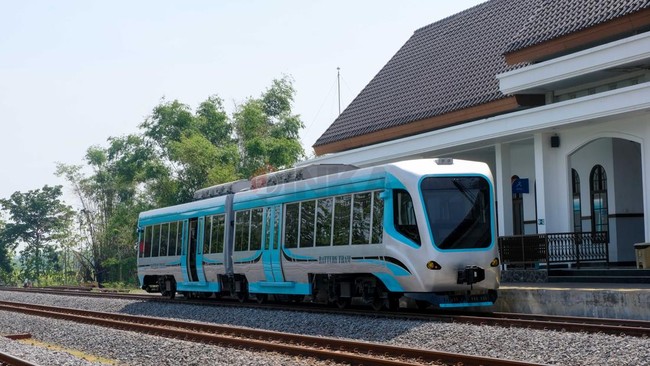
The Bali Provincial Government, together with the Badung Regency Government and PT Kereta Api Indonesia (Persero) or KAI, is following up on the development of railway transportation in Bali through a plan to build a battery-based electric tram connecting I Gusti Ngurah Rai International Airport with the Canggu area in Badung Regency.
The tram mode was chosen as a transportation concept deemed most suitable for Bali’s characteristics. Unlike MRT or LRT, the designed tram will use battery technology, meaning it will not require overhead electric cables along the tracks.
The initial route prepared has a length of approximately 12 km, covering the International Airport-Canggu corridor. The track is designed using two lanes with crossing areas to support smooth operations. In terms of size, the tram is designed to be relatively small, with a track width of about three metres, while the tram dimensions are slightly above two metres, making it smaller than a bus.
The development of the tram is projected to be one of the solutions to overcome traffic congestion in the Badung area, particularly the Airport-Canggu corridor, which has a very high mobility rate. It is estimated that around 150,000 people move through the area daily, with vehicle numbers reaching approximately 80,000 units.
This condition is one of the main considerations for the need for a new mass transportation mode capable of reducing public dependence on private vehicles while simultaneously increasing inter-regional connectivity. The tram is targeted to support the mobility of residents and tourists, reduce vehicle density, and strengthen the connectivity of tourism areas.
At maximum capacity, the tram is projected to be able to transport approximately 15,000 to 20,000 passengers, with a travel time of about 30 minutes. The departure interval between trams is designed to be around 10 minutes. If operating at full capacity, the transport capacity is projected to reach approximately 60,000 passengers per day. This figure is expected to accommodate about 40% of the mobility density on the Airport-Canggu corridor.
Governor of Bali, Wayan Koster, stated that this cooperation is a follow-up to proposals from the Ministry of National Development Planning/Bappenas and the Bali Provincial Government to improve transportation facilities and systems in Bali, particularly in the Badung Regency, which faces traffic congestion issues. According to Koster, the tram concept is now becoming more concrete as an alternative to address congestion on the Airport-Canggu route.
However, the development of this transportation must continue to respect Bali’s characteristics. The infrastructure built must not sacrifice beauty, the environment, or the lives of the community.
“Transportation development must continue to consider the uniqueness of Bali, maintain Bali’s beauty, support tourism, and not disturb the lives of the community,” said Koster, as quoted from the Bali Provincial Government website.
He emphasised that the tram construction must take into account the presence of hotels, tourist accommodation, tourist attractions, the environment, residential areas, and the lives of the people located along the route. The comfort of tourists is also a key focus in the development of this transportation mode.
“The comfort of tourists must be maintained. The presence of the tram is actually expected to become a new attraction for Balinese tourism,” Koster added.
Based on the initial plan, the groundbreaking for the tram construction is targeted for March 2027. The first route is targeted to begin operations in 2028, while the entire line up to Canggu is targeted for completion and operation by 2029.
Involving Traditional Villages and Tourism Stakeholders
The government will also involve traditional villages (desa adat) and various stakeholders located along the development corridor. Tourism players, hotels, and tourist accommodation providers will also be involved in the development process.
This involvement is considered essential so that the tram development is not only oriented towards infrastructure but also considers the social, economic, and environmental conditions, as well as the needs of the community.
The tram concept itself is designed with several characteristics, including being environmentally friendly, using battery technology, having low noise levels, being relatively small in size, and being able to integrate with other transportation systems.