
Bali requests increased central government support for strategic infrastructure
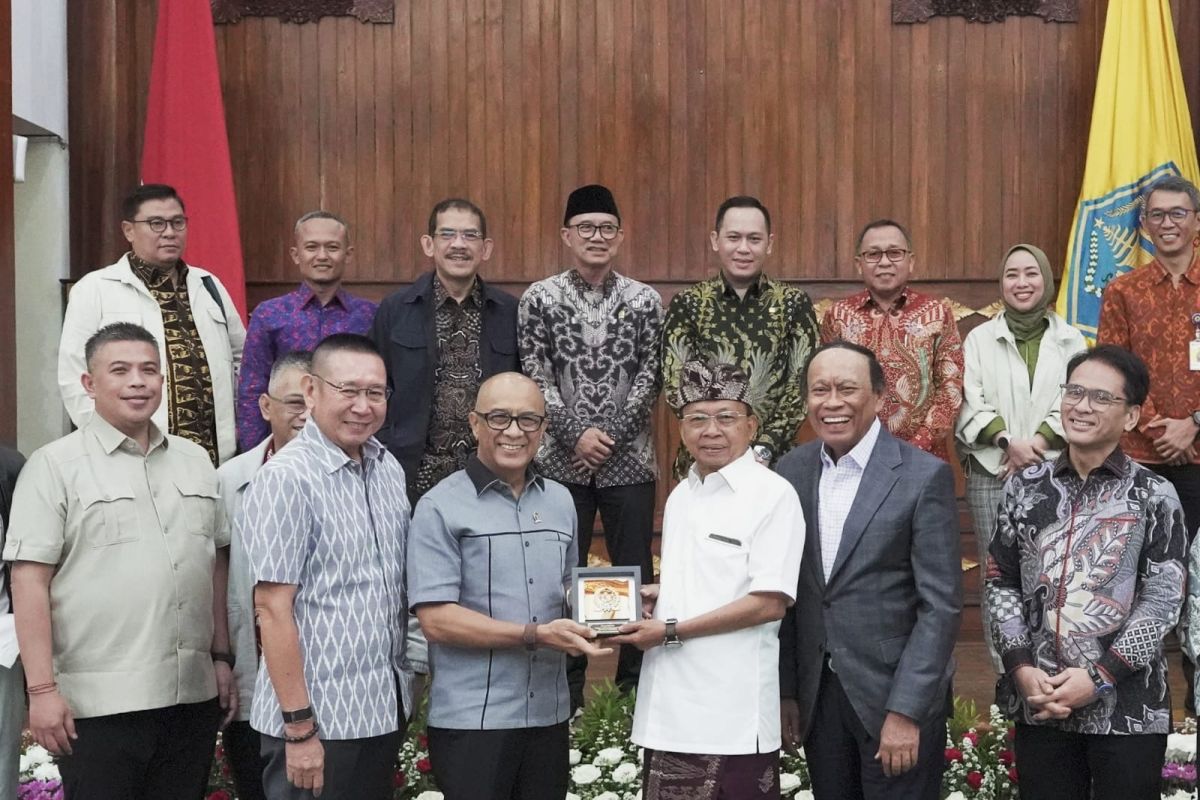
The Bali Provincial Government is requesting support from the central government through the House of Representatives (DPR RI) to increase regional transfer allocations and the State Budget (APBN) to accelerate the development of strategic infrastructure on the Island of the Gods.
“We express our hope that the allocation of transfers to the regions for Bali can be increased, particularly to support strategic infrastructure development, because Bali’s infrastructure needs have a national dimension, not just regional interests,” said Governor of Bali Wayan Koster in a statement from the Bali Provincial Government in Denpasar on Saturday.
Koster stated that Bali’s development is carried out under the principle of ‘one island, one pattern, and one governance’ in accordance with the spirit of Nangun Sat Kerthi Loka Bali, which integrates nature, humanity, and culture.
According to him, Bali’s development needs cannot be calculated solely based on population size and land area, as the region also bears the burden of being an international tourism destination.
Bali recorded approximately 16.3 million tourist visits throughout 2025, consisting of 7.05 million international tourists and 9.28 million domestic tourists. Meanwhile, Bali’s tourism foreign exchange in 2024 was recorded at around Rp176 trillion, representing approximately 55 per cent of the national tourism foreign exchange total of Rp319.9 trillion.
“This significant contribution must be accompanied by adequate development support, as Bali requires infrastructure capable of maintaining tourism quality while providing good services to the community,” Koster said.
Several issues are still being faced by Bali, including traffic congestion, limited public facilities, and development disparities between South Bali and other regions. Therefore, APBN support is required to realise the construction of national roads, the Singaraja-Mengwi connectivity, the Bali Ring Road, and inter-regency connecting networks.
Other infrastructure deemed important includes connectivity for Nusa Penida, the Nusa Ceningan-Nusa Lembongan bridge, as well as the development of ports and logistics in Celukan Bawang, Sangsit, Amed, and Gunaksa.
The Bali Provincial Government also prioritises the provision of clean water through the Telagawaja SPAM, the Sidan Dam, and the Titab Dam, as well as waste management from upstream to downstream.
Koster said that even connectivity across North, East, Central, and West Bali is necessary to create new economic growth centres outside the southern region. “We do not only want to chase tourist numbers, but we want to build tourism that is high-quality, competitive, dignified, and sustainable,” he added.
Syarief refuted the assumption regarding a decrease in transfer allocations from the central government, noting that part of the budget is allocated through national strategic programmes whose benefits are felt directly by the regions.
“It is not actually a decrease because many transfer budgets are now used for national programmes implemented by the central government, such as the regional authority for part-time PPPK (government employees with work agreements), the majority of which is being covered by the centre gradually,” said Syarief.
The DPR RI Budget Committee appreciated the Bali Provincial Government’s presentation regarding the characteristics and potential of the region, which holds a strategic position for the national economy through the tourism sector.
The delegation noted Bali’s need to maintain high-quality, competitive, and sustainable tourism through the strengthening of environmental quality, infrastructure, services, and the preservation of Balinese culture.