
Bali offers sustainable development model to global partners
For Bali, development is not merely about today’s economic profit, but about the legacy we will leave for generations one hundred years from now.
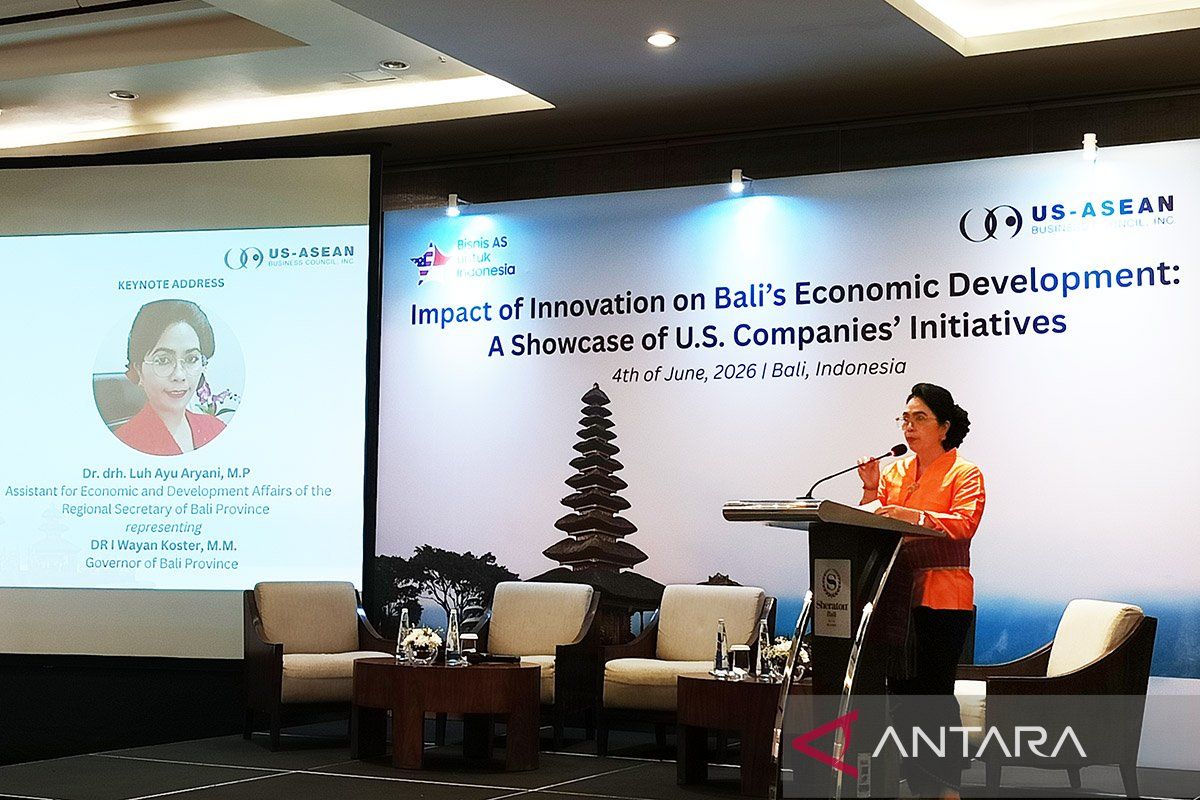
Kuta, Bali - The Bali Provincial Government has presented a vision of sustainable development based on culture, environment, and economy to global partners and international business leaders during the US-ASEng Business Council Executive Briefing 2026.
Luh Ayu Aryani, Assistant for Economic and Regional Development of Bali Province, representing Governor Wayan Koster at the event titled ‘Impact of Innovation on Bali’s Economic Development: A Showcase of U.S. Companies’ Initiative’ in Kuta, Badung Regency, emphasised that Bali is pursuing economic progress without losing its cultural identity, damaging the environment, or sacrificing the interests of future generations.
According to Aryani, Bali’s current development is based on the ‘Bali Future Development Roadmap: 100 Years of the New Bali Era 2025-2125’, which was established through Bali Provincial Regulation Number 4 of 2023.
“We want to demonstrate that custom, tradition, arts, culture, technology, economy, and the environment can grow together harmoniously. Modernisation does not have to eliminate identity, and progress does not have to sacrifice human values,” said Aryani.
She explained that Bali’s development direction is realised through the ‘Nangun Sat Kerthi Loka Bali’ vision, which focuses on the balance between economic growth, cultural preservation, environmental sustainability, and the harmony of community life. As part of this economic transformation, the Bali Provincial Government has also drafted the ‘Kerthi Bali Economic Transformation Roadmap’ based on the ‘Sad Kerthi’ philosophy. This development model does not only pursue economic growth but also simultaneously creates social, cultural, and ecological value.
Aryani identified six leading sectors that serve as the pillars of Bali’s economy: agriculture in its broadest sense, marine and fisheries, manufacturing and culture-based industries, small and medium enterprises (SMEs) and cooperatives, the creative and digital economy, and the tourism sector.
During the session, Aryani also invited international partners, including United States companies, to invest in various strategic sectors such as clean energy, green technology, digital transformation and artificial intelligence, education, healthcare, modern agriculture, the creative economy, as well as research and innovation.
While opening wide investment opportunities, the Bali Provincial Government emphasised that every investment must respect customs, traditions, arts, culture, sacred areas, environmental sustainability, and the principle of intergenerational sustainability.
“For Bali, development is not just about today’s economic profit, but about the legacy we will leave for generations one hundred years from now,” she stated.
Aryani added that Bali holds a strategic position as the face of Indonesia to the world and is being directed to become a model for sustainable development based on custom, tradition, arts, culture, and local wisdom. Through this forum, she invited all international partners to build collaborations that are mutually respectful, mutually strengthening, and capable of creating shared value to realise a more advanced, just, humane, and sustainable future.