
Bali Mobility Increases, KAI Begins Railway Development Study
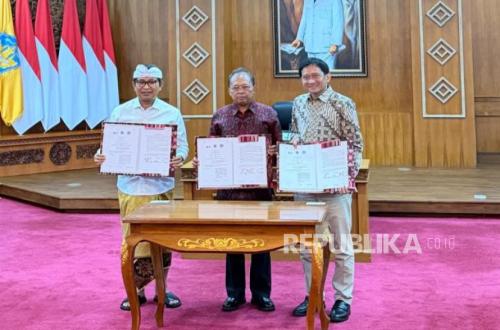
PT Kereta Api Indonesia (Persero), known as KAI, alongside the Bali Provincial Government and the Badung Regency Government, has begun studying plans for railway development in Bali. This step was marked by the signing of a Joint Agreement regarding the Railway Development Plan in Bali Province on Tuesday (1/9/2026).
The agreement was signed by the President Director of KAI, Bobby Rasyidin, the Governor of Bali, Wayan Koster, and the Regent of Badung, I Wayan Adi Arnawa. This agreement serves as the initial stage for the three parties to prepare studies and coordinate regarding the possibility of railway expansion in Bali.
KAI President Director Bobby Rasyid stated that economic development, tourism, and public mobility are several key factors that must be considered when planning Bali’s future transport system.
“The economic development and tourism activities in Bali must be accompanied by transport planning capable of meeting future mobility needs. Through this agreement, we are working with the local government to study how railways can become part of the development of Bali’s transport system,” said Bobby.
According to him, Bali possesses a unique mobility character as one of Indonesia’s primary tourism hubs. Therefore, the development of the transport system needs to consider the connectivity between community activity centres, tourism areas, and various existing transport modes.
Based on data from the Central Bureau of Statistics (BPS) for Bali Province, Bali’s economy grew by 5.78 per cent in the second quarter of 2026 compared to the same period the previous year. During this period, the Gross Regional Domestic Product (GRDP) at current prices reached IDR 89.27 trillion.
The accommodation and food services sector was the largest contributor, accounting for 21.91 per cent. This economic growth aligns with tourism activities, which are driving the demand for mobility in Bali.
BPS also noted that the number of international tourists arriving directly in Bali in June 2026 reached 605,013 visits. This figure represents a 4.63 per cent increase compared to May 2026, which saw 578,251 visits.
During the same period, the number of international flight passengers departing from Bali reached 650,838 people, an increase of 4.93 per cent month-on-month. Meanwhile, domestic flight passengers departing from Bali were recorded at 329,891, an increase of 4.68 per cent from the previous month.
Bobby stated that these various developments are part of the considerations in assessing Bali’s long-term transport needs. However, he emphasised that railway development still requires a comprehensive study.
“Bali has a unique character in terms of mobility and regional development. Therefore, the needs, potential, intermodal integration, and the feasibility of railway development need to be studied thoroughly so that the prepared plans have a strong foundation and align with regional requirements,” said Bobby.
The scope of the agreement includes data and information inventory, the preparation of feasibility studies and/or Detailed Engineering Designs (DED), intermodal integration, human resource competency enhancement, and coordination with ministries, agencies, business entities, and relevant stakeholders.
The Joint Agreement is valid for five years from the date of signing. The agreement can be further implemented through Cooperation Agreements in accordance with the authority of each party.
“KAI is ready to bring its railway experience and competence to the joint study process. Every stage will be prepared carefully, prudently, and in accordance with regulations to ensure the resulting plan is feasible and provides long-term benefits for public mobility and the regional development of Bali,” said Bobby.