
Bali Chamber of Commerce and Industry (KADIN) Prioritises Developing 'Cool Young MSMEs' with AI
Bali Chamber of Commerce and Industry (KADIN) Prioritizes Developing “Cool Young MSMEs” with AI, Synergizing Industry and Education
Bali Chamber of Commerce and Industry (KADIN) Prioritizes Developing “Cool Young MSMEs” with AI, Synergizing Industry and Education
Admin 2 -
atnews
2026-05-16
Bagikan :
Denpasar (Atnews) - The Chairman of the Bali Chamber of Commerce and Industry (KADIN), Made Ariandi, is encouraging the younger generation to become “Cool Young MSME” entrepreneurs.
This initiative was inspired by the “Cool Young Farmers” movement. The momentum for realizing “Cool Young MSMEs” is now to develop future Indonesian entrepreneurs, leading to a Golden Indonesia 2045.
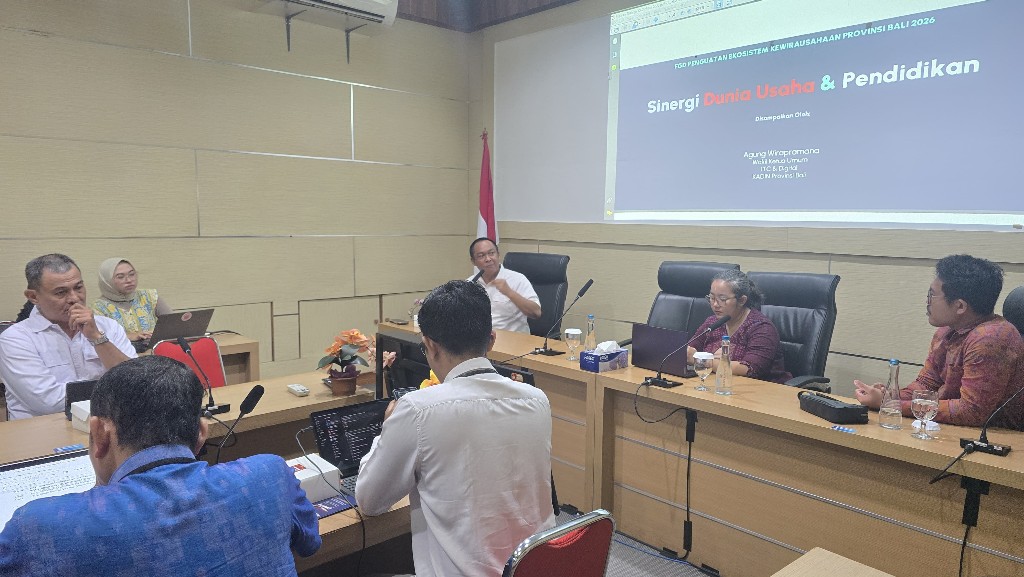
This effort aims to create new jobs and develop young talent with the latest technology. Chairman of the Bali Chamber of Commerce and Industry, Ariandi, accompanied by the Deputy Chairman of ITC & Digital of the Bali Chamber of Commerce and Industry, Agung Wirapramana, also known as Gung Pram, stated this during a Focus Group Discussion (FGD) on Strengthening the Bali Provincial Entrepreneurship Ecosystem 2026, organized by the LPPM Business Incubator (INBIS Unud) of Udayana University in Denpasar on Wednesday (May 13).
The topic was “Synergy of Business & Education.” To date, the Bali Chamber of Commerce and Industry (KADIN) has collaborated with both private and public universities in Bali, including Udayana University (Unud), National Education University (Undiknas), Bali Tourism Polytechnic (Poltekpar Bali), State Polytechnic of Bali (PNB), Dwijendra University, Waru University, and Maruya University.
He stated that Bali does not possess abundant natural resources. However, it does possess human resources. Therefore, human resources of Bali must be globally competitive and ready to become young entrepreneurs.
The readiness of these human resources will determine the progress of the region and the nation. Meanwhile, KADIN itself is a strategic partner of the government in promoting the business world, as stipulated in Law Number 1/1987.
KADIN has the opportunity to accommodate the entire business world through its numerous associations in Bali. Besides, it has business practitioners in various fields, including education, agriculture, import/export, and tourism.
This will continue the momentum of the 1,000 MSME Mass Micro Credit Program (KUR) Agreement. Hopefully, it will build an inclusive entrepreneurial ecosystem in Bali Province.
Although KADIN cannot provide direct business capital, it does have institutional and organizational partners ready to coordinate and collaborate. There is collaboration across the Ministries of MSMEs, Law, and Creative Economy to connect over 1,500 participants from MSMEs, business incubators, and student entrepreneurs with strategic capital access.
The Indonesian Chamber of Commerce and Industry (KADIN) is also involved in implementing linkages between industry and education.
This includes Business Incubation, integration of industry-based competency-based curricula at universities (Udayana, Warmadewa, Undiksha), and strengthening of UPK (Technical Implementation Units) and campus business incubators through the market network of KADIN Bali members.
This concrete partnership is expected to attract the interest of young people into the business world, as not all university graduates can work in offices or industry.
“University graduates are not just office and industry workers. We should focus on digitally empowering budding MSMEs and being savvy in identifying opportunities,” he explained.
Moreover, President Prabowo Subianto has instructed that the interest rate for the Mekaar National Capital Program (PNM) could be lowered to below 9 percent. The President announced this decision in his remarks at the Office Complex of Attorney General in Jakarta on Wednesday (May 13).
“This is a political decision. I have made a decision to lower the interest rate for National Capital Program (PNM), a loan for underprivileged families, from 24 percent to below 10 percent, below 9 percent,” the President said.
In his remarks, President Prabowo highlighted the unequal access to financing, which has burdened micro-entrepreneurs with higher interest rates than large businesses.
“Even though large entrepreneurs might get 10 percent, 9 percent from the bank. Well, Mr. Rosan, how much? 9 percent? Just imagine, the rich get 9 percent, while the poor 24 percent. This is a Pancasila country; I do not understand,” he stated.
The President even requested that the new interest rate scheme be reduced to below 9 percent. According to the Head of State, the state must not allow the poor to bear a heavier financial burden than the upper economic class.
“We will continuously study where the weakness of our system lies, and we will correct any shortcomings. Our benchmark is Pancasila and the Constitution 1945, not just slogans. We would like to realize the real situation,” said the President.
In addition to the policy of lowering credit interest rates, the President also emphasized the importance of regulatory reform and accelerating business licensing. He asked all ministries and institutions to reduce bureaucratic obstacles having been deemed to slow down investment and business activities.
“All officials from all ministries and institutions are looking for ways to improve the system, reduce inefficiencies, simplify licensing, and do not make it difficult. Entrepreneurs also complain: they want to work and invest, but sometimes the wait for permits can take one or two years,” he affirmed.
To seize the opportunity of the policy of President Prabowo, alertness and human resource readiness are required. If we do not quickly seize the opportunity, it could be taken by other regions.
“It must be done quickly; it is estimated that incentives like this will not last long. If you are not prepared, you will not be able to capitalize on opportunities,” he added.
He further emphasized the need to redesign the economic struc