
Bali-Based Startup Transforms Cassava and Seaweed into Eco-Friendly Plastic
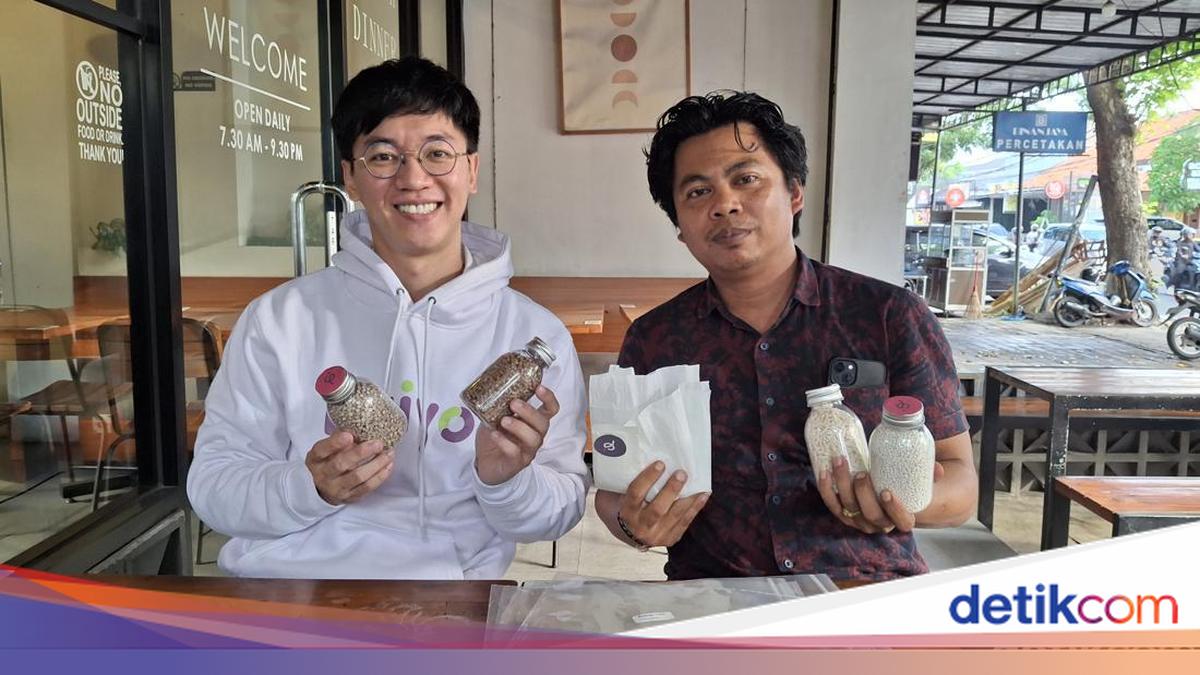
Who would have thought that a piece of cassava and seaweed could serve as both an environmental savior and an economic driver? No longer just food ingredients, these two materials are now being developed into raw materials for eco-friendly plastic.
Through Baiyo, a Bali-based startup, Willy D. Liusan and his team are attempting to provide a solution to the harsh realities of the national plastic industry. Amidst global geopolitical tensions driving up crude oil prices, the plastic industry has been significantly impacted. Ironically, plastic raw materials in Indonesia remain almost entirely dependent on imports.
CEO of Baiyo, Willy D. Liusan, stated that nearly all plastic raw materials in Indonesia are brought in from abroad. “Plastic materials are almost 100 per cent imported, approximately 3.8 million tonnes based on 2025 data. Most originate from Malaysia and Middle Eastern countries. That is one of the reasons we are developing Baiyo,” Willy said when met in Denpasar on Saturday (17/04/2025).
Willy’s interest in developing eco-friendly plastic began while studying seaweed cultivation, which led him to the Kalimajari Foundation, which had previously researched bioplastics. From there, he became interested in scaling that research to an industrial level.
Baiyo’s journey began in 2021. Research was conducted alongside Prof. I Made Joni. A series of failures in the laboratory became commonplace. Finding an alternative plastic formula that was strong, elastic, and environmentally friendly proved to be far more complex.
Initially, they focused on developing seaweed-based plastic. However, after considering market realities, the production costs were deemed too expensive for mass marketing. “We developed the seaweed version first. But after calculating the production costs, it turned out to be too expensive. Consequently, we sought other alternatives,” he said.
Through intensive problem-solving, Baiyo began focusing on using cassava as the primary ingredient in 2023, as it was deemed more economical. The cassava used is a high-starch variety, not the type commonly consumed by the general public.
“Cassava only requires land and water. It does not rely heavily on fertiliser. If fertiliser is still imported, a new dependency will arise. Furthermore, the production method can be carried out by Indonesian human resources,” he explained.
In the early stages of experimentation, the cassava-based plastic pellets they produced were very brittle. Failures were frequent; in subsequent research, the resulting plastic pellets had an unpleasant odour or melted when exposed to heat. The formula was changed repeatedly, and each pellet was re-examined. For the team, failure was simply a step closer to success.
Baiyo operates on a Business-to-Business (B2B) model. They do not sell plastic bags directly to consumers but instead supply eco-friendly plastic resin to processing factories. The current momentum of naphtha shortages and surging plastic prices makes Baiyo a viable alternative.
“We sell B2B to plastic factories. Given the current conditions, the price of plastic raw materials is rising, so many industry players are starting to look for alternatives. Some have already contacted us, although we do not yet have our own factory,” he said.
Currently, Baiyo is still in the pilot project stage. However, new challenges have emerged. Successfully producing a formula at a laboratory bench is vastly different from mass production in a factory, which requires significant funding, technological adjustments, and the mental fortitude to face further failures.
“The formula produced in a lab is like a cooking recipe used in my home kitchen, then taking that same recipe to a ‘Master Kitchen’—a large restaurant cooking for a thousand people at once. You cannot use the exact same method or recipe; it won’t work. Adjustments must be made. That is the position we are currently in with our pilot project,” he added.
To mature through this crucial phase, Baiyo has partnered with several universities, including Padjadjaran University (Unpad), Sebelas Maret University (UNS), and most recently, Udayana University (Unud). Support has also been received from the Ministry of MSMEs, the Ministry of Trade, and the Ministry of Industry. Currently, one Japanese company and three local companies have been recorded as exploring collaborations with Baiyo.
For the pilot project, Baiyo intentionally chose Bali as the initial location for establishing a factory. Willy believes Bali possesses a stronger environmental awareness compared to other regions.
“We consciously chose Bali to start this pilot project because, compared to other provinces, Bali cares most about the environment. Bali was also the first province to ban the use of single-use plastic bags in minimarkets,” said Willy.
He noted that the people of Bali possess local wisdom that is in harmony with nature, making the implementation of eco-friendly products much easier.