
Balai Karangan Durian and a Million Potential Along the Sekayam River
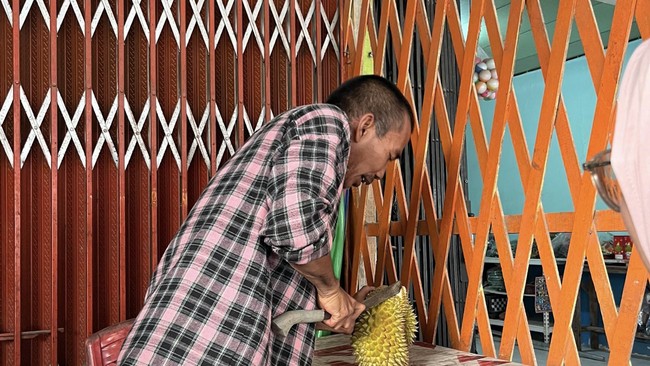
Balai Karangan village, in Sekayam Sub-district, Sanggau Regency, West Kalimantan Province, lies not far from the Entikong National Border Post (PLBN). As the centre of activity for Sekayam Sub-district, Balai Karangan has a fairly lively economy and high community mobility. Amidst all this activity lies a long-standing local potential, one capable of reaching the podium of the Sanggau durian contest: durian.
“The durian here is of very good quality, and it has won contests in Sanggau and Pontianak several times. But we haven’t been able to market it widely,” said the Head of Balai Karangan Village, Erzan Umar, to the Universitas Indonesia Patriot Expedition Team on Tuesday, 11 August 2026.
After digging deeper, the durian trees growing along the Sekayam River and into the interior of the village have been passed down from generation to generation, producing fruit with a distinctive character. Yet behind their quality and abundance lies a bigger question: why has such great potential not fully become an economic strength for the local community?
The Story of Pak Tam, Farmer and Middleman
His name is Pak Tam (Gunawan). He is not merely a durian farmer, but also a middleman who connects fruit from residents’ orchards to the market. He is a key figure when discussing Balai Karangan durian, especially after winning second place in the all-Sanggau durian contest held in Pontianak.
His durian orchard contains fifteen trees that can only be reached by crossing the river. Uniquely, the trees are almost never given special care; they are simply left to grow naturally and only “attended to” when the durian season arrives. For Pak Tam, this orchard is not merely an economic asset, but an ancestral inheritance passed down through four generations, with a history said to span hundreds of years.
Interestingly, this is where the distinctiveness of Balai Karangan durian originates: the great age of the trees is believed to be one reason the fruit is considered special compared with younger cultivated durian.
“This orchard isn’t mine personally. It’s an inheritance from my ancestors, already in its fourth generation,” said Pak Tam when met by the Universitas Indonesia Patriot Expedition Team at his home, recounting the history of durian trees he said were hundreds of years old.
Local Varieties, Premium Quality
Balai Karangan knows many varieties of local durian, from sembut, balening, karung, udang and notu, to the two names most fragrant to residents’ ears: raja udang and serumput. Among them all, serumput is the king.
“This one is the most premium — the flesh is deep yellow, the texture is soft and creamy, and the sweetness can exceed 40 per cent,” he said, which according to Pak Tam was the deciding factor in his victory at the durian contest. Because of this reputation, serumput is sold at a price far above ordinary durian, reaching up to one million rupiah per fruit in Pontianak.
Production and Turnover: Promising but Not Yet Optimal
In a single harvest season, Pak Tam can gather around 200–300 kilograms of durian from his fifteen trees, with turnover that can touch ten million rupiah a day. 2026 is even said to have brought an additional blessing, as the harvest has occurred twice. The peak of the season usually falls in the second to third week after the durian begins fruiting, with the overall harvest period lasting around forty days.
Ironically, an abundant harvest does not always mean a blessing for farmers. In 2024, durian prices in Balai Karangan plummeted due to a flood of supply, made worse by Malaysian durian stock flooding the market.
To date, nearly all of Pak Tam’s durian marketing channels lead to a single city: Pontianak. The system is simple. Marketers from Pontianak come directly to Balai Karangan to collect supplies, rather than Pak Tam sending them there. This one-way, single-destination distribution pattern makes it difficult for Balai Karangan durian, however fine its quality, to reach a wider market.
“Well, perhaps some reaches beyond Pontianak, but usually it still goes to Pontianak first. Those who package it might manage, because if it’s still whole fruit the time is limited, and once it’s opened, the fruit’s shelf life also drops. It’s difficult,” said Pak Tam.
Inter-island Distribution: An Opportunity Still at a Dead End
According to Pak Tam, demand from outside the island has actually existed for a long time. “Since the 2000s I’ve known how to package durian so it can be shipped far, but what’s difficult is the time, the manpower, and how to do it,” he explained, which is why market access has never truly opened up.
According to Pak Tam, Balai Karangan village has around thirty middlemen and hundreds of durian farmers spread along the Sekayam River. If all this potential were consolidated, the harvest of a single village at peak season is estimated to reach around ten tonnes a day — a figure far exceeding the capacity of a single middleman like Pak Tam, who can only handle 200 fruits a day.
Unfortunately, this enormous potential is not matched by institutional support. There has been no support from the relevant agencies, and even among the farmers themselves no solid cooperation has been established. The majority of other farmers choose to sell directly to middlemen because of limited labour and climatic challenges that make harvesting on their own difficult.
When asked whether forming a farmers’ community and opening wider market access was possible, Pak Tam’s answer was brief but full of conviction: “It can be done.” He has even begun gathering other farmers to find ways together to preserve the existence of Balai Karangan durian, though still through meetings at coffee stalls.
Not Yet an Icon, Not Yet Supported
Although durian has been the unofficial identity of Balai Karangan village for generations, there has been no official direction from the village government to designate it as a flagship commodity. “So far there has been no contribution from the village or the agencies,” Pak Tam admitted when the issue was discussed.
This admission aligns with what the village government itself said. “It seems there’s been no assistance from the agencies, especially regarding this durian,” said the Head of Balai Karangan Village, Erzan Umar, to the Universitas Indonesia Patriot Expedition Team on Tuesday, 11 August 2026.
Yet the threat to the durian’s survival is real: land conversion from durian orchards to oil palm plantations has already reached thousands of hectares in the area. For Pak Tam, this is not merely an economic matter, but also a matter of protecting an ancestral inheritance from simply disappearing. This commitment is what keeps him going, even though not a single media outlet has ever told his story before.
Spotlight from the UI Patriot Expedition Team
The story of Pak Tam and Balai Karangan durian came to light through field research by the Universitas Indonesia Patriot Expedition Team together with Tanjungpura University, who went directly into the field to document the potential and the problems that have long escaped attention. One important point in the spotlight, and a reminder, is that branding and the popularity of local commodities remain a challenge for villages far from the media’s gaze.
Balai Karangan already possesses something not easily built from scratch: competitive local varieties, farmers with hereditary knowledge, and consumers willing to pay a premium for a certain quality. Yet quality and potential alone have proven insufficient.
A market still fixated on one city, the absence of an inter-island distribution system, prices that collapse each time supply surges, the lack of institutional support from the village or the agencies, and the threat of land conversion leave one great task remaining for Balai Karangan village.
That task is certainly no longer to discover what makes it exceptional, but to ensure that the durian continues to grow, becomes known, and finally bears fruit as prosperity for the local community.