
Bakrie Group's VKTR Reports 25% Profit Increase in First Half of 2026
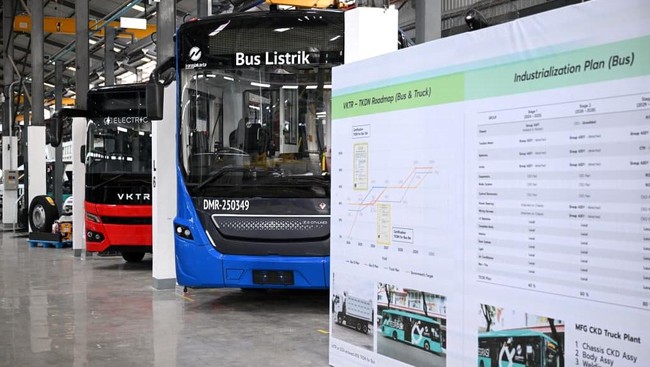
The Bakrie Group’s electric bus manufacturer, PT VKTR Teknologi Mobilitas Tbk (VKTR), recorded net sales of Rp648 billion, representing a 56% year-on-year growth, during the first half of 2026. This increase was supported by the growth of the commercial electric vehicle business in line with rising market demand.
Meanwhile, the Company’s spare parts manufacturing segment also contributed positively to its performance, driven by the ongoing recovery of the national automotive industry throughout this year. The increase in revenue also drove improved profitability, with operating profit recorded at Rp15 billion, or a 1,782% year-on-year growth, while net profit reached Rp10 billion, up 25% year-on-year.
From a balance sheet perspective, the Company’s total assets as of the end of June 2026 were recorded at Rp1,817 billion, with liabilities amounting to Rp561 billion and equity at Rp1,256 billion. This position serves as a foundation for VKTR to continue business development and strengthen its capacity to capture growth opportunities in the commercial electric vehicle sector in Indonesia.
The President Director of PT VKTR Teknologi Mobilitas Tbk, A. Ardiansyah Bakrie, stated that this growth demonstrates that the need for commercial electric vehicles is increasingly expanding and appearing across various operational needs, ranging from public transport and logistics to plantations, as well as the industrial and mining sectors.
Entering this growth phase, VKTR observes that the challenges of electrification moving forward are no longer solely about vehicle availability, but also about how the adoption of electric vehicles can be made easier, more flexible, and more scalable for operators and business players.
Therefore, in addition to strengthening its portfolio and capacity for commercial electric vehicles, VKTR is beginning to develop Electric Mobility-as-a-Service (e-MaaS) as part of its strategy to act as an enabler in accelerating electric vehicle adoption.
By shifting the expenditure structure from capital expenditure (CAPEX) to operational expenditure (OPEX), this model provides greater financial flexibility, reduces exposure to funding risks, and allows for more measurable and predictable budget planning.