
Baketrans Sets Policy Priorities to Address Transport Challenges
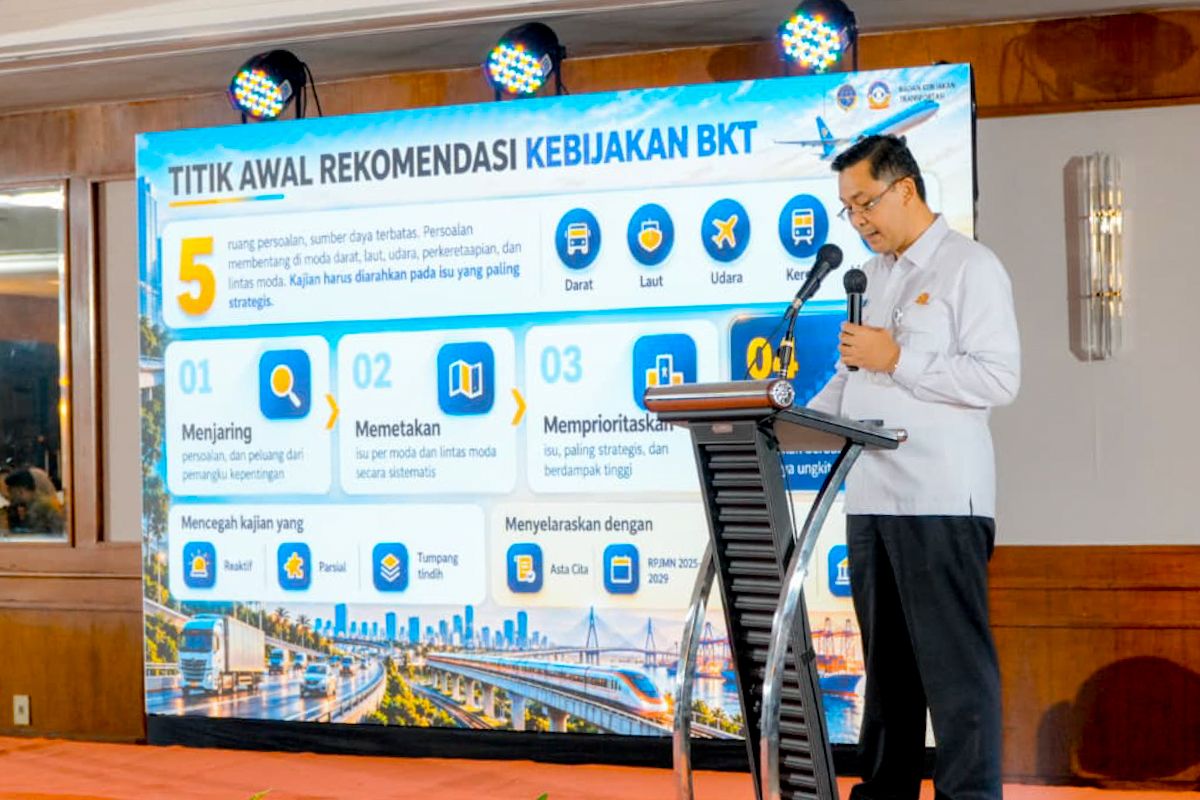
Jakarta (ANTARA) – The Transport Policy Agency (Baketrans) at the Ministry of Transportation is identifying priority issues to strengthen the national transport system, including connectivity, logistics efficiency, safety, sustainability and evidence-based policy governance.
Baketrans head Hermanta said that, given the wide range of challenges across road, sea, air and rail transport, as well as cross-modal issues, the agency would ensure its studies focused on the most strategic matters.
“Baketrans is tasked with providing policy recommendations,” Hermanta said at the 2026 Strategic Issues Agenda-Setting for the Transport Sector event, as confirmed in Jakarta on Tuesday.
He said agenda-setting was the starting point for Baketrans’ policy recommendations, helping to identify, map and prioritise a range of challenges and opportunities.
“A systematic agenda-setting process will prevent studies from being reactive, fragmented or overlapping,” he said.
Transport policy, he added, was a shared responsibility requiring collaboration among all stakeholders.
Hermanta said he hoped the discussions would result not merely in an administrative document, but in a shared commitment to identifying priority issues and addressing them through policies that were well-targeted, practical and sustainable.
The transport sector continues to face a range of challenges, including national logistics costs of around 14.29 per cent of gross domestic product (GDP), and uneven connectivity between regions, particularly in eastern Indonesia and in disadvantaged, frontier and outermost areas.
Other concerns include safety, including the problem of over-dimension and overloading (ODOL) vehicles; urban congestion caused by the limited availability of public transport; and pressure on sustainable financing, governance and regulation.
“This makes comprehensive and integrated reform of the transport system necessary,” he said.
Baketrans secretary Siti Maimunah added that agenda-setting was an important stage in the policy decision-making cycle.
Maimunah said the agency needed to move from identifying issues to implementing policies, from a sectoral approach to an integrated system, and from research focused on academic outputs to policies that deliver tangible impact.
Ultimately, she said, good transport policy was not simply policy that had been formulated, but policy capable of improving safety, reducing costs, expanding accessibility and delivering real benefits to the public.
She also explained that effective agenda-setting would provide the basis for Baketrans’ programmes and activities in the following year, while taking into account budget availability, public needs and national priority programmes.
In her view, future transport challenges would become increasingly complex due to technological disruption, urbanisation, changing mobility patterns and demands for sustainable transport.
The discussions also highlighted the importance of evidence-based public policy governance. Speakers agreed that transport policies should be formulated, implemented and evaluated in measurable ways so they can have a tangible impact on the public.