
Bahlil's Mandate Expanded: Academics Highlight Importance of Synchronising Downstreaming and Energy
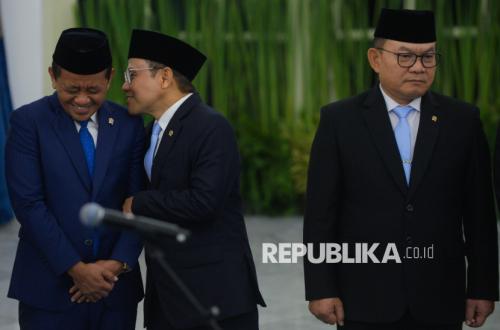
The expansion of Bahlil Lahadalia’s mandate as the Coordinating Minister for Downstreaming and Energy Transition, while simultaneously serving as the Minister of Energy and Mineral Resources (ESDM), is viewed as an opportunity to strengthen the coordination of downstreaming, energy, and national industrialisation policies.
Bahlil was officially inaugurated as the Coordinating Minister for Downstreaming and Energy Transition on Thursday (1/10/2026). In this assignment, Bahlil will continue to perform his duties as the Minister of ESDM. The government stated that this unification of coordination is aimed at accelerating the implementation of the downstreaming and energy transition agendas.
Fatkur Huda, an economist at the Muhammadiyah University of Surabaya, believes that unifying the coordination of downstreaming and energy transition is relevant because both agendas are closely linked. Mineral downstreaming requires large energy supplies, while the future competitiveness of industry is increasingly influenced by the availability of competitive and low-emission energy.
“The merger of downstreaming and energy transition coordination is highly strategic because the two cannot be separated. Mineral downstreaming requires large amounts of energy, while the direction of future industrial development is increasingly determined by the availability of competitive and low-emission energy,” Fatkur said when contacted on Friday (3/10/2026).
According to Fatkur, the scale of the downstreaming agenda is reflected in the sector’s investment realisation in the first semester of 2026, which reached Rp300.1 trillion, or approximately 29.7 per cent of the total national investment realisation. Data from the Ministry of Investment and Downstreaming/BKPM noted that these downstream investments cover several mineral sectors, including nickel, bauxite, copper, as well as iron and steel.
He noted that Bahlil’s position as both Coordinating Minister and Minister of ESDM could provide a space to bring together mining, energy, downstreaming, and investment policies under a more integrated coordination.
“The magnitude of downstreaming investment shows that this agenda has become a vital part of the national economic transformation. Therefore, energy requirements must be designed from the outset so that industrial development does not face energy supply issues in the future,” he said.
Fatkur also highlighted the development of domestic mineral processing. He noted that the increase in nickel processing capacity demonstrates a shift in Indonesia’s industrial structure from exporting raw materials to developing a processing industry.
He assessed that the next challenge is ensuring downstreaming moves towards products with higher added value. For nickel commodities, for example, development can be directed towards precursors, cathodes, battery cells, battery packs, electric vehicles, and the recycling industry. Meanwhile, copper can be developed into cables and various electrical or electronic components, while bauxite can be directed towards aluminium and its derivatives.
“With this strategy, downstreaming does not stop at the construction of smelters, but becomes the foundation for national re-industrialisation,” said Fatkur.
He added that the energy aspect is also a vital part of developing these industries. Indonesia’s downstream products in the future will not only be judged by their economic value but also by the efficiency and carbon footprint of their production processes.
“This is where the link between downstreaming and energy transition becomes important. Indonesia’s downstream products will be judged not only on their economic value but also on the carbon footprint of their production processes. Therefore, the development of hydro, geothermal, solar, and other clean energy sources needs to be increasingly integrated with industrial zones and smelters,” he said.
Regarding energy security, Fatkur also highlighted the national oil lifting achievement throughout 2025, which reached 605.3 thousand barrels per day, or approximately 100.05 per cent of the State Budget (APBN) target. This achievement serves as one of the performance indicators for the ESDM sector achieved that year.
He believed that strengthening domestic energy production must go hand in hand with the agenda of import substitution and the development of domestic industry. Thus, energy policy should not only be aimed at meeting current needs but also at supporting long-term industrial development.
Similar views were expressed by public policy expert from Parahyangan Catholic University (Unpar), Kristian Widya Wicaksono. He assessed that the expansion of Bahlil’s responsibilities could strengthen the coordination of development agendas that have traditionally involved many ministries and agencies.
According to Kristian, downstreaming intersects with the mining, industry, investment, trade, and labour sectors. Meanwhile, the energy transition requires coordination with the finance, environment, industry, and local government sectors.
“Placing both under one coordination opens opportunities for the government to unify policy direction and reduce fragmented decision-making,” said Kristian.
Kristian noted that the continuity of Bahlil’s role could serve as capital in executing this mandate. Before becoming Coordinating Minister, Bahlil led the Task Force for the Acceleration of Downstreaming and National Energy Security while also serving as the Minister of ESDM.
In July 2025, the Task Force for the Acceleration of Downstreaming and National Energy Security submitted 18 pre-feasibility study documents for downstream projects to Danantara Indonesia, with planned investment values reaching 38.63 billion USD, or approximately Rp618.13 trillion.
“The continuity of Bahlion’s role as the Chairman of the Task Force for the Acceleration of Downstreaming and National Energy Security, Minister of ESDM, and now Coordinating Minister has the potential to provide advantages in policy implementation,” said Kristian.
However, he warned that the expansion of the mandate must be accompanied by clear coordination mechanisms, division of authority, supervision, and performance metrics. This is essential to ensure that cross-ministerial coordination does not result in overlapping authorities.
Source: jawawa.id (https://jawawa.id/newsitem/bahlils-mandate-expanded-academics-highlight-importance-of-synchronising-downstreaming-and-energy-1791035563)
Originally published by Republika (https://ekonomi.republika.co.id/berita/tmc11u522/mandat-bahlil-diperluas-akademisi-soroti-pentingnya-sinkronisasi-hilirisasi-dan-energi), translated from Indonesian